Hunting Elk in a Foothills Clearcut
Finding elk in Alberta's vast foothills can feel like searching for a needle in a haystack, especially when you're looking at a patchwork of cutblocks and clearcuts that all seem to blend together. Many hunters get frustrated, walking miles through dense regrowth only to find old sign or spook a wary herd. This guide will help you decipher elk patterns in foothills clearcuts, offering practical strategies to increase your odds and make your hunt more successful in these often-overlooked areas.
Why Elk Love (And Leave) Foothills Clearcuts
Clearcuts in Alberta's foothills might look like a messy, chaotic landscape to us, but to elk, they represent a smorgasbord of food and a mosaic of cover. Understanding why elk utilize these areas, and perhaps more importantly, when and how they utilize them, is the first step to hunting them effectively. It’s not just about seeing a clearcut on a map; it's about seeing it through an elk's eyes.
The Food Source Advantage
When a section of forest is clearcut, the sunlight suddenly pours onto the forest floor, stimulating a massive flush of new growth. This creates an explosion of forage that elk absolutely thrive on. We’re talking about lush grasses, forbs, and succulent shrubs like willow, aspen regeneration, and various berry bushes. These are all high-preference foods for elk, especially during the spring, summer, and early fall before deep snows cover everything. You'll often find them browsing along the edges where the new growth meets the mature timber, or even venturing deeper into the cut if the forage is particularly good and security cover isn't too far off. Knowing this, you can start to identify clearcuts with specific types of regrowth that will hold more animals.
During the early archery seasons, elk will be heavily focused on these high-energy food sources to pack on weight before winter. The key is to look for clearcuts that are a few years old, where the initial logging debris has broken down, and the tender regrowth is well established but not yet so tall and dense that it becomes impassable or completely hides animals. Too fresh, and it’s just a mess of stumps and branches; too old, and the saplings are often too woody or the canopy has closed in again, reducing the prime forage.
Thermal Cover and Security
While clearcuts offer incredible food, elk are always balancing feeding with their need for security and thermal regulation. They won't spend all day out in the open sun or biting wind. Within a clearcut, or more often, immediately adjacent to it, you'll find islands of untouched timber, thick riparian zones along creeks, or north-facing slopes with denser residual stands. These areas provide crucial thermal cover during extreme weather and dense escape cover when they feel threatened. Think about it: a mature bull might browse in the open clearcut at dawn or dusk, but as soon as the sun climbs or hunting pressure mounts, he’ll melt back into the darkest timber pockets nearby.
Identifying these security zones is paramount. Often, elk will bed down just inside the treeline bordering a clearcut, allowing them to quickly access the feeding area while still feeling hidden and safe. They might use a small patch of untouched conifers within the clearcut itself, especially if it offers a good vantage point or a quick escape route into heavier timber. These bedding areas are often marked by rubs, droppings, and well-worn trails leading to and from the feeding grounds. Understanding these patterns is essential for Elk Hunting Alberta's Foothills.
Seasonal Movements and Patterns
Elk use clearcuts differently depending on the season and the specific conditions. In the spring and early summer, cows and calves will spend a lot of time in clearcuts, taking advantage of the abundant nutrition for milk production and calf growth. Bulls might be nearby, though often still in bachelor groups in denser timber, starting to grow their antlers. As fall approaches and the rut kicks in, clearcuts can become incredibly active, particularly those interspersed with timber where bulls can challenge each other and chase cows.
During the peak of the rut, roughly late September into early October, a clearcut that offers both feeding and good visual lines can be a hotspot for activity. A dominant bull might stage at the edge, bugling into the cut, challenging any intruders, and gathering his harem. After the rut, as temperatures drop and hunting pressure increases, elk tend to become more nocturnal and seek out the thickest, nastiest cover they can find. This might mean moving away from the more exposed clearcuts into denser, unlogged timber blocks or transitioning to areas where they can find easier access to browse beneath a closed canopy, especially when snow starts to pile up.
Scouting Smarter in Alberta's Clearcuts
Before you even set foot in an Alberta foothills clearcut, you can do a ton of homework from the comfort of your home. The digital age has revolutionized how we scout, and for good reason. Clearcuts, by their very nature, are dynamic landscapes, and what was prime elk habitat last year might be less so this year. Strategic scouting, both remotely and on the ground, will save you countless wasted steps and increase your chances of encountering elk.
Using Technology for Pre-Season Planning
Start with online mapping tools. Satellite imagery, especially high-resolution options, is your best friend when it comes to clearcuts. You can easily identify the boundaries of recent logging activity, distinguish between older, regenerating cuts and newer, sparser ones, and pinpoint those crucial pockets of residual timber or thick draws within or adjacent to the clearings. Look for variations in vegetation color and texture; lighter green usually indicates younger growth, while darker green signifies mature timber. Platforms like GoHunt offer detailed satellite maps and topography layers, allowing you to mark potential feeding zones, bedding areas, and travel corridors even before you leave the house.
Layering in topography is also critical. Elk are efficient travelers, and they'll use benches, saddles, and drainages to navigate the landscape. A clearcut on a gentle, south-facing slope might be a great feeding area, while a steep, north-facing slope with heavy timber on the edge could be a prime bedding area. Pay attention to pinch points where multiple clearcuts converge, or where a clearcut funnels into a narrow band of timber. These are natural travel routes that elk will use, particularly during low light. For more advanced mapping techniques, check out Scouting With Satellite Imagery in Alberta.
Boots-on-the-Ground Reconnaissance
As helpful as digital tools are, nothing beats getting your boots on the ground. Once you've identified potential clearcuts and key features from your armchair scouting, it's time to confirm your suspicions. Early season scouting, ideally before hunting season officially opens, allows you to find fresh sign without disturbing the animals during hunting hours. Look for fresh elk tracks, particularly along the edges of the clearcut and where it meets thicker timber. Droppings can tell you how recently elk have been in the area and how many. Large, fresh piles mean recent activity.
Rub lines on small trees or saplings indicate bulls have been present, especially as the velvet comes off their antlers in late summer. Wallows, where elk have rolled in mud or damp earth, are also clear indicators of their presence and often reveal preferred travel routes. Don’t just walk the obvious paths; venture into the thicker stuff. Sometimes the most productive clearcuts are the ones that are hardest to penetrate, offering better security for the elk. Be prepared to navigate through thick slash and uneven terrain. When you’re out there, remember to also read your Alberta WMU Map Before You Go to understand the specific regulations and land access.
Locating Key Features
When you're on the ground, you're trying to connect the dots between feeding, bedding, and travel. Within the clearcut itself, identify the specific areas with the most palatable forage. These are your feeding zones. Then, search for those adjacent or internal pockets of timber – the bedding areas. These will often be elevated slightly, offering a view of the surrounding clearcut, or be in dense cover that provides good concealment. Look for "elk benches" – flat spots on a slope where elk might rest.
Lastly, focus on the escape routes. How would an elk get out of this clearcut quickly if it felt pressured? Often, these are well-worn game trails leading directly into thick timber, down a steep draw, or across a saddle into another valley. These routes are critical because they tell you where elk will be moving when they are pressured, which can be invaluable for setting up an ambush or understanding their escape patterns. Think about it like a deer hunter in the whitetail woods: finding the Hunting a Cutline Intersection for Whitetails is similar to finding a key intersection in an elk clearcut.
Effective Hunting Strategies in the Timber Slash
Hunting elk in foothills clearcuts requires a blend of patience, stealth, and a good understanding of elk vocalizations. The open nature of some clearcuts, combined with the dense regrowth in others, presents unique challenges and opportunities. Success often hinges on your ability to adapt your approach to the specific conditions of the terrain and the elk's behavior.
Spot-and-Stalk Tactics
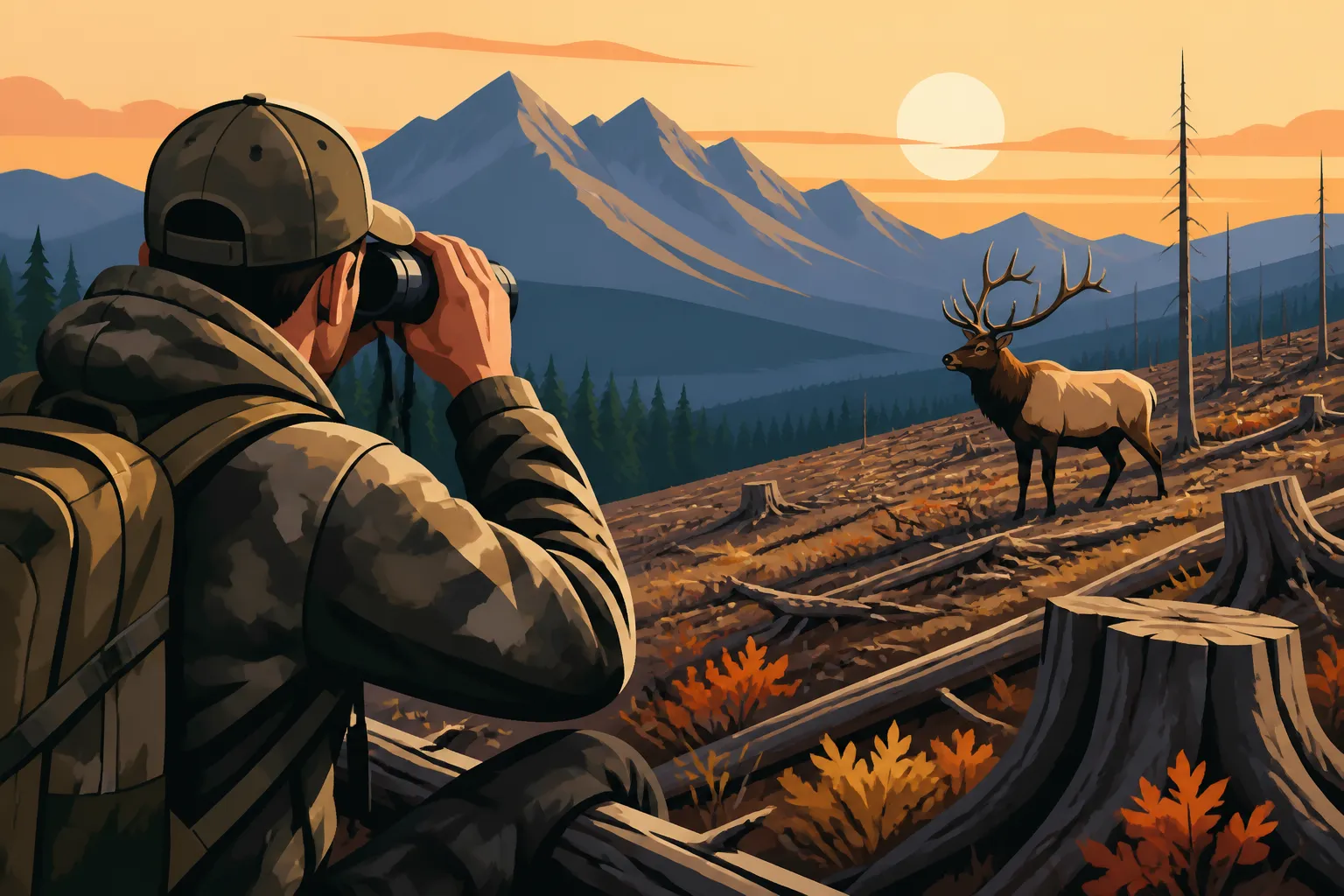
Clearcuts with scattered timber and good visibility can be ideal for spot-and-stalk hunting, especially during the early morning and late evening when elk are often out feeding. Find a high vantage point that overlooks a clearcut or a series of cuts. Set up your spotting scope and binoculars, and patiently glass every single patch of timber, every shadow, and every open pocket. Elk blend in incredibly well, so take your time. Using a tool like GoHunt's 3D mapping can help you identify these glassing knobs beforehand. Once you spot elk, plan your approach carefully.
The challenge with clearcuts is that while they offer good visibility for spotting, they also expose you. Use the terrain to your advantage: drainages, humps, and patches of residual timber can provide cover for your stalk. Pay meticulous attention to the wind, as it can swirl unpredictably in these broken landscapes. Remember that elk in clearcuts are often wary due to previous logging activity and human presence, so a slow, quiet, and deliberate approach is essential. Don’t rush the stalk. If you blow it, they'll often disappear into the thickest cover faster than you can blink.
Ambush Points and Stand Hunting
Sometimes, the best strategy isn't to chase them, but to let them come to you. This is where identifying those key travel corridors and pinch points comes into play. If you've scouted well and found well-used trails leading from bedding areas in dense timber to feeding areas in the clearcut, or a narrow strip of timber that elk must pass through, these can be excellent ambush locations. Consider hanging a treestand or setting up a ground blind along these routes. This is particularly effective during the rut, when bulls are less cautious and more focused on breeding.
Water sources, if present within or near a clearcut, can also be natural ambush points, especially in drier years. Elk need water, and a small seep or creek crossing can funnel animals through a predictable area. Just like Hanging a Stand on an Alberta Bush Edge for whitetails, finding the right spot in an elk clearcut often comes down to predicting their movement patterns between food, water, and cover. Early morning and late afternoon are generally the best times for stand hunting, as elk are typically on the move to or from feeding areas.
Calling Strategies in Clearcut Terrain
Calling for elk in clearcuts can be incredibly effective, but it requires a nuanced approach. The open nature of some clearcuts means your calls can carry a long way, but also that elk can pinpoint your location quickly. During the rut, aggressive bugling can challenge a dominant bull and draw him in, especially if he thinks another bull is trying to steal his cows. However, in heavily hunted areas, sometimes a more subtle approach, like soft cow calls or mews, can be more effective.
If you hear a bull bugle from a distance, try to position yourself downwind and out of sight, ideally on the edge of the clearcut or within a timber pocket, before initiating your calls. Use the terrain to create a visual barrier. If a bull comes in, he will likely try to circle downwind to get your scent, so be prepared for him to approach from unexpected angles. Knowing Bugling Elk in Alberta's Foothills effectively is a critical skill, and the broken landscape of a clearcut can either amplify or complicate your calling sequence. Always be ready for a quick shot once they commit.
The Importance of Wind and Thermals
In the foothills, wind and thermals are constant variables that can make or break your hunt, especially in clearcuts. The absence of a continuous canopy means wind patterns are often more unpredictable than in dense timber. Thermals, which are air currents that rise as the sun heats the ground and fall as it cools, play a huge role in how elk move and how you should approach. In the morning, thermals typically rise, carrying your scent uphill. In the evening, they fall, carrying your scent downhill.
Understanding these dynamics is vital for every approach and stand setup. If you're approaching a clearcut where you expect elk to be feeding, always try to come in from downwind, factoring in both horizontal wind direction and thermal movement. For example, in the morning, if you want to approach a clearcut from below, you'll need to circle around and come in from above to keep your scent from blowing up to the elk. Tools like GoHunt often include wind mapping features that can give you a general idea, but always carry a wind checker and pay close attention to local conditions.
Essential Gear and Safety for Clearcut Elk Hunts
Hunting foothills clearcuts in Alberta isn't just about strategy; it's also about preparedness. The terrain can be challenging, and you're often far from immediate assistance. Having the right gear and prioritizing safety are non-negotiable aspects of a successful and responsible hunt.
Footwear and Navigation
The ground in clearcuts can be a nightmare. You'll encounter a mix of logging slash, uneven ground, stumps, thick regrowth, mud, and sometimes steep slopes. Therefore, high-quality, ankle-supporting, waterproof boots are absolutely essential. Look for boots with aggressive traction to help you navigate slippery conditions and maintain stability. A comfortable pair of gaiters can also prevent debris from getting into your boots, which can quickly lead to blisters and discomfort.
Navigation is another critical component. While GPS devices and smartphone apps are excellent, always carry a physical map and compass as a backup, and know how to use them. Cell service can be spotty to non-existent in many foothills areas, especially in draws and valleys. Marking key waypoints, like your vehicle, a significant landmark, or a game trail, is smart practice. It's easy to get disoriented in the repetitive landscape of a clearcut, so vigilance is key.
Pack Essentials
When hunting clearcuts, you'll likely be covering a lot of ground, so a comfortable day pack is crucial. Beyond your weapon, ammunition/arrows, and calls, here's a quick list of essentials:
| Item | Purpose | Notes |
|---|---|---|
| Water | Hydration is critical, especially when hiking | Carry more than you think you’ll need |
| Snacks | High-energy options like nuts, granola bars | Keep energy levels up throughout the day |
| First-Aid Kit | For minor injuries, cuts, blisters | Include pain relievers, bandages, antiseptic wipes |
| Headlamp/Flashlight | For low-light conditions, early morning, late evening | Essential for safety, always carry spare batteries |
| Knife | Field dressing, general utility | Sharp, durable, and easy to access |
| Fire Starter | Matches, lighter, ferro rod | Emergency warmth, signaling |
| Rain Gear | Jacket and pants | Weather in the foothills can change quickly |
| Whistle | Signaling for help | Louder and more effective than yelling |
| Satellite Messenger/PLB | For emergency communication where cell service is absent | Devices like Garmin InReach or Spot |
| Game Bags | To protect meat once an animal is down | Lightweight, breathable, essential for meat care |
| Blaze Orange | As required by Alberta Blaze Orange Requirements | Especially important during general seasons for visibility |
Wildlife Awareness and Emergency Preparedness
Alberta's foothills are prime habitat for more than just elk. Black bears are common, and grizzly bears are present, particularly in the western fringes of the foothills. Always carry bear spray, know how to use it, and have it readily accessible. Make noise as you move through thick cover, especially if you're alone, to avoid surprising a bear. For more insights on bear activity, consider Timing an Alberta Spring Bear Hunt to understand their seasonal movements.
Beyond bears, preparing for personal emergencies is vital. Inform someone of your hunting plans, including your route and expected return time. If you hunt with a partner, always know where they are. Be aware of the signs of hypothermia and dehydration, and dress in layers to adapt to changing temperatures. Hunting Alberta Winter Weather Safely emphasizes these precautions, but they apply to all seasons in the unpredictable foothills. Always be mentally prepared for the unexpected, whether it's an animal encounter or a sudden change in weather.
Disclaimer
Hunting is an inherently risky activity. This guide provides information for educational purposes only and is not a substitute for professional instruction, adherence to local laws, or personal responsibility. Always prioritize safety, respect wildlife, and obtain all necessary licenses and permits before hunting. Conditions in the backcountry can change rapidly, and you are responsible for your own preparedness and decisions.