Hunting a Cutline Intersection for Whitetails
Finding consistent success hunting whitetail deer in Alberta's dense bush can feel like chasing ghosts sometimes, especially when those elusive bucks seem to vanish into thin air. Many hunters struggle to pinpoint exactly where deer are moving and why, leading to frustrating days in the stand without seeing much action. This guide is dedicated to unlocking one of the most productive, yet often overlooked, strategies for intercepting mature whitetails: effectively hunting cutline intersections.
Why Cutline Intersections are Whitetail Gold Mines in Alberta
Cutlines are a defining feature of Alberta's northern and central forested regions, crisscrossing the landscape like a vast, irregular grid. They were originally created for oil and gas exploration, seismic surveying, or forestry, and while some are maintained, many grow over with successional growth, creating unique habitat features. For whitetail deer, these narrow clearings are far more than just paths; they are crucial components of their daily lives and movement patterns, and where these lines meet, you often find a convergence of deer activity.
Think about it from a whitetail's perspective. The deep woods offer cover and food, but navigating through thick timber can be energy-intensive and noisy. A cutline, even one with some brush growing up, offers an easier travel corridor. Deer use them like highways, moving between bedding areas, feeding zones, and water sources. But why are intersections specifically so potent?
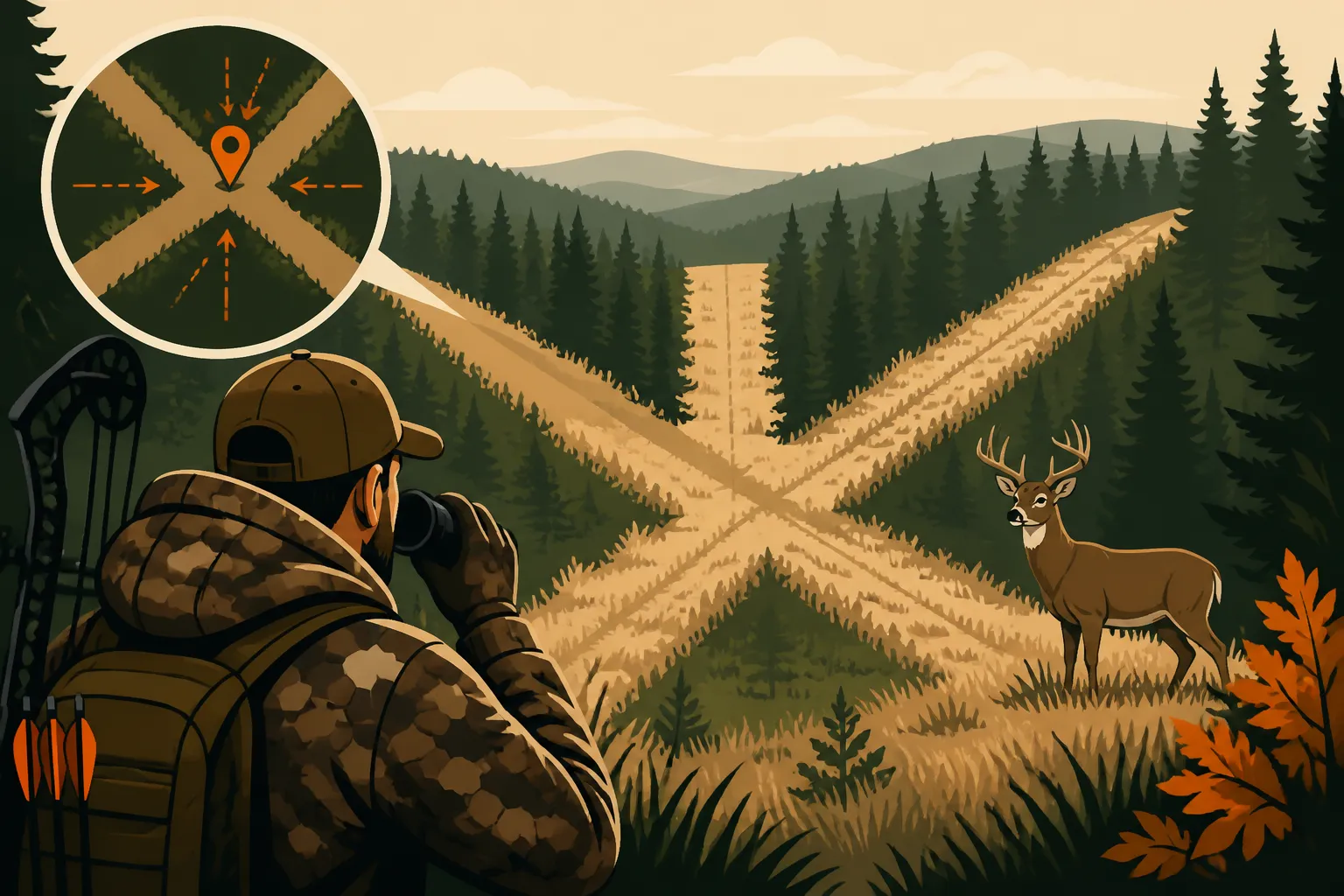
Firstly, an intersection represents a "decision point" for a deer. They're coming down one line, and at the crossing, they have options: continue straight, turn left, or turn right. This pause, even momentary, can give you the precious extra seconds you need for a shot. More importantly, these crossroads are natural funnels. Deer from multiple directions, using different cutlines, will eventually converge at these points. It's a high-traffic area, increasing your odds significantly compared to simply picking a random spot along a single cutline. During the rut, these intersections become even more critical, as bucks tirelessly cruise these travel corridors looking for does, and does use them to escape persistent suitors. A well-chosen intersection can be the difference between an uneventful sit and a thrilling encounter with a mature buck.
Understanding Deer Movement Along Cutlines
Whitetails are creatures of habit, driven by their basic needs for food, water, and security. In Alberta's vast forested zones, cutlines offer a streamlined way to meet these needs while minimizing exposure. Deer will use cutlines for swift travel, especially at night or during low light conditions, to move between dense bedding cover and more open feeding areas, such as recent clearcuts, natural meadows, or even agricultural edges bordering the bush.
During daylight hours, deer might be a bit warier of open cutlines, especially the wider, more manicured ones. However, older, overgrown cutlines that offer some visual obstruction can be used more liberally. The key is recognizing when and why they use a particular cutline. For instance, a cutline running parallel to a known bedding area and leading directly to a prime feeding spot is likely to see heavy evening traffic. Conversely, a line connecting two dense timber blocks might be a midday travel route for a buck trying to skirt open areas.
These movements are heavily influenced by wind direction, food availability, and hunting pressure. Deer will almost always try to travel with the wind in their face, or quartering to them, to detect threats ahead. If a cutline allows them to do this while traveling from point A to point B, it will be preferred. Knowing this, and using tools like GoHunt to analyze wind direction over topographical maps, can help you predict which specific cutline will be most active on any given day. Recognizing these patterns of travel, influenced by factors like security and wind, is paramount to success.
The Dynamics of Intersections and Junctions
While all cutlines offer travel, intersections amplify the potential. An intersection isn't just two lines crossing; it's a hub of activity. Imagine a four-way stop in deer country. Deer using any of the four approaching lines might pass through this central point. This creates a higher probability of encountering deer than on a simple linear path. Junctions, where multiple cutlines converge or diverge, have a similar effect, often forming natural funnels that can be very productive.
These areas can also serve as rub lines and scrape lines, particularly during the pre-rut and rut. Bucks will often establish territory and communicate their presence at these conspicuous points, making them natural magnets for deer during breeding season. Hunting the Rut in Early November is a prime time to capitalize on this behavior. The edges of cutlines also provide excellent forage from the regenerating vegetation, making deer more likely to browse as they travel, slowing their pace and offering better shot opportunities. Think of the intersection as a social gathering point and a travel bottleneck—it’s where information is exchanged (scents, rubs), and paths often meet.
Scouting for the Perfect Cutline Intersection
You can't just pick any intersection and expect magic. Successful hunting at these locations starts long before the season with meticulous scouting. This isn't just about finding deer sign; it's about understanding the flow of deer traffic and how best to intercept it. Technology has made this easier than ever, allowing you to narrow down your focus before even stepping foot in the woods.
Start your scouting digitally. High-resolution satellite imagery on platforms like GoHunt is invaluable. Look for dense timber blocks, potential bedding areas, open clearcuts or agricultural fields (feeding areas), and water sources. Then, identify the network of cutlines connecting these critical habitats. Pay close attention to areas where multiple cutlines converge, or where a cutline intersects a natural funnel like a creek crossing or a dense swamp edge.
Once you have a few promising intersections marked, it's time for boots on the ground. Visit these spots, ideally in the off-season or just before the season opens, when deer activity is less pressured. Look for fresh deer sign: tracks, droppings, rubs, and scrapes. The fresher the sign, the better. Don't just look at the intersection; scout a couple hundred yards in each direction along all connecting cutlines. You're trying to determine which lines are getting the most traffic and where that traffic is coming from and going to. This detailed reconnaissance can tell you a story about how deer use the area.
Utilizing Topography and Habitat Features
While cutlines themselves are man-made features, their effectiveness is often amplified by natural topography and habitat. Deer, being creatures of efficiency and security, will use cutlines that offer the easiest travel or the most concealment. Look for intersections that are near significant changes in elevation, like a ridge or a subtle rise, which might offer a deer a vantage point before crossing an open area. Similarly, cutlines that cut through low-lying areas, especially those prone to holding water or featuring thick, swampy vegetation, can be excellent travel corridors, particularly if they offer dry passage.
Consider the surrounding habitat. Is one side of the intersection dense, old-growth timber, while another side is a regenerating clearcut? This tells you a lot about potential bedding and feeding movements. A cutline intersection where one or more lines merge into thicker cover or a natural draw is often more productive than one situated in a completely open, exposed area. Understanding how deer utilize Hunting an Aspen Bluff on Farm Ground or Hunting a Frozen Slough Crossing adjacent to cutlines can inform your intersection choice. The goal is to find intersections that are not only high-traffic but also offer deer a sense of security during their travels.
Identifying Fresh Sign and Deer Trails
When on the ground, don't just walk the cutlines. Dive into the bush periodically, especially near the edges of the intersection. Whitetails often parallel cutlines just inside the timber, using the dense cover for security but still benefiting from the easier travel. Look for subtle deer trails entering and exiting the cutline at various points around the intersection, not just directly across from each other. These faint paths, often worn down by repeated use, can reveal the exact entry and exit points deer prefer.
Pay close attention to rubs and scrapes. During the pre-rut and rut, bucks will create rubs on saplings and small trees along these travel corridors and at intersections. Scrapes, patches of bare earth where bucks urinate and paw, often appear beneath low-hanging branches (licking branches) at these key points. The presence of fresh rubs and active scrapes is a clear indicator that bucks are using this intersection, not just passing through, but actively participating in the deer communication network. Using tools like mapping apps on your phone to mark these specific signs with GPS coordinates, perhaps through a GoHunt waypoint, will help you build a comprehensive picture of deer activity over time. This detailed tracking of activity will inform your stand placement and overall strategy.
| Intersection Type | Key Characteristics | Whitetail Appeal | Best Hunting Time |
|---|---|---|---|
| Two-Way Cross | Simple cross of two cutlines. | Primary travel route, quick decision point. | Early morning, late afternoon. |
| T-Junction | One cutline ends at another. | Funnels deer from terminating line onto main line. | Mid-morning, late afternoon. |
| Multi-Junction | Three or more lines converge. | High traffic, multiple travel options, often a hub. | All day during rut, low light otherwise. |
| Natural Funnel Tie-in | Cutline meets creek, ridge, or swamp edge. | Combines human-made and natural funnels, very strong. | Consistent, high potential. |
| Overgrown | Lines with significant new growth. | Offers more security, deer feel safer using during daylight. | Midday, less pressured times. |
| Active/Wide | Recently maintained, more open. | Faster travel, but deer may be warier in daylight. | Low light, during the rut. |
Setting Up for Success: Stand Placement and Approach
Once you've scouted thoroughly and identified your prime cutline intersection, the next critical step is positioning your stand. This isn't just about getting high in a tree; it's about minimizing your footprint, maximizing your visibility and shot angles, and considering every variable from wind direction to sun angle.
Your stand placement should always prioritize safety first. Make sure the tree is healthy, and always use a safety harness. Beyond that, the goal is to be invisible and odorless. Consider prevailing winds for your chosen spot. Whitetails have an incredible sense of smell, and a single gust carrying your scent across an active travel route will blow your hunt. Set up downwind of where you expect deer to approach from, or on a crosswind that will carry your scent away from the intersection. For Alberta's often unpredictable winds, having a couple of different stand options for various wind directions in the same general area can be a game-changer.
Think about the sun's position. You don't want to be staring directly into the rising or setting sun, both for comfort and for clear visibility. Position your stand so the sun is at your back or to your side during peak hunting hours. Lastly, consider your approach and exit routes. Can you get to and from your stand without alerting deer? This means staying off the main cutlines and using dense cover, creek beds, or natural depressions to minimize your disturbance.
Optimal Stand Placement for Intercepting Deer
The ideal stand placement at a cutline intersection involves a delicate balance. You want to be close enough for an ethical shot, but far enough not to be detected. Aim for 20-30 yards from the intersection itself. This distance offers a good balance of shot opportunity and minimizing detection. Look for a tree that provides good cover behind you, breaking up your silhouette, and allows you to cover all branches of the intersection.
Consider the angle of your shot. Whitetails don't always stop perfectly broadside in the middle of an intersection. They might be quartering away, quartering towards, or walking directly at you. A good stand location will offer multiple shooting lanes, covering the approaches and the intersection itself. You may need to trim some shooting lanes, but do so sparingly and well in advance of the season to avoid alerting deer to your presence. Remember, deer might slow down at the intersection, but they often don't stop entirely, so practice quick, decisive shooting in your setup. If you are Hanging a Stand on an Alberta Bush Edge, apply the same principles of concealment and wind advantage.
Managing Scent, Noise, and Visibility
Effective scent control is non-negotiable when hunting whitetails, especially at high-traffic areas like cutline intersections. Start with scent-free clothing washed in unscented detergent, and use scent-eliminating sprays on yourself and your gear. More importantly, play the wind. Always. Even with the best scent control products, a direct blast of human odor will spook deer. As mentioned earlier, having multiple stand sites for different wind directions, or at least a plan to hunt a different area on unfavorable winds, is crucial.
Noise is another major factor. Even subtle sounds can travel far in the still morning air of the Alberta bush. Be mindful of creaking stands, rattling gear, or even the rustle of clothing. Practice quiet movements, from climbing into your stand to drawing your bow or raising your rifle. Minimize metallic noises by padding gear or using rubber coatings.
Visibility is about both concealing yourself and having clear lines of sight. Choose a tree with a busy trunk or branches that can break up your outline. Camouflage clothing is essential, but proper movement is even more so. Avoid sudden, jerky movements. Scan the area slowly, using your peripheral vision, and only turn your head when necessary. If a deer approaches, wait for it to pass behind cover or lower its head before making any adjustments. Think like a predator: unseen, unheard, and ready.
Tactics for Hunting Intersections
You've done the scouting, picked your spot, and managed your scent and noise. Now comes the exciting part: the hunt itself. Hunting cutline intersections isn't a "set it and forget it" strategy; it requires active engagement, adaptability, and an understanding of whitetail behavior during different phases of the season.
During the early archery season, or the general rifle seasons, deer might be more predictable in their movements between food and bedding. Focus on dawn and dusk, when deer are most active. As the season progresses into the rut, behavior becomes more erratic, and bucks will be on the move throughout the day, often using these cutlines to cruise for does. This is when an intersection can really shine, offering all-day action. Be prepared to sit for long hours, especially during cold snaps, as deer need to move more to feed and maintain energy. Hunting Whitetails at Thirty Below requires extreme preparation, but these intersections can still be productive.
Patience is your biggest ally. Don't fidget, don't check your phone constantly. Be present and observant. Continuously scan all approach routes and the surrounding timber. Deer can appear silently and quickly, especially in the thick cover of the boreal forest or aspen parkland. Remember, you're not just waiting for a deer to walk across; you're anticipating their movements and being ready for a shot at any moment.
Timing Your Hunt with Deer Activity
Understanding the peak times for deer movement is paramount. In general, the first and last two hours of daylight are prime for whitetails. During these low-light periods, deer feel safer venturing onto cutlines. However, this pattern shifts during the rut. Bucks, driven by the urge to breed, will travel throughout the day, making midday hunts at an intersection incredibly productive. Pay attention to weather patterns, too. The day before a major front moves in or immediately after a cold snap often sees increased deer activity as they feed heavily.
Consider the moon phase as well. While not as strong an influence as weather or the rut, anecdotal evidence suggests that deer movement can be heightened during certain moon phases, especially around the new and full moon. Combining these factors with your knowledge of specific cutline use (e.g., a certain cutline is primarily an evening route, another a morning bedding access) will allow you to maximize your time in the stand. Always consult Alberta's legal shooting hours, which typically range from one hour before sunrise to one hour after sunset.
Using Calls and Decoys at Intersections
Cutline intersections are fantastic places to use deer calls and even decoys, especially during the rut. The natural funneling effect of an intersection means your calls can reach deer on multiple lines, and approaching deer are more likely to see a decoy positioned centrally. For calling, rattling antlers can be incredibly effective when bucks are actively seeking out fights or does. Position yourself with shooting lanes prepared, and then initiate a rattling sequence. Start soft, then build to an aggressive clash, followed by a grunt or two. Wait patiently, as bucks might take a while to commit.
Doe bleats and fawn bawls can also draw in curious deer, particularly during the early season or if you believe a doe might be in the area. Grunt Calls Late in Alberta's Rut can also be powerful, mimicking a buck cruising for a receptive doe. When using a decoy, place it upwind of your stand so that any deer approaching the decoy will pass downwind of you, allowing your scent to be carried away. A small doe decoy can be particularly effective, drawing in cruising bucks who will often approach it cautiously, giving you time to evaluate and prepare for a shot. The visibility on a cutline makes a decoy a highly effective tool, but always be aware of other hunters and ensure your decoy is clearly visible to avoid any confusion.
Adapting to Wind and Pressure
Wind is perhaps the biggest challenge when hunting any area, but especially linear features like cutlines. As mentioned, having multiple stand options for different wind directions is ideal. If you only have one spot, and the wind is wrong, it’s often best to change your plan or hunt a different area entirely rather than risk blowing your hunt with a bad scent cone. Modern mapping apps, coupled with real-time weather data, can show you your scent cone and help you visualize how your scent will travel over a specific intersection. Tools like GoHunt can predict wind direction hours in advance, allowing you to plan accordingly.
Hunting pressure also plays a significant role. If you know an intersection receives heavy pressure from other hunters, deer will quickly learn to avoid it during daylight hours. In such cases, consider hunting deeper in the bush along fainter trails or setting up further back from the actual intersection, where deer might stage before committing to cross. Alternatively, focus on hunting the intersection during the most aggressive parts of the rut when a buck's caution is often overridden by breeding instincts. Adjusting your tactics to account for both environmental factors and human influence is key to consistently filling your tag when Whitetail Hunting in Alberta.
Disclaimer
Hunting is an inherently dangerous activity. This guide provides general information and strategies, but it is not a substitute for proper hunter education, safety training, and adherence to all local, provincial, and federal hunting regulations. Always prioritize safety, understand your equipment, and respect wildlife and the environment. Ensure you have all necessary licenses and permits, and confirm season dates and rules with Alberta Fish and Wildlife before hunting.