Hunting Huns Along a Farm Shelterbelt
Finding Hungarian partridge, or 'Huns' as we affectionately call them, can be incredibly rewarding, but it's also notoriously challenging. These wily little birds have a knack for disappearing into plain sight, especially when they're tucked away in the dense cover of farm shelterbelts across Alberta. If you've spent countless hours trudging through fields only to come up empty-handed, you're not alone. This comprehensive guide is going to peel back the layers on hunting Huns specifically along those crucial farm shelterbelts, helping you understand their habits, find their hiding spots, and develop effective strategies for success.
Understanding the Elusive Hungarian Partridge and Their Shelterbelt Secrets
Hungarian partridge are small, fast, and incredibly adept at vanishing. They thrive in open agricultural landscapes, but they're not out in the wide-open fields all the time. Those lines of trees and shrubs, often planted decades ago to break the wind and prevent soil erosion, are absolute magnets for Huns. Understanding why they gravitate to these linear strips of cover is your first step toward consistent success.
Why Shelterbelts are Prime Hun Real Estate
Think of a shelterbelt as an oasis in a vast, often monotonous landscape. For Huns, it's a lifeline. These birds need three things to survive and thrive: food, water, and cover. While the surrounding fields provide abundant food in the form of seeds, grains, and insects, and nearby potholes or ditches offer water, the shelterbelt provides crucial, multifaceted cover. It's a place to escape predators, a thermal buffer against harsh Alberta winds and extreme temperatures, and a social gathering point.
In the fall, after the harvest, much of the surrounding field cover disappears, making shelterbelts even more critical. They offer concealment from aerial predators like hawks and owls, and ground predators such as coyotes and foxes. The dense undergrowth within older shelterbelts, or even just the tangled branches of younger trees, creates a ceiling of protection that allows Huns to feel safe while still being adjacent to feeding areas. They can dart out to feed and quickly retreat to safety, making them incredibly difficult to ambush without the right approach. When the snow starts to fly and temperatures drop, these belts also offer vital thermal cover, acting as a windbreak that can make a difference of several degrees, preserving energy for these small birds.
Typical Hun Behavior Within Shelterbelts
Hungarian partridge are highly social birds, typically found in coveys ranging from a handful of birds to a dozen or more. When a covey is flushed, they'll often explode outwards, scattering in multiple directions, only to regroup a short distance away. This "explode and regroup" behavior is key to understanding how to hunt them. Within a shelterbelt, Huns often run ahead of perceived danger rather than flying immediately, especially if the cover is thick enough. They're quick on their feet and can weave through dense brush faster than most hunters.
They tend to stick to the edges of the shelterbelt, where the cover meets the open field, as this allows them quick access to both food and escape routes. During midday, or in periods of inclement weather, they'll burrow deeper into the densest parts of the belt. As evening approaches, they might move back to the edges or even into light stubble fields to feed before roosting for the night, often in a tight circle, tails inward, to conserve heat and keep an eye out for predators. Their keen eyesight and incredible camouflage make them exceptionally challenging to spot on the ground, even when you know they're there. Recognizing these patterns of movement and habitat preference is crucial for developing successful hunting strategies.
Scouting Smart: Pinpointing Productive Shelterbelts
You can walk miles of shelterbelts and never see a feather if you're not smart about your scouting. Effective scouting isn't just about looking for birds; it's about looking for signs of birds and understanding the nuances of the habitat that make one shelterbelt more attractive than another. This is where tools and local knowledge truly shine.
Leveraging Technology and Maps for Pre-Season Scouting
Before you even leave your couch, modern mapping tools can save you countless hours of unproductive walking. Services like GoHunt, or other robust mapping applications, allow you to overlay satellite imagery with land ownership maps, helping you identify promising shelterbelts and plan your access routes. Look for belts that are adjacent to grain fields (wheat, barley, canola, peas are all favorites), areas with diverse vegetation, or those that connect to other forms of cover like sloughs, draws, or fence lines.
Pay close attention to the width and density of the shelterbelt. Narrow, sparse belts might offer some cover, but wider, thicker ones with a good mix of trees and shrubs provide better protection and more holding capacity for Huns. Identifying these potential hotspots on a map allows you to prioritize which areas to scout on foot and, critically, which landowners to approach for permission. Remember, Reading an Alberta WMU Map Before You Go can reveal critical land designations and access points, and scouting with satellite imagery can give you a significant advantage.
On-the-Ground Sign Recognition
Once you've identified potential areas on a map, it's time to put boots on the ground. The key to finding Huns is to look for their subtle signs. Fresh droppings, often found along game trails or under roosting trees, are a dead giveaway. These are small, dark, and often have a white cap. Feather piles can indicate a predation event, but fresh single feathers or dust baths are positive indicators of recent bird activity.
Listen for their distinctive call, a sharp, often repetitive "chi-chi-chi" or "tee-ka" sound, especially during early morning or late evening. This call can carry surprisingly far on a calm day. Pay attention to the ground for tracks, although these can be hard to distinguish from other small birds. Most importantly, look for areas where the cover is dense enough to hide a covey but still offers escape routes to the field. Look for areas with a mix of woody browse, tall grasses, and broadleaf plants that provide both cover and food sources. Also, note any water sources nearby. Huns won't be far from where they can get a drink.
Here’s a quick overview of what to look for when scouting shelterbelts:
| Feature | Ideal Characteristics | Why It Matters for Huns |
|---|---|---|
| Vegetation Type | Mixed deciduous/coniferous, dense shrubs, tall grasses | Provides year-round cover, food variety, and windbreak |
| Width & Density | At least 15-20 feet wide, thick undergrowth | More protection from predators and elements, holds more birds |
| Field Proximity | Adjacent to stubble fields (wheat, barley, canola) | Easy access to abundant food sources after harvest |
| Water Sources | Near sloughs, dugouts, ditches, or snow drifts | Essential for hydration |
| Connections | Linked to other cover (fence lines, draws, woodlots) | Offers corridors for movement and expanded refuge |
| Sign | Fresh droppings, dust baths, feathers, distinctive calls | Direct evidence of recent or current Hun presence |
Strategic Approaches to Hunting Huns in Shelterbelts
Once you’ve done your homework and found a promising shelterbelt, the real fun begins. Hunting Huns in this specific habitat requires patience, calculated movements, and often, a good dog. These birds are master evaders, and a haphazard approach will only result in educated birds that vanish before you get a shot.
Walking Strategies: Pushing and Flanking
Hunting shelterbelts is often a team effort. If you have multiple hunters, a classic strategy is to have one or two "pushers" walk directly through the densest part of the shelterbelt, while "flankers" walk parallel to the belt, about 20-40 yards out in the adjacent field. The idea is for the pushers to flush birds that are holding tight, while the flankers are in a position to intercept birds that burst out into the open. Huns often prefer to run rather than fly, especially if they can stay within the cover. The pushers' job is to make that cover uncomfortable enough to force a flush.
Communication is paramount. Call out when you see a bird run, or when one flushes. Move slowly and deliberately, pausing occasionally. These pauses can often make a nervous Hun think the immediate threat has passed, causing them to flush when you resume movement. Pay attention to the wind direction; approaching from downwind can help mask your scent, but it can also make it harder for your dog to pick up scent. Conversely, an upwind approach can give your dog a better chance, but the Huns might smell you coming sooner. Experiment with both to see what works best in specific conditions.
For single hunters, it's a bit tougher but still doable. Walk zig-zag patterns, covering both the edge and interior of the belt. Again, periodic pauses can be very effective. Being ready to shoulder your shotgun at a moment's notice is crucial, as Huns are known for their explosive, often unexpected flushes.
The Indispensable Role of a Good Bird Dog
Let's be honest, hunting Hungarian partridge along a shelterbelt without a good bird dog is like trying to find a needle in a haystack blindfolded. Dogs, particularly pointing breeds, are an absolute game-changer. Their superior sense of smell allows them to locate birds that you would walk right past, buried deep in the cover or hidden under a tangle of branches. A well-trained pointing dog will lock up on scent, giving you precious seconds to get into position before the covey flushes.
Breeds like German Shorthaired Pointers, English Pointers, Brittanys, and Setters are fantastic for this kind of work. Flushing dogs like Springer Spaniels or Labs can also be effective, but they require a different approach, often working closer to the hunter to ensure birds are flushed within shooting range. Whichever breed you choose, ensure your dog is well-trained, obedient, and accustomed to working in dense cover and around fences. A strong retrieve is also vital, as shot birds can disappear into the thickest parts of the shelterbelt. Remember, a dog is not just a tool; they are a partner, and their safety and well-being should always be your top priority. You might want to brush up on Using a Pointing Dog on Alberta Prairie or Using a Flushing Dog in Thick Cover for more detailed dog-specific strategies.
Maximizing Opportunities After the Flush
The initial covey flush is often chaotic, and getting a shot off can be tough, especially in thick cover. Don't despair if you miss or only get one bird. The true opportunity often comes after the initial flush. As mentioned earlier, Huns are known for their "explode and regroup" behavior. They'll fly a short distance, typically 50-200 yards, and then land and hunker down again. This is where your dog becomes even more invaluable.
Mark where the birds land as best you can. Then, calmly walk in the direction of the scattered birds. They will be much harder to flush a second time, often holding incredibly tight. This is where a steady pointing dog really shines, allowing you to walk in and prepare for the single bird flush. Singles or pairs are generally easier targets than a full covey. Be patient, let your dog work the scent, and be ready. This secondary hunt for scattered birds can often yield more success than the initial covey rise. Always be mindful of The Hungarian Partridge Daily Limit and ensure you are within legal boundaries.
Essential Gear and Safety Considerations
Hunting Huns along Alberta's farm shelterbelts is a fantastic experience, but it requires the right gear and, most importantly, a strong commitment to safety. The terrain can be challenging, the weather unpredictable, and shared land access means heightened awareness is always necessary.
Shotguns and Ammunition
For Hungarian partridge, a fast-swinging shotgun in 12 or 20 gauge is ideal. These birds are quick, so you'll want something you can get on target swiftly. Many hunters prefer an over-and-under or side-by-side for quick follow-up shots, but a semi-automatic or pump action can also be very effective. Choke selection is important; an Improved Cylinder or Modified choke is usually sufficient for the often close-range, fast-flushing shots you'll encounter in a shelterbelt. Some hunters might even run an Open or Skeet choke in the first barrel for very tight flushes.
When it comes to ammunition, a good quality field load with shot sizes 6, 7, or 7.5 will do the trick. The pellets need enough energy to cleanly take down a fast-moving bird, but not so much that they destroy the meat. Always confirm Alberta Game Bird Seasons and Limits and ensure you are using non-toxic shot if hunting areas that require it (though usually not for Huns unless they are migratory birds in a specific context). Given the typical open nature of agricultural land and the risk of ricochet in dense cover, paying attention to your background is crucial before every shot.
Apparel and Footwear for Alberta Conditions
Alberta's fall and winter weather can be fickle. Dress in layers to adapt to changing temperatures throughout the day. Moisture-wicking base layers, insulating mid-layers, and a durable, water-resistant outer shell are essential. Alberta Blaze Orange Requirements mandates wearing hunter orange, and this is especially important when hunting with others or in areas where you might encounter other hunters. A blaze orange vest or hat ensures you are highly visible.
For footwear, sturdy, waterproof boots with good ankle support are non-negotiable. You'll be walking through potentially uneven terrain, mud, snow, and dense vegetation. Good grip is important, as is comfort, since you'll be covering a lot of ground. Consider gaiters to keep burrs, snow, and moisture out of your boots and off your pants. Gloves are also essential, especially in cooler weather, to maintain dexterity and protect your hands from thorns and brush.
Respecting Land Access and Safety
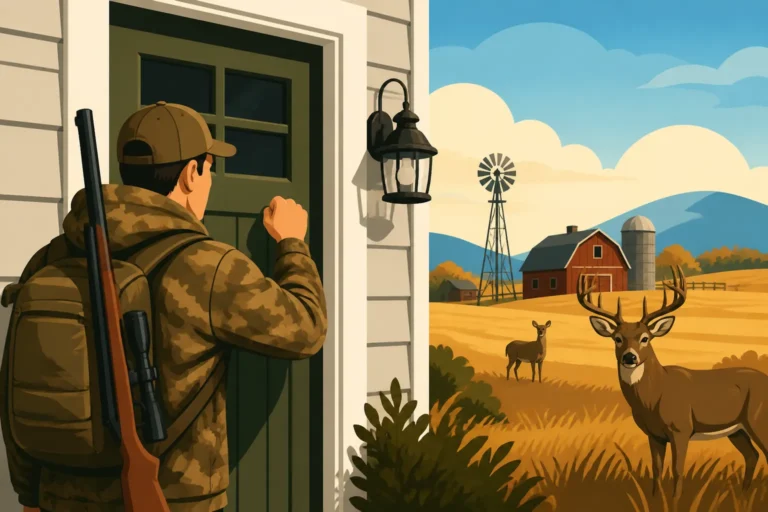
One of the biggest challenges and responsibilities when hunting Huns along farm shelterbelts is securing and maintaining good landowner relations. Most shelterbelts are on private land, and Alberta Trespass Act and Hunting clearly outlines the need for permission. Always Knocking on Doors in Alberta Farm Country and ask for explicit permission before setting foot on any private property. Be polite, offer to share some of your harvest if successful, and always respect any conditions the landowner sets. Leaving gates as you found them, avoiding driving on wet fields, and picking up spent shells are small gestures that build trust and ensure future access for yourself and other hunters. This is also covered in Getting Permission for a Goose Field, which offers insights into private land access.
Safety extends beyond just firearms handling. Always know who is in your hunting party and where they are. Communication is vital. Be aware of your surroundings, especially if hunting near roads, farmsteads, or livestock. In Alberta's farm country, you're rarely far from human activity, so always err on the side of caution. Carry a first-aid kit, a fully charged cell phone (though service can be spotty), and a way to communicate in emergencies, such as a satellite messenger. It's also wise to inform someone not in your party of your hunting plans and expected return time, particularly if you're venturing into more remote areas, or even just a less-traveled shelterbelt far from the main road.
Disclaimer
Hunting carries inherent risks, including but not limited to injury, wildlife encounters, and unforeseen environmental conditions. This guide provides general information for educational purposes only and is not a substitute for professional training, adherence to all applicable laws and regulations, or sound personal judgment. Always prioritize safety, respect wildlife, and obtain proper licenses and permissions before engaging in any hunting activity. Always consult the most current Alberta hunting regulations.