Transporting Firearms Into Alberta
The thought of crossing an international border with a firearm can send shivers down even the most seasoned hunter's spine. The rules, the paperwork, the fear of doing something wrong – it's enough to make anyone second-guess their Alberta hunting plans. But don't let that anxiety deter you! Bringing your hunting rifle or shotgun into Alberta for a memorable hunt is absolutely possible and straightforward, provided you understand and meticulously follow the Canadian regulations. This guide will walk you through everything you need to know to ensure a smooth, stress-free entry with your firearms, from paperwork to packing, so you can focus on the adventure ahead.
Navigating the Canadian Border with Your Firearm
Let's face it, dealing with border customs can feel like walking a tightrope. One wrong step, and your hunting trip could be over before it even begins. The key to success is preparation, honesty, and understanding Canada's specific firearm laws, which can differ significantly from those in your home country.
The RCMP Non-Resident Firearm Declaration Form
This form is your golden ticket for bringing a non-restricted firearm into Canada. It’s formally known as the RCMP 5589 form, and it’s non-negotiable for anyone who isn’t a Canadian resident. Many hunters mistakenly think it's a permit you apply for in advance, but it's actually a declaration you present and get confirmed at the point of entry.
Firstly, you absolutely must print this form off the Canadian Border Services Agency (CBSA) or Royal Canadian Mounted Police (RCMP) website before you leave home. Do not wait until you are at the border to fill it out; it will save you time and stress. Fill out all the required information accurately, detailing your personal information and every single firearm you intend to bring. This means make, model, serial number, calibre, and barrel length. Double-check everything for typos!
A critical detail: Do not sign the form until you are in front of a Canadian Border Services Officer (BSO). They need to witness your signature. This form functions as a temporary license and registration for your firearms for up to 60 days. There is a fee associated with processing this declaration, currently CDN $25, which can be paid in Canadian currency or by credit card. Keep multiple copies of the signed, confirmed declaration form with you throughout your hunt, one with your firearm, and one on your person. This is proof that you legally possess your firearm in Canada.
Required Documentation Beyond the Declaration
While the firearm declaration is paramount, it's not the only piece of paper you’ll need. Think of your hunting trip as a puzzle, and each document is a crucial piece. Without them all, the picture isn't complete.
- Valid Passport or Enhanced Driver's License: This is your primary identification for international travel. Ensure it’s current and not expired.
- Alberta Wildlife Identification Number (WIN) Card: Every hunter in Alberta, resident or non-resident, needs a WIN card. It’s a prerequisite for purchasing any hunting license. You can apply for this online through the AlbertaRELM system before your trip. It's a simple process, but you need to factor in a few days for processing. You can learn more about Alberta's WIN Card and Wildlife Certificate to get this sorted early.
- Alberta Hunting Licenses and Tags: You’ll need the appropriate licenses and tags for the species you intend to hunt (e.g., an Alberta Resident White-tailed Deer Licence or a Non-Resident Alien Black Bear Licence). These are purchased after you have your WIN card. Ensure they are valid for the specific Wildlife Management Unit (WMU) and season dates you plan to hunt. Reviewing Rules for Non-Residents Hunting Alberta is highly recommended.
- Proof of Hunter Education: While not always explicitly asked for at the border, it's a good practice to carry proof of your hunter education certification from your home state or province. Canadian authorities want to ensure you are a responsible and trained hunter. You can get more information on Alberta Hunter Education Requirements for clarity.
- Invitation Letter (if applicable): If you are hunting with an outfitter or a Canadian hunter host, a letter of invitation from them can be very helpful. It explains the purpose of your trip and provides contact information for verification. This isn't legally required, but it demonstrates legitimate intent and can smooth the process. When hunting with a resident friend, understanding Hunting Alberta With a Hunter Host becomes essential.
What Firearms Are Allowed and What Aren't
Canada categorizes firearms into three main types: Non-restricted, Restricted, and Prohibited. For hunting purposes, you will almost exclusively be dealing with non-restricted firearms. Any deviation from this can lead to serious legal trouble.
- Non-Restricted Firearms: These are the vast majority of common hunting rifles and shotguns. This category includes most bolt-action, lever-action, pump-action, and semi-automatic rifles and shotguns used for hunting. As a general rule, if it's designed for hunting big game or waterfowl and has a barrel length over 18.5 inches (or an overall length over 26 inches), it's likely non-restricted. The RCMP 5589 form is specifically for these types of firearms.
- Restricted Firearms: This category primarily includes handguns and some semi-automatic rifles, often those with shorter barrels or certain military characteristics. As a non-resident, it is incredibly difficult, if not impossible, to obtain authorization to bring a restricted firearm into Canada for hunting. You need an Authorization to Transport (ATT) and other specific permits, which are generally not issued for hunting. Do not attempt to bring a handgun for "bear protection" or any other reason without prior, explicit, and rare permission.
- Prohibited Firearms: This category includes automatic firearms, certain modified firearms, and specific models designated as prohibited by law (e.g., certain short-barrelled AR-15 variants, .50 BMG rifles). These are absolutely forbidden to bring into Canada. Period. Attempting to bring a prohibited firearm will result in confiscation, significant fines, and potential arrest or refusal of entry.
Magazine Capacity: This is a crucial point many non-residents overlook. In Canada, magazines for semi-automatic centerfire rifles are generally limited to five rounds. Magazines for handguns are typically limited to ten rounds. There are no capacity limits for bolt-action, lever-action, or pump-action rifles and shotguns, but it's always safest to check specific regulations for your firearm. If your semi-automatic hunting rifle has a magazine that holds more than five rounds, you cannot bring that magazine into Canada. Many hunters opt to purchase compliant magazines once in Canada or ensure their existing magazines are permanently altered to meet Canadian standards before crossing. Tools like GoHunt can offer useful resources to verify these specific regulations.
Packing and Transporting Your Firearms Safely
Once you've got your paperwork in order and confirmed your firearms are legal, the next step is safely packing them for transport. This isn't just about protecting your gear; it's about complying with the law and ensuring your safety and the safety of others.
Proper Storage and Security for Travel
Whether you're driving or flying, Canadian law dictates how firearms must be transported. There's no room for guesswork here; strict adherence is a must.
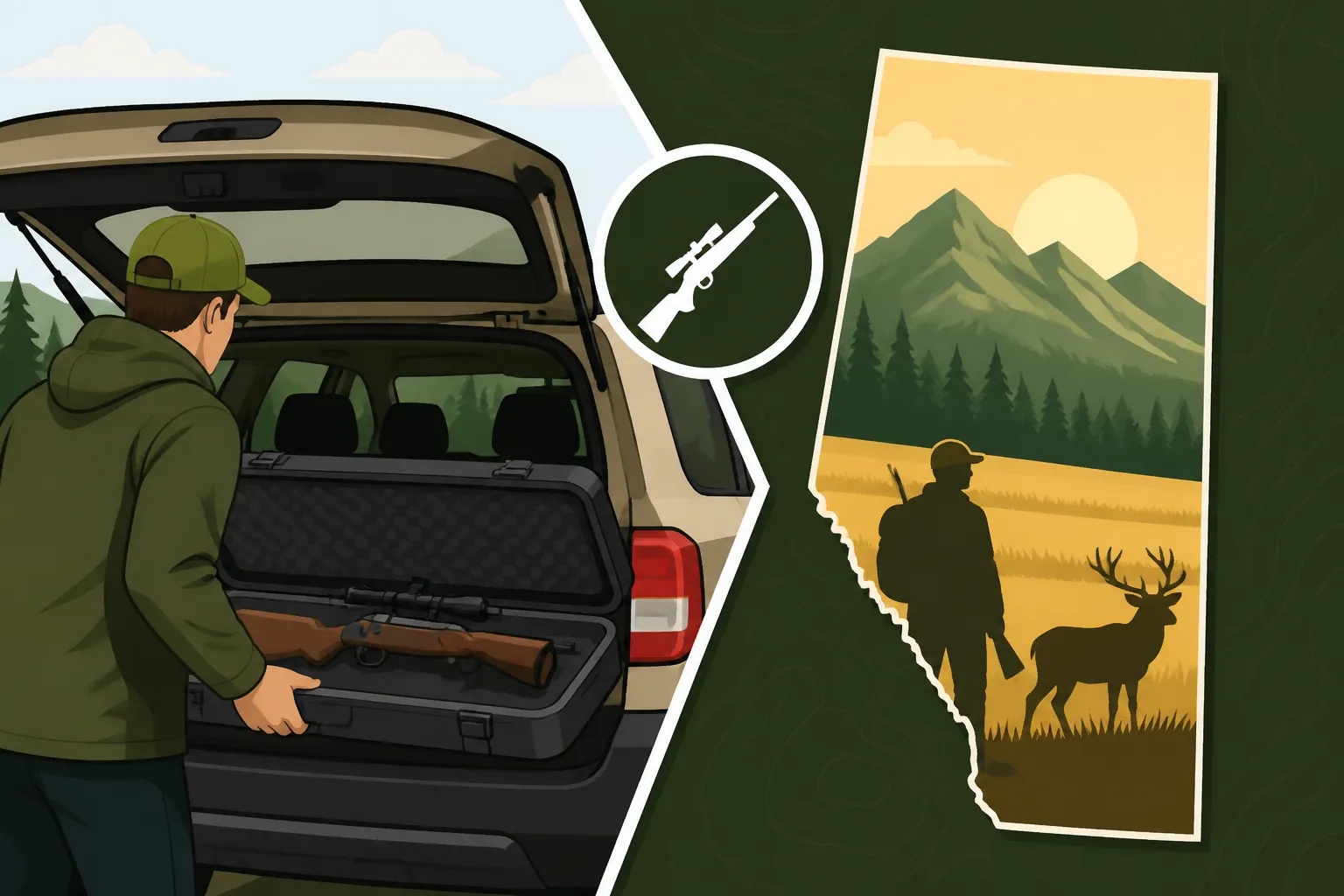
- Unloaded and Locked: Your firearm must be unloaded, and it must be secured in a sturdy, non-transparent case that is locked. This can be a hard-sided plastic case or a metal case. The key is that it cannot be easily opened or accessed. Many hunters also remove the bolt from their bolt-action rifles and transport it separately, often in a small locked case or even on their person (though typically the bolt is fine in the same locked case as the rifle, just not inserted into the rifle itself).
- Ammunition Separated: Ammunition must always be transported separately from the firearm. It should be in its own secure container, preferably the original manufacturer’s box or a purpose-built ammo container, and packed away from the firearm.
- Flying with Firearms: If you're flying into Alberta, say through Calgary International (YYC) or Edmonton International (YEG), you must declare your firearm to the airline at check-in. It will always be checked baggage. Airlines have specific procedures, so it's wise to check your chosen carrier's (e.g., WestJet, Air Canada) firearm transport policy well in advance. Usually, this involves taking your locked case to an oversized baggage counter or a specific security point after check-in. You'll often be required to show the firearm to a security agent before it's cleared for travel. Remember to Flying to Alberta With a Rifle means extra steps and time at the airport.
- Vehicle Transport: For driving, the same rules apply: unloaded, locked case, ammunition separate. The firearm should be out of sight, ideally in the trunk or a locked compartment, not easily accessible from the passenger cabin.
Ammunition Rules and Limits
Understanding ammunition rules is just as important as knowing firearm regulations. Many cross-border issues arise from hunters not properly declaring or storing their ammunition.
- Quantity for Air Travel: For air travel, the Transportation of Dangerous Goods Regulations limit the amount of ammunition an individual can carry to 5 kg (11 lbs) gross weight per person. This typically allows for a decent supply of hunting rounds, but it's essential to check the exact weight of your ammunition with its packaging. Make sure it’s in its original factory packaging or a proper container, not loose in a bag.
- Quantity for Vehicle Travel: When driving, there isn't a strict legal limit on the amount of ammunition you can bring for personal use during a hunt, beyond what is reasonable. However, it must still be stored separately from the firearm in a secure, non-accessible manner. Do not bring excessive quantities that could be perceived as for commercial sale.
- Storage: Ammunition should be in its original manufacturer’s packaging or a secure, non-metallic container designed for ammunition. It should be stored in checked baggage or in the vehicle's trunk, away from passengers and separate from the firearm itself.
Border Crossing Specifics: Driving vs. Flying
The experience of crossing the border will differ depending on your mode of transport. Both require vigilance and patience.
- Driving Across the Border: When you approach the Canadian customs booth, declare your firearms immediately and clearly to the BSO. "I am declaring firearms for a hunting trip." Have all your documentation (passport, WIN card, hunting licenses, and the unsigned RCMP 5589 form) readily accessible. The officer will direct you to a secondary inspection area where they will review your paperwork, verify your firearms, and witness your signature on the declaration form. This process can take anywhere from 15 minutes to an hour, depending on traffic and staffing. Be polite, be patient, and answer all questions truthfully. Remember, they are there to enforce the law, and your cooperation helps ensure a smooth process.
- Flying into an Alberta Airport: The process begins at your departure airport with the airline, as discussed. Once you arrive in Alberta, you'll clear customs as usual. You must still declare your firearm on your customs declaration form. After clearing immigration, you'll proceed to the baggage carousel. Your firearm will often arrive at a special baggage area or be held by airport authorities. Follow the instructions provided by the airline or airport staff. You'll present your confirmed RCMP 5589 form to the CBSA officer at the airport, who will then release your firearm to you. This might involve an additional stop at the CBSA office within the airport. Give yourself plenty of time between your flight landing and any connecting flights or scheduled pickups.
Avoiding Common Pitfalls and Ensuring a Smooth Entry
Even with all the information, it's easy to make a mistake if you're not careful. Knowing the common trip-ups can help you sidestep them entirely.
Common Mistakes Non-Residents Make
Hunters coming into Alberta often make similar errors. By being aware of these, you can ensure your trip goes off without a hitch.
- Not Declaring Your Firearm: This is arguably the biggest mistake. Even if you forget or think it’s not a big deal, failure to declare a firearm is a serious offense. It can lead to confiscation, fines, refusal of entry, and even a permanent ban from Canada. Always declare, even if you’re unsure.
- Incorrectly Filled or Unsigned Forms: As mentioned, filling the RCMP 5589 form accurately is crucial. Typos in serial numbers or incorrect calibres are red flags. And remember, do not sign it until a BSO witnesses it.
- Bringing Prohibited or Restricted Firearms: Assuming that because a firearm is legal in your home state, it's legal in Canada is a dangerous misconception. Handguns and "assault-style" semi-automatic rifles are generally not allowed for non-resident hunters. Always double-check Canada's classification system. Understanding Rules on Rifle Calibres for Big Game can help you determine what's permissible for hunting.
- Oversized Magazines: This one catches many hunters off guard. Those 10-round or 30-round magazines for your AR-15 (even if it's a non-restricted variant) or other semi-auto rifle are not legal in Canada if they exceed the 5-round limit for centerfire semi-auto rifles. Ensure your magazines comply.
- Undeclared Ammunition or Improper Storage: Just like the firearm itself, ammunition must be declared and stored correctly. Loose rounds, excessive quantities, or ammo stored with the firearm are all violations.
- Lack of Patience or Argumentative Behavior: Border Services Officers have a job to do. Being impatient, disrespectful, or argumentative will only make the process longer and more difficult for you. A polite, cooperative attitude goes a long way. Many insights into such situations are discussed in What Non-Residents Get Wrong About Alberta.
What to Expect from Border Services Officers
Canadian Border Services Officers are highly trained professionals. They are generally courteous but firm, and they take their duties very seriously.
- Questions, Questions, Questions: Expect to be asked numerous questions. These will cover your purpose of travel, where you are going, how long you will be staying, what you will be hunting, if you have an outfitter or hunter host, and detailed questions about your firearms and ammunition. Answer truthfully and directly. Avoid jokes or sarcasm.
- Inspection of Documents and Firearms: They will thoroughly review all your documents. They may also ask to physically inspect your firearms and ammunition to ensure they match your declaration and comply with Canadian law. This is a normal part of the process.
- Verification: They might call your outfitter or hunter host to verify your hunting plans. This is why having accurate contact information is important.
- Patience is Key: Border crossings can take time, especially if the border is busy or if you have specific items like firearms to declare. Budget extra time for your crossing, whether driving or flying. Rushing will only add to your stress.
If You're Hunting with an Outfitter or Hunter Host
Many non-residents choose to hunt with an outfitter or a resident hunter host in Alberta. These individuals can be invaluable resources in preparing for your border crossing.
- Outfitter Assistance: Reputable Alberta outfitters (e.g., those offering Booking an Alberta Whitetail Hunt or Booking an Alberta Moose Hunt) often provide detailed pre-trip information that includes guidance on firearm importation. They might send you the RCMP 5589 form, advise you on how to fill it out, and explain the process. They are familiar with the regulations and can offer practical tips. However, remember that ultimately, the legal responsibility for compliance rests with you, the individual bringing the firearm.
- Hunter Host Guidance: If you're hunting with an Alberta resident as a hunter host, they should also be well-versed in the requirements for non-residents. They can walk you through the process, answer questions, and even provide the invitation letter. It’s always best to have these conversations well in advance of your trip. While they can guide you, make sure you understand the rules for yourself. Always cross-reference their advice with official government sources (CBSA, RCMP) as regulations can change. Before you even finalize your plans, consulting resources like GoHunt, which can provide insights into specific WMU regulations and access points, will enhance your preparation and ensure a smoother trip. Remaining informed, often through detailed resources and platforms like GoHunt, is your strongest tool against unforeseen challenges at the border or during your hunt.
Staying meticulously organized and informed is your best defense against any issues. Many successful hunts are built on meticulous research, and tools like GoHunt can provide invaluable insights into provincial regulations and specific hunting zones, ensuring you're compliant from the moment you consider crossing the border.
Here’s a quick reference table for your convenience:
| Document/Item | Purpose | Key Points for Hunters |
|---|---|---|
| RCMP 5589 Form | Non-Resident Firearm Declaration (temporary license/registration) | Print & fill before travel. Do NOT sign until witnessed by BSO. Declare ALL firearms. CDN $25 fee. Valid for 60 days. Keep multiple copies. |
| Passport/ID | Primary identification for international travel | Ensure it is valid and unexpired. |
| WIN Card | Wildlife Identification Number (required for all Alberta hunting licences) | Apply online via AlbertaRELM well in advance. |
| Alberta Hunting Licences | Legal permission to hunt specific species in specific WMUs/seasons | Purchase after receiving your WIN Card. Ensure species, WMU, and dates are correct for your hunt. |
| Hunter Education Proof | Demonstrates hunting competence (recommended to carry) | Carry your hunter education card or certificate from your home jurisdiction. |
| Firearms | Your hunting rifle(s) or shotgun(s) | Must be Non-Restricted. Unloaded, secured in locked, opaque case. Bolt removed (recommended). Check Rules on Rifle Calibres for Big Game for specifics. |
| Ammunition | Rounds for your firearm(s) | Must be stored SEPARATELY from firearms, in original packaging or secure container. Max 5 kg (11 lbs) for air travel. |
| Magazines | Detachable magazines for semi-automatic firearms | Max 5 rounds for semi-automatic centerfire rifles. Max 10 rounds for handguns (though bringing handguns is not advised). No limit for bolt/lever/pump actions. |
| Invitation Letter | From outfitter or hunter host (recommended for smooth process) | Not legally required but can aid verification. Provides legitimacy and contact info. Important for those using a Hunting Alberta With a Hunter Host for their trip. |
Transporting your firearm into Alberta for hunting is a process that demands respect for the rules and attention to detail, but it shouldn't be a source of dread. With proper preparation and a cooperative attitude, you'll be through customs and on your way to chasing game in Alberta's stunning wilderness in no time.
Disclaimer
Please remember that hunting regulations, firearm laws, and border crossing procedures can change. Always consult the official websites of the Canadian Border Services Agency (CBSA), the Royal Canadian Mounted Police (RCMP), and Alberta Fish and Wildlife before your trip to ensure you have the most current information. This guide is for informational purposes only and should not be considered legal advice.