Judging a Bighorn Ram’s Age
One of the most intense and rewarding challenges in Alberta's high country is hunting bighorn sheep. You've spent countless hours scouting, endured tough climbs, and finally, you've spotted a ram through your optics. But then comes the critical moment: is it a legal ram? The regulations in Alberta for bighorn sheep are quite specific, often centered around horn development, which directly relates to the animal's age. This isn't just about finding a big one; it's about ethical harvesting, promoting sustainable populations, and ensuring future generations of hunters have the same opportunities. This guide will walk you through the nuances of judging a bighorn ram's age in the field, helping you make informed decisions when it truly counts.
Why Age Matters in Bighorn Hunting
Hunting bighorn sheep in Alberta isn't just a pursuit of a magnificent trophy; it's a deeply regulated activity designed to ensure the long-term health and vitality of these iconic mountain dwellers. The emphasis on judging a ram's age comes directly from these conservation principles, affecting everything from legal requirements to the quality of the hunting experience. It’s a challenge that demands patience, keen observation, and a good understanding of bighorn biology.
Understanding Alberta's Regulations
Unlike some other big game species where antler points might be the primary legal descriptor, bighorn sheep regulations in Alberta often hinge on the ram's horn development, which is a direct indicator of age. You'll frequently encounter terms like "full curl" or "3/4 curl," which refer to how much the horn has grown and curled back towards the animal's face. The specific regulations are crucial for any hunter hoping to pursue these animals legally. You absolutely need to know these rules inside and out before you even step foot into sheep country. This isn't a "shoot first, ask questions later" kind of hunt; misjudging a ram can lead to serious consequences and a deep regret that no trophy could ever make up for. Many hunters spend years going through extensive preparation, and some also apply for special draws, so ensuring a legal harvest is paramount.
The Role of Selective Harvesting
The reason these age and curl regulations exist is rooted in sound wildlife management. By targeting older, more mature rams, we're practicing selective harvesting. This strategy allows younger rams to reach their full potential, both physically and genetically, before they are removed from the population. Younger rams are vital for breeding and contributing to the herd's genetic diversity. If we indiscriminately harvested rams of all ages, it could skew the herd's age structure, reduce reproductive success, and ultimately diminish the overall health and trophy quality of the population over time. It's about maintaining a robust population, not just about bigger horns. This ethical approach also means that when you do harvest a mature ram, you know you're taking an animal that has lived a good life, contributed to the herd, and is now ready for harvest. It adds a deeper layer of respect and appreciation to the hunt.
Conservation and Population Health
Beyond individual hunt regulations, judging age accurately contributes to broader conservation efforts for bighorn sheep in Alberta. These populations face challenges, including habitat loss, disease, and predation. By carefully managing harvest pressure through age-based rules, wildlife biologists can ensure that hunting remains a sustainable activity that doesn't negatively impact the overall population. Every legal ram taken is a testament to successful conservation. For us as hunters, it means being good stewards of the land and the wildlife. It’s about more than just our own hunt; it’s about the future of the species. Understanding the biological reasons behind horn growth and age indicators helps you appreciate the animal more and reinforces the importance of responsible hunting. If you're planning a hunt in the high country, check out Bighorn Sheep in Alberta's Mountains for a broader overview of these incredible animals.
The Tell-Tale Signs: Horn Growth and Annuli
When you're glassing a distant hillside in Alberta's mountains, searching for that legal ram, your eyes will naturally be drawn to the horns. They are the primary indicator of age and legality in bighorns. But it's not just about how big they are; it's about understanding the nuances of their growth pattern, specifically the annuli, or growth rings. This is where the real skill of field judging comes into play, turning what might look like a simple spiral into a living timeline.
Annual Growth Rings (Annuli)
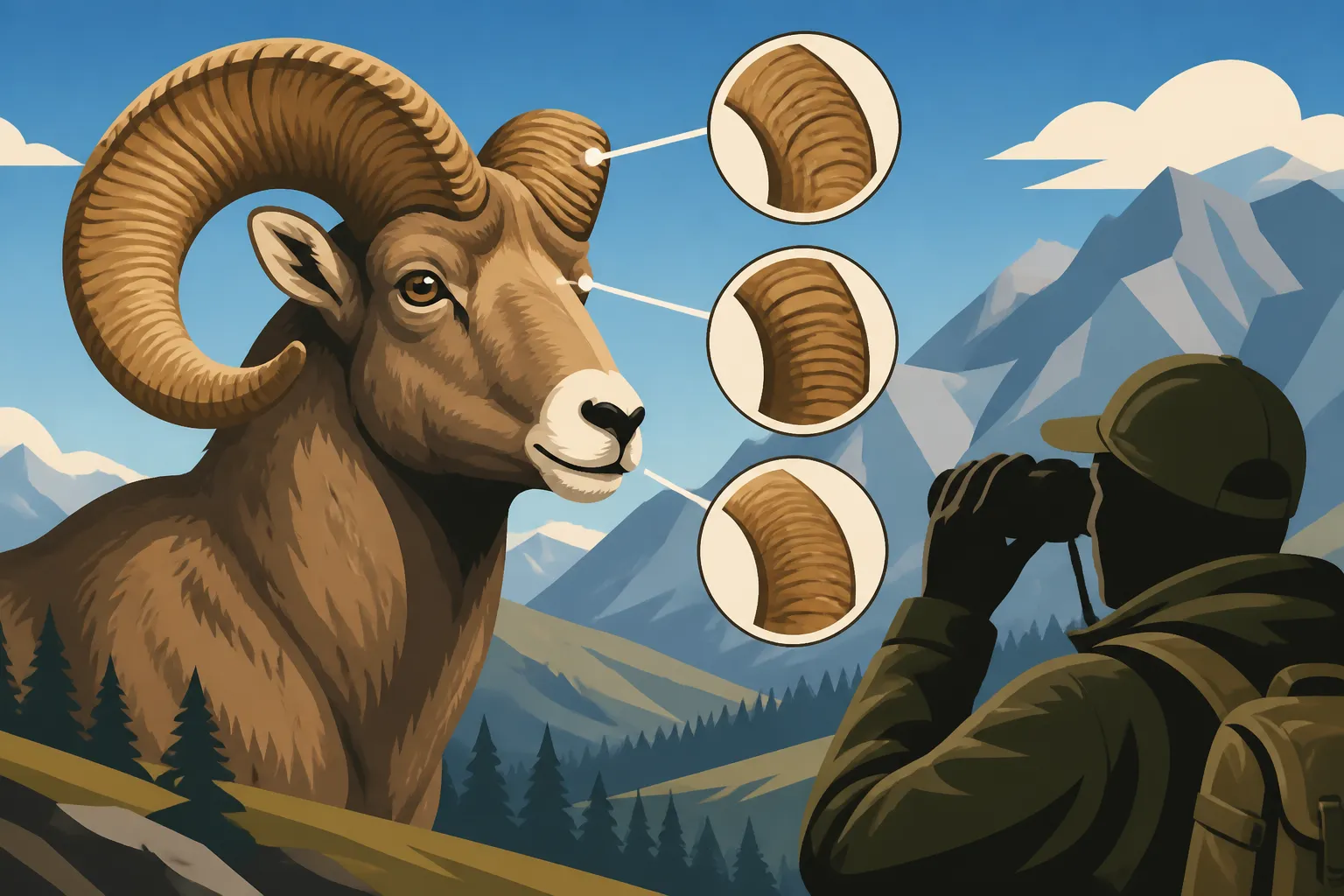
Think of a bighorn ram's horn like the rings of a tree. Each year, the horn grows, and then, typically during the winter months when forage is scarcer and resources are directed towards survival rather than rapid growth, a distinctive constriction or "ring" forms. These are the annuli, and they are your most reliable guide to a ram's age. A ram will typically have its first annuli formed around the age of one year. The subsequent rings mark each passing year. So, a ram with four distinct annuli is likely a five-year-old animal.
It's not always as straightforward as counting neat rings, though. The first few annuli, especially, can be quite tight and close to the head, sometimes even hidden by hair or the base of the horn. As the ram ages, these rings become more pronounced and easier to distinguish, particularly on the outside curve of the horn. You’ll be looking for distinct indentations and ridges that encircle the horn. Good optics are absolutely essential here. You're trying to count these rings from a distance, sometimes in tricky light, across vast mountain landscapes. This is where a high-quality spotting scope truly shines, allowing you to zoom in and discern those subtle but critical markers. It takes practice to confidently identify each annuli, especially differentiating them from minor chips or imperfections in the horn.
Horn Mass and Length
While the annuli give you the exact age, the overall mass and length of the horns are powerful secondary indicators. As a ram ages, his horns don't just get longer; they get thicker, especially at the base. A young ram might have fairly long, slender horns, but an older ram will exhibit significant mass, giving his horns a much more robust appearance. Think of it like comparing a teenager's arm to a seasoned lumberjack's—the form might be similar, but the bulk is undeniable. This mass is a key component of what makes a ram a true trophy.
Moreover, the length and sweep of the horns contribute to the "curl" measurement that Alberta regulations often reference. A ram that is considered "full curl" means the tip of its horn has grown past a specific point, often the back of the eye, or has broken off naturally, indicating significant age. This isn't just arbitrary; it suggests the ram has reached a mature age, typically seven or eight years or older, allowing for multiple breeding seasons. You'll often see older rams with broom-tipped horns, where the tips have been worn down or broken off from fighting or rubbing, which also counts towards "full curl" under many regulations. This phenomenon is a strong indicator of an old, dominant ram. If you're interested in pursuing these mountain monarchs, knowing Where Alberta's Big Rams Live can help you narrow down your scouting efforts.
The Appearance of the Horns Over Time
The horns don't just grow; they also show the wear and tear of a ram's life in the harsh mountain environment.
- Young Rams (1-3 years): Horns are relatively short, slender, and often lack significant curl. Annuli are hard to distinguish or not yet fully formed. These rams are typically sleek-bodied and agile, often seen trailing ewes or in bachelor groups with other young rams.
- Adolescent Rams (4-6 years): Horns start to gain length and mass, and the curl becomes more evident. You can usually start to pick out distinct annuli more easily. The horns will still look quite clean and relatively undamaged. These rams are growing into their prime and beginning to challenge older rams.
- Mature Rams (7+ years): This is where you see significant horn development. The mass is pronounced, the curl is often well past 3/4 or even full curl, and the annuli are usually very distinct, though they might be worn down or "blunted" on the outside curve from years of rubbing and fighting. The tips are often broomed off. These rams carry themselves with confidence and power, and their bodies show the robust musculature of a dominant animal. The color of their horns might also darken with age, acquiring a rich, deep hue. Understanding these visual cues is crucial for a successful and legal hunt.
Beyond the Horns: Other Age Indicators
While horns are undoubtedly the primary indicator for judging a bighorn ram's age in the field, a truly skilled hunter understands that the animal's entire presence speaks volumes. You can learn a lot about a ram by observing its overall physique, muscle development, and even its behavior. These "soft" indicators can help confirm what the horns are telling you, or in some cases, provide crucial clues when the horns alone are ambiguous.
Body Size and Musculature
Just like humans, bighorn rams mature physically over time. A young ram, say 2-3 years old, might appear leggy and lean, still growing into his frame. His body will lack the dense, powerful musculature of an older, mature animal. As rams age, particularly into their prime (5-8 years), they fill out significantly. Their chests will be deep and broad, their neck muscles will swell, especially during the rut, and their hindquarters will be visibly powerful. You'll notice a general bulkiness and a more compact, robust appearance.
When you're Glassing Alpine Basins for Bighorn Sheep, pay close attention not just to the horns but to the entire animal. A mature ram often looks like a solid block of muscle, a testament to years of navigating steep terrain and competing with rivals. This physical development goes hand-in-hand with horn growth. A ram with impressive horns but a somewhat spindly body might be a ram with good genetics but still a couple of years away from true maturity. Conversely, a ram with a magnificent, powerful physique, even if his horns aren't perfectly symmetrical or are broomed, is likely an older, dominant animal. This holistic view helps you build a complete picture of the ram's age and overall condition.
Facial Features and Coat Condition
Believe it or not, a ram's face can also offer clues to its age. Older rams sometimes develop a more weathered look. Their muzzles might appear greyer or show more definition around the eyes. While this isn't a hard-and-fast rule and can be affected by genetics and individual health, it's another subtle indicator to add to your assessment. Think of it like looking at an old-timer in your own family; there's a certain wisdom that settles into their features.
The coat condition can also tell you something, though it's more about overall health and season than specific age. However, generally speaking, very old or struggling rams might have a duller, less vibrant coat compared to a ram in its prime. During the rut, rams in their prime will often be sleek and well-conditioned, radiating health and dominance, while very old rams might start to show signs of decline. These are less about definitive age and more about painting a complete picture of the animal's overall vitality.
Behavior and Social Dynamics
Bighorn sheep are incredibly social animals, and their behavior can reveal a lot about their age and dominance. Young rams (1-3 years) are often found in larger groups, more skittish, and typically follow the lead of ewes or older rams. They're still learning the ropes of mountain life. Adolescent rams (4-6 years) will start to spar and test their strength, but they usually defer to the older, more dominant rams. They'll be seen pushing and shoving, but rarely engaging in full-on head-to-head clashes with the real heavyweights.
Mature rams (7+ years) exhibit a different demeanor entirely. They often form smaller, more exclusive bachelor groups, or during the rut, they will be actively challenging and dominating younger rams for breeding rights. They move with a confident, unhurried gait. When you see a ram that is clearly the boss, pushing other rams around, claiming the best bedding spots, or simply carrying himself with an air of authority, you're likely looking at an older, experienced animal. This behavioral observation is a critical piece of the puzzle, especially when horn characteristics alone might be hard to decipher from a distance. The way a ram interacts with its environment and other sheep can be as telling as the rings on its horns. For a deeper dive into the challenges of a sheep hunt, consider Backpack Hunting Alberta's Bighorn Country.
Practice and Patience: Becoming a Skilled Judge
Judging a bighorn ram's age in the rugged and expansive landscapes of Alberta's mountains is far from easy. It's a skill that's honed over time, requiring keen eyesight, quality equipment, and a whole lot of patience. You won't become an expert overnight, but with dedication, you can significantly improve your ability to quickly and accurately assess a ram in the field, giving you the confidence to make the right call when it matters most.
The Importance of High-Quality Optics
Let's be realistic: you're likely going to be judging rams from significant distances, often hundreds of yards or more. The sheer scale of Alberta's mountain ranges means you need to be able to pick apart details on an animal far away. This is where your optics become your most vital tool, arguably even more important than your rifle or bow on a sheep hunt.
A good pair of binoculars (10x or 12x) is essential for initial spotting and broader observation. But to truly count annuli, assess horn mass, and observe subtle body characteristics, you need a high-magnification spotting scope. Look for a scope with a large objective lens (at least 65mm, 80mm or more is even better) for light gathering, and a powerful zoom eyepiece that can go up to 60x or even higher. A stable tripod is non-negotiable; even the slightest wobble will make it impossible to discern fine details. Invest in the best optics you can afford. The clarity, light transmission, and field of view provided by top-tier optics like those from GoHunt (an excellent resource for gear choices and hunting intel) will dramatically improve your ability to judge sheep. They allow you to spend more time observing, waiting for the ram to turn its head just right, or to step into better light. Remember, you're not just looking for a ram; you're studying it.
Learning from Experience and Photos
There's no substitute for time spent in sheep country, but not everyone has endless opportunities. So, how do you gain experience?
- Study Photos and Videos: Before your hunt, spend hours poring over high-resolution photos and videos of bighorn rams. Look for rams of known age, if possible. Pay attention to how the annuli are spaced, how the horn gains mass, and how the body changes. Analyze successful hunter photos – try to guess the ram's age before reading any descriptions. Many hunting publications and online forums feature detailed photos that can be incredibly educational. Look for examples of rams that are "just legal" versus those that are undeniably old and mature.
- Practice in the Field (Without Shooting): Even if you don't have a sheep tag in your pocket, or you're out scouting for other species, bring your spotting scope and practice. Find any rams you can, observe them, and try to age them. Make a mental note (or even sketch it) of what you see. If you can, take photos through your scope and review them later. This low-pressure practice helps train your eye and build confidence. The more hours you spend glassing and analyzing, the better you'll become. Consider joining other hunters or a mentor for Scouting an Alberta WMU Before Season to gain more field practice.
- Seek Out Mentors: If you know experienced sheep hunters or guides, spend time with them. Ask questions, have them walk you through their judging process, and listen to their insights. They've likely made mistakes and learned from them, and their knowledge can accelerate your own learning curve. Many of these seasoned hunters have accumulated a wealth of knowledge from years spent high in Alberta's mountains.
Common Mistakes to Avoid
Even with the best intentions and equipment, it's easy to make mistakes when field judging bighorn rams.
- Rushing the Judgment: This is perhaps the most common error. The excitement of finally spotting a ram can lead to a hasty decision. Take your time. Observe the ram from multiple angles, wait for it to move, and watch it interact with other sheep. Patience is your greatest ally. Don't feel pressured to make a call if you're not 100% confident. If you have any doubt, let the ram walk.
- Light Conditions: Flat light, strong backlight, or shadows can obscure crucial details. A ram might look legal one moment and questionable the next. Try to observe the ram when the sun is illuminating it clearly. This might mean waiting for the animal to move or for the sun to change position.
- Focusing Only on Length/Curl: While important, remember that mass and annuli are often more reliable age indicators. A ram with very long, slender horns might look impressive but could still be younger than a shorter-horned, massier ram with more distinct annuli. Always consider all indicators.
- Estimating Distance Incorrectly: What looks like a chip or a distinct annuli at 500 yards might be something else entirely at 800 yards. Use a rangefinder to get accurate distances, and understand that atmospheric conditions can play tricks on your eyes.
- "Ground Shrinkage" Mindset: While often joked about, it’s a real phenomenon. A ram always looks bigger through the scope and alive on the mountain. Be conservative in your judgment. If you're on the fence, it's probably best to pass. The integrity of the hunt and the conservation of the species are far more important than a missed opportunity. If you're serious about your chances, consider how Alberta Mountain Sheep Outfitters can help provide expert guidance.
Becoming proficient at judging a bighorn ram's age is a journey, not a destination. It’s a skill that will deepen your appreciation for these magnificent animals and make your time in Alberta's wild mountains even more rewarding.
Disclaimer
This article is for general informational purposes only and does not constitute professional advice. Laws, prices and regulations vary by location and change over time. Consult a qualified professional for guidance on your specific situation.