Rules on Rifle Calibres for Big Game
There's a lot of chatter and sometimes outright confusion among hunters, especially new ones or those coming from different provinces or states, about what rifle calibres are actually legal for big game here in Alberta. It's not just about what can take an animal down, but what the regulations explicitly state to ensure ethical and humane harvesting. This guide will walk you through Alberta's specific rules regarding rifle calibres for big game, help you understand the reasoning behind them, and offer practical advice for making responsible choices in the field.
Decoding Alberta's Big Game Rifle Calibre Rules
Navigating hunting regulations can sometimes feel like trying to read a legal textbook while simultaneously planning a backcountry trip – it's dense, critical, and often leaves you with more questions than answers. But when it comes to the rifle you're carrying for big game in Alberta, understanding the exact rules around calibre is non-negotiable. These aren't arbitrary rules; they're in place to promote ethical hunting practices and ensure that when you take a shot, you have the best chance of a quick, humane harvest. Alberta's regulations are quite clear, focusing on two main criteria: projectile diameter and muzzle energy.
The Core Regulations: Minimum Diameter and Muzzle Energy
Alberta Fish and Wildlife sets out specific minimums for rifles used on big game. Your rifle and ammunition combination must meet both of these requirements, or you're simply not legal. First off, the projectile, or bullet, must have a diameter greater than 5.7 mm (0.224 inches). This is a crucial detail that often catches people out. Many popular varmint and predator calibres, like the .223 Remington or 5.56mm NATO, typically use a .223-inch diameter bullet. Even if you find a load that theoretically hits the energy requirement, the bullet diameter itself makes it illegal for big game hunting in Alberta.
Secondly, the projectile fired from your rifle must generate at least 2168 joules (which translates to approximately 1500 foot-pounds) of muzzle energy. Muzzle energy is the kinetic energy of the bullet as it leaves the barrel, and it's a critical factor in ensuring adequate penetration and energy transfer to the animal for a swift kill. While many calibres can meet this, it's not a given, especially with lighter bullet weights or shorter barrels. For instance, a very light, fast .243 Winchester bullet might struggle to consistently meet this energy threshold at typical hunting distances, though most standard hunting loads will easily clear it at the muzzle. Always check the specifications of your chosen ammunition. A good way to do this is to consult ballistic tables provided by ammunition manufacturers or use an app like those offered by GoHunt to compare different loads and their downrange performance. It's your responsibility to know these numbers for your specific setup.
Prohibited Ammunition Types and Calibres Too Small
Beyond the minimums, Alberta's regulations also explicitly prohibit certain types of ammunition for big game. You absolutely cannot use full metal jacket (FMJ) bullets. These bullets are designed for maximum penetration with minimal expansion, which is fine for target shooting or military applications, but highly unethical for hunting big game as they often punch straight through an animal without imparting sufficient energy to cause a quick, humane death. For ethical hunting, you need bullets designed to expand and transfer energy within the animal. Furthermore, any tracer or incendiary bullets are completely prohibited for all hunting, not just big game, due to obvious safety and wildfire risks.
As discussed, any calibre with a bullet diameter of 0.224 inches or less, regardless of its muzzle energy, is off-limits for big game. This explicitly rules out popular calibres such as the .17 HMR, .22 Hornet, and the ubiquitous .22LR, which are designed for small game and varmints. Even if a particular load in, say, a .22-250 Remington could technically achieve 1500 ft-lbs of muzzle energy, its .224-inch diameter still puts it on the wrong side of the regulations. This is where many non-residents or new hunters get tripped up, assuming that if a round is "powerful" enough, it's good to go. Always remember: both diameter and energy minimums must be met.
Matching Your Calibre to Alberta's Diverse Big Game
Once you've wrapped your head around the legal requirements, the next step is choosing a calibre that's not just lawful but also appropriate for the specific big game species you're pursuing in Alberta. While a .243 Winchester might be legal for all big game, it's certainly not the ideal choice for a mature bull moose. Ethical hunting dictates using a cartridge that provides a sufficient margin of error and delivers ample energy for a quick kill, even if the shot isn't absolutely perfect.
Deer Hunting: Whitetails, Muleys, and the Versatile Cartridge
When it comes to hunting deer in Alberta, whether you're after a wily whitetail in the aspen parkland or a trophy mule deer on the open prairie, you have a wide range of excellent legal calibre choices. For many, the venerable .270 Winchester, .308 Winchester, and .30-06 Springfield are absolute classics. These calibres offer a fantastic balance of manageable recoil, flat trajectory, and ample power for deer-sized game. They are highly versatile and readily available, making them a popular choice for hunters pursuing Whitetail Hunting in Alberta or Mule Deer Hunting Alberta's Prairie and Badlands.
However, there are also excellent options on the lighter side that still meet Alberta's regulations. The .243 Winchester, as long as it's pushing a sufficiently heavy bullet to maintain that 1500 ft-lbs of muzzle energy, is a fantastic deer cartridge, particularly for smaller-bodied whitetails or for hunters sensitive to recoil. Similarly, the 6.5 Creedmoor has become incredibly popular due to its mild recoil, excellent accuracy, and solid performance on deer. For those who prefer a little more punch for potential longer shots on mule deer across a wide-open coulee, cartridges like the 7mm-08 Remington or .280 Remington also shine. When choosing, consider the typical distances you'll be shooting, the terrain you'll be hunting in, and your personal comfort level with recoil. An accurate shot with a slightly smaller, well-placed bullet is always superior to a flinching shot with a magnum.
Taking on Larger Game: Moose, Elk, and Black Bear
Stepping up to Alberta's larger big game species like moose, elk, or black bear requires a calibre with significantly more power, not just to meet legal minimums, but to ensure deep penetration and decisive energy transfer. While technically legal, a .243 Winchester or 6.5 Creedmoor would be severely underpowered for a heavy-boned bull moose or a charging black bear, putting both the animal and potentially the hunter at risk.
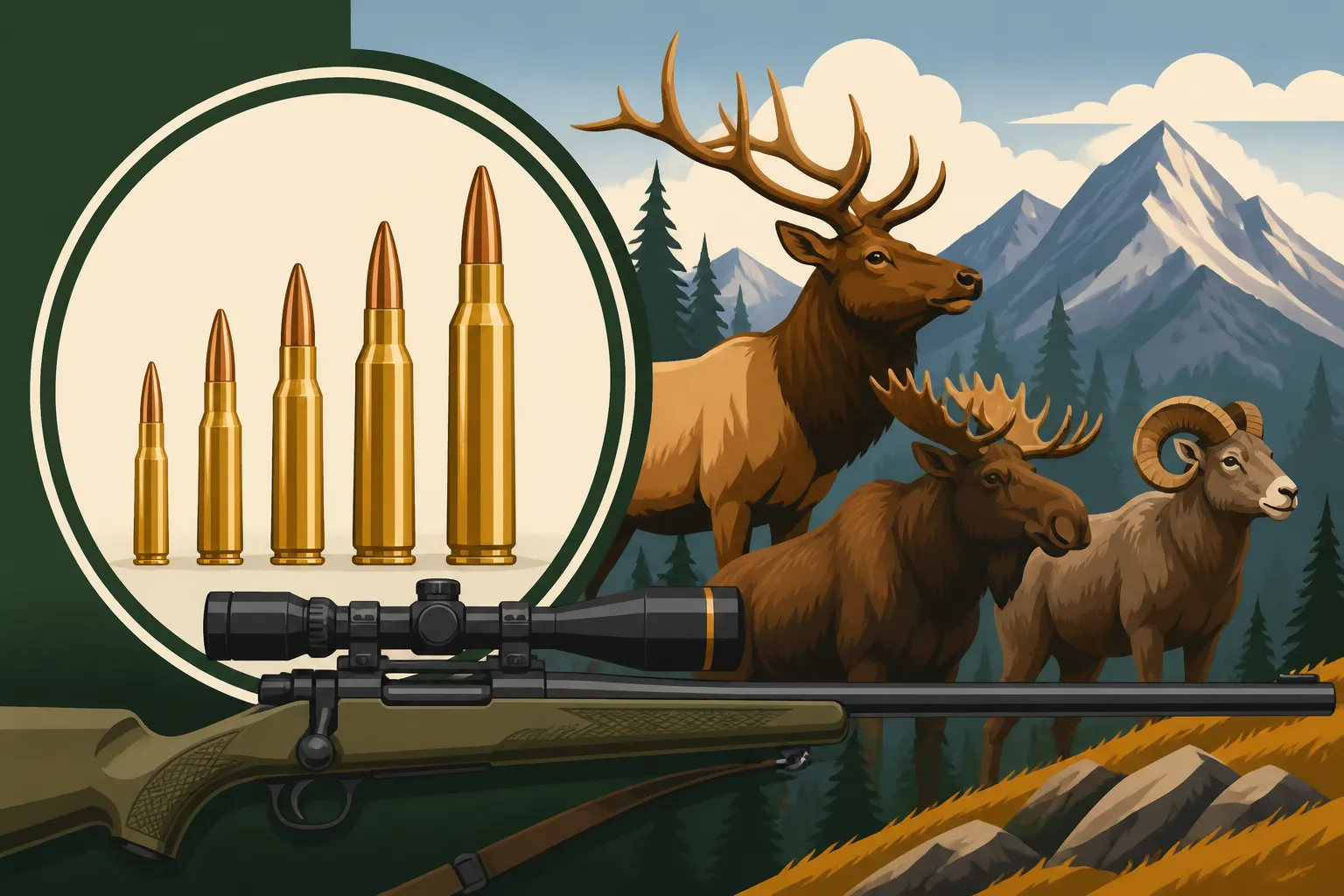
For these larger animals, you're generally looking at calibres starting around the .30-06 Springfield and moving upwards. The .30-06, with heavier bullets (180-grain and up), is often considered the minimum ethical choice for Moose Hunting Alberta's Boreal Forest or Elk Hunting Alberta's Foothills. However, many seasoned hunters prefer more potent options for these situations. The .300 Winchester Magnum is a powerhouse, offering a flatter trajectory and considerable knockdown power, making it an excellent choice for elk in mountainous or open foothill terrain where longer shots might be necessary. Other superb options include the 7mm Remington Magnum, .338 Winchester Magnum, and even larger calibres like the .375 H&H Magnum for those specifically targeting massive bears or wanting maximum insurance for any scenario. When considering Black Bear Hunting in Alberta, particularly in dense bush where encounters can be close and sudden, a robust calibre with heavy, penetrating bullets is paramount.
The table below provides a general overview of recommended rifle calibres for various big game species in Alberta, keeping both legality and ethical hunting in mind.
| Big Game Species | Legal Calibre Range (Examples) | Recommended Calibre (Examples) | Considerations |
|---|---|---|---|
| Whitetail Deer | .243 Win (if energy met) to .300 Win Mag | .270 Win, .308 Win, 6.5 Creedmoor, .30-06 Spr. | Versatility, recoil, typical shot distance, ethical dispatch. |
| Mule Deer | .243 Win (if energy met) to .300 Win Mag | .270 Win, .30-06 Spr., 7mm Rem Mag, .300 Win Mag | Potential for longer shots in open country, wind drift, bullet energy retention. |
| Elk | .243 Win (if energy met) to .375 H&H Magnum | .30-06 Spr., 7mm Rem Mag, .300 Win Mag, .338 Win Mag | Penetration on heavy bone, energy for large body mass, longer ranges in foothills. |
| Moose | .243 Win (if energy met) to .375 H&H Magnum | .30-06 Spr. (heavy bullets), .300 Win Mag, .338 Win Mag, .375 H&H Mag | Deep penetration through muscle and bone, dense cover hunting, high energy transfer. |
| Black Bear | .243 Win (if energy met) to .375 H&H Magnum | .30-06 Spr., 7mm Rem Mag, .300 Win Mag, .338 Win Mag | Close-range power, ability to stop an animal quickly, bullet construction for tough hide/bone. |
| Pronghorn | .243 Win (if energy met) to .30-06 Spr. | 6.5 Creedmoor, .270 Win, .25-06 Rem | Flat trajectory for long shots, minimal recoil for spotting impacts. |
| Bighorn Sheep/Mtn Goat | 6.5 Creedmoor to .300 Win Mag | 6.5 Creedmoor, .270 Win, 7mm Rem Mag | Lightweight for mountain hunting, flat trajectory, accuracy at range, ethical clean kills. |
Note: This table provides general recommendations. Always verify your specific ammunition meets Alberta's legal minimums for muzzle energy and bullet diameter.
Understanding Magnum Power and Its Place
Magnum cartridges, like the 7mm Remington Magnum, .300 Winchester Magnum, or .338 Winchester Magnum, deliver significantly more velocity and energy than their standard counterparts. This extra power translates to a flatter trajectory over longer distances and increased energy on impact, which can be a distinct advantage when hunting larger game or when shots are expected to be at extended ranges. For instance, when trying to spot and stalk Hunting Mule Deer in the Badlands Coulees or when you need to reach out to an elk across a big valley, that flatter trajectory can make a difference.
However, magnum power comes with increased recoil, which can be a significant deterrent if you're not comfortable with it. Excessive recoil can lead to flinching, poor shot placement, and a general aversion to practicing with your rifle. A hunter who consistently shoots a .30-06 well will be far more effective than one who flinches with every shot from a .300 Win Mag. There's also the consideration of barrel life and ammunition cost. While modern magnum rifles are built to handle the pressure, they can wear barrels faster, and ammunition is generally more expensive. The key is to choose a magnum if its benefits genuinely outweigh these drawbacks for your specific hunting style and physical comfort. GoHunt offers great resources to help you compare ballistic data and understand how different cartridges perform.
Beyond the Law: Ethical Considerations and Ballistics
Meeting the legal requirements is the bare minimum. As responsible hunters, we have an ethical obligation to ensure we're doing everything possible to achieve a clean, humane harvest. This goes beyond just the rifle calibre and delves into bullet construction, our personal proficiency, and a deep understanding of ballistics.
The Critical Role of Bullet Construction
A bullet's construction is arguably as important as, if not more important than, its calibre. Even with a powerful magnum, using the wrong bullet can lead to poor performance, such as insufficient penetration, premature expansion, or catastrophic fragmentation. For big game, you generally want an expanding bullet that retains a significant portion of its weight.
There are several types of hunting bullets, each designed for different purposes:
- Cup-and-Core: These are traditional bullets with a lead core and a copper jacket. Many variations exist, with some featuring bonded cores (where the lead core is chemically fused to the copper jacket) or interlocked designs to improve weight retention and controlled expansion. Good examples include Federal's Power-Shok or Remington's Core-Lokt.
- Partitioned: Bullets like the Nosler Partition have a barrier that separates the front and rear lead cores. The front portion expands aggressively, while the rear portion remains intact for deep penetration. These are excellent for larger, tougher animals.
- Monolithic/Solid Copper: These bullets are typically made entirely of copper or a copper alloy. They offer excellent weight retention, deep penetration, and consistent expansion across a wide velocity range. Brands like Barnes TSX, Hornady GMX, and Federal Trophy Copper are popular choices, especially where lead-free ammunition is required (though not currently a blanket rule in Alberta for rifles).
For large, tough-skinned animals like moose and elk, you need a bullet designed for deep penetration through heavy muscle and bone. For deer, a slightly softer bullet that expands rapidly might be preferred for quicker energy transfer. Always match your bullet choice to the species you're hunting and the expected range. This will help ensure that your meat is properly cared for, even with temperature swings, as the animal will be dispatched quickly. For more on this, check out our guide on Meat Care in Alberta's Cold and Warm Swings.
The Human Element: Practice, Proficiency, and Shot Placement
No matter how legally compliant or ballistically superior your rifle and ammunition setup is, it's ultimately the hunter's skill that matters most. A poorly placed shot with a .338 Winchester Magnum is far less ethical than a well-placed shot with a .270 Winchester. Consistent practice at the range is paramount. You need to know your rifle's capabilities, your ammunition's trajectory, and, most importantly, your own limits.
This means spending time on the shooting bench, practicing from different field positions (prone, kneeling, standing), and understanding how factors like wind, temperature, and elevation affect your bullet's flight. Programs like the Alberta Hunter Education and Conservation Course emphasize the importance of responsible hunting, and part of that responsibility is ensuring you can make an ethical shot. Using a ballistic calculator, perhaps one from GoHunt, can help you understand your holdovers and windage adjustments at various distances.
Never take a shot in the field that you aren't 100% confident in. This might mean passing on a shot that's too far, at an awkward angle, or in insufficient light. Patience and discipline are virtues in hunting, and they directly contribute to ethical outcomes. Always strive for a clean, humane kill through precise shot placement, aiming for the vitals (heart and lungs). Know your rifle, know your ammunition, and most importantly, know yourself.
Disclaimer
The information provided in this guide is for general informational purposes only and does not constitute legal advice. Hunting regulations in Alberta are subject to change, and it is the hunter's sole responsibility to consult the most current Alberta Guide to Hunting Regulations and all applicable provincial and federal laws before engaging in any hunting activities. Always confirm specific requirements with Alberta Environment and Parks or appropriate authorities.