Hunting Where Two Coulees Meet
Hunting in Alberta's vast, often bewildering landscape can feel like trying to find a needle in a haystack, especially when you're targeting deer in the endless folds of coulees. It's easy to get lost in the sheer scale of the terrain and feel like you're just wandering aimlessly. But savvy hunters know that deer are creatures of habit and efficiency, and they leave clear clues about their preferred routes and hideouts. This guide is all about simplifying that challenge by focusing on one of the most consistently productive locations: where two coulees meet, creating natural funnels that practically scream "deer highway!"
Understanding Why Deer Love Coulee Junctions
Coulees are natural depressions in the landscape, often carved by ancient water flow or glacial melt, and they are absolute magnets for deer, especially mule deer and whitetails in the prairie and parkland regions. They offer a unique combination of shelter, food, and water, creating microclimates that can be surprisingly different from the open land just above them. But a single coulee, while good, doesn't compare to the strategic advantage of a junction. When two coulees converge, they create an even more pronounced funnel, concentrating deer movement and amplifying the resources available.
Deer, by nature, seek the path of least resistance and maximum security. A coulee offers concealment from predators and harsh weather, particularly the biting winds and deep snows of an Alberta winter. The slopes provide thermal cover from the cold or shade from the summer sun, depending on the season and time of day. You'll often find a denser growth of brush, aspen bluffs, or willow runs within these cuts, providing critical browse. When two coulees meet, all these advantages are doubled. It becomes a crossroads where deer traveling along one coulee naturally merge with deer using the other, often creating a super-highway of tracks and trails. These intersections are also prime areas for natural springs or low spots where water collects, drawing deer in for a drink.
In the lean months, these junctions become vital winter ranges. The thicker vegetation provides critical bedding cover, and the varied terrain can hold patches of snow-free browse longer than the exposed prairie. This concentration of resources makes a coulee junction a high-value target for any hunter looking to understand deer patterns in Hunting a Prairie Coulee Bottom.
Identifying Prime Coulee Intersections on the Map
Before you even lace up your boots, modern mapping tools are your best friend for pinpointing those sweet spots where coulees converge. Forget just driving around hoping to stumble upon something good; with tools like onX Hunt or GoHunt, you can analyze the topography of an entire Wildlife Management Unit (WMU) from your couch. You’re looking for distinct features that amplify the natural funnel effect.
When studying your map, zoom in and look for areas where two distinct coulee systems merge into one, or where a smaller, feeder coulee drains into a larger one. Pay attention to the contour lines: tight contour lines indicate steep slopes, which can create natural pinch points even within the coulee itself. A broad, gently sloping junction might offer more open movement, while a narrow, steep-sided convergence will really funnel deer through a constricted area. Think about how deer would move through these spaces. Would they walk the bottom, skirt the edges, or cross over the neck of the junction?
Also, consider the surrounding land use. Is one coulee bordered by a vast stubble field and the other by a dense block of aspen? The deer will likely use the coulees as safe travel corridors between these distinct habitats. Look for areas where the coulees run close to agricultural fields, especially those that have been swathed or harvested, as deer will often bed in the coulee bottoms and move up to feed at dusk. Identifying these patterns is key to understanding Scouting With Satellite Imagery in Alberta.
Here's a quick checklist for what makes a coulee intersection truly prime:
| Feature | Why It's Important for Deer | What to Look For on a Map/Ground |
|---|---|---|
| Converging Trails | Deer consistently use these paths for travel, feeding, bedding. | Numerous well-worn paths merging at the junction. |
| Varying Vegetation | Offers diverse food sources and cover options. | Patches of dense brush, treelines, open grass, willow thickets. |
| Water Source Proximity | Essential for hydration, especially in dry periods. | Springs, seepages, low spots that collect water, nearby sloughs. |
| Pinch Points/Funnels | Naturally directs deer movement into a concentrated area. | Steep, narrow sections, bottlenecks where coulees constrict. |
| Bedding Cover Nearby | Deer feel safe resting close to travel routes and food. | Thick patches of brush, north-facing slopes, dense timber pockets. |
Remember, a prime spot isn't just about the intersection itself, but how it connects to other key deer habitat like bedding areas and feeding grounds. Sometimes a subtle bend or a gradual slope leading up to a field edge is just as important as the dramatic meeting of two large cuts.
Effective Hunting Strategies for Coulee Junctions
Once you've identified a promising coulee junction, your hunting strategy needs to be precise and adaptable. These areas can be incredibly productive, but they also require careful consideration of wind, access, and how deer are likely to use the terrain. The goal is to be in the right place at the right time, without alerting the deer to your presence.
One of the most effective methods is stand hunting, whether from a tree stand or a ground blind. Placement is absolutely critical. You want to set up in a spot that offers a clear shot at the primary travel routes through the junction, but more importantly, one that accounts for the prevailing wind. Coulees can create unpredictable swirling winds, so pay close attention to wind currents throughout the day. Often, positioning yourself slightly above the coulee rim, looking down into the junction, can give you a better wind advantage than being right in the bottom. Think about where the deer will likely approach from and where they will go if they feel pressured. You want to be downwind of their anticipated travel path, ready for an ethical shot. For hunters focused on whitetails, understanding Hanging a Stand on an Alberta Bush Edge near one of these junctions can be incredibly effective, especially if that edge provides an overview into the coulee.
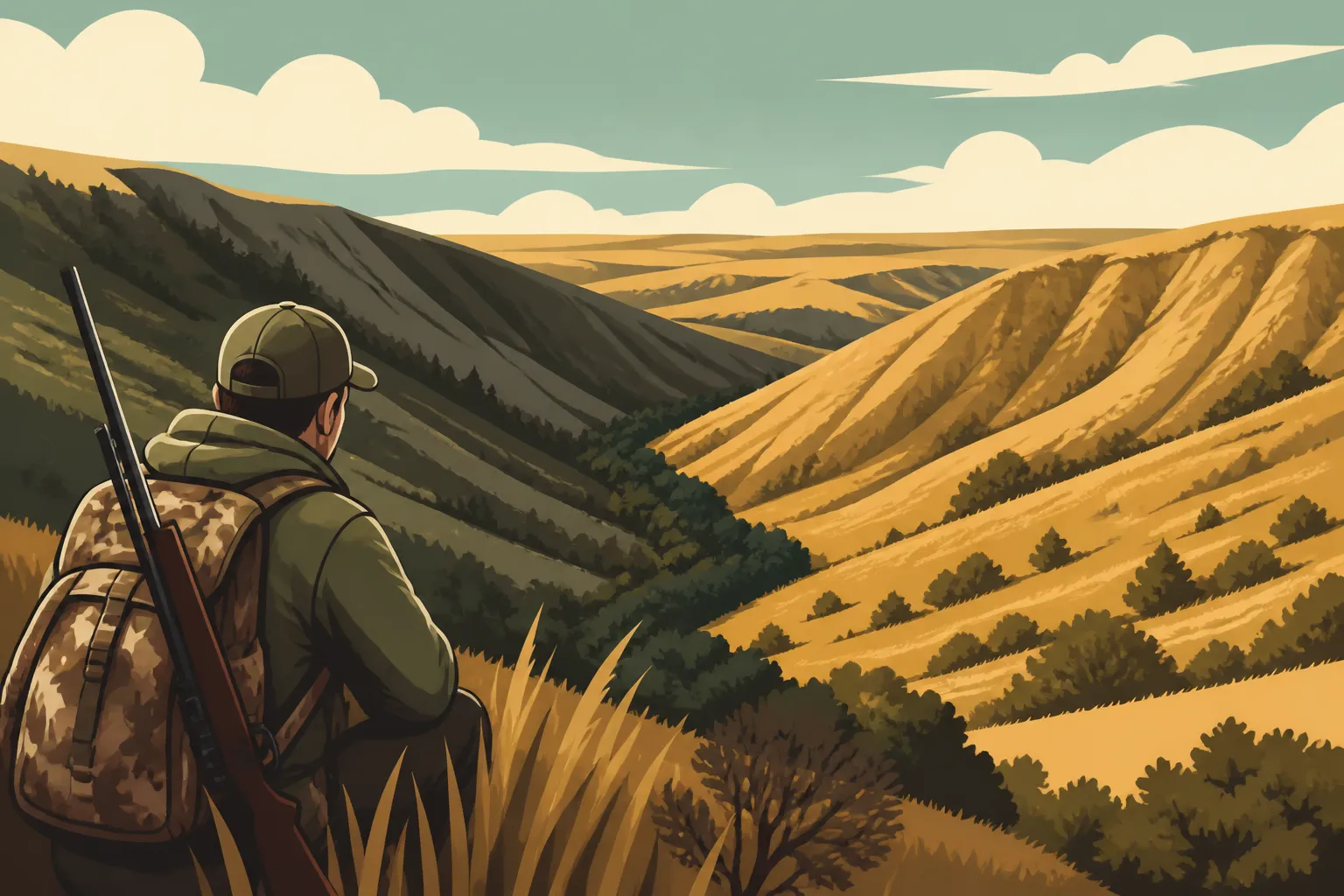
Another highly effective tactic, especially for mule deer that often prefer more open country, is spot-and-stalk. You might glass the coulee junction from a distant high point at first light or last light, identifying deer as they move through or bed down. Once you spot an animal, the challenge becomes using the coulee's terrain to your advantage for a silent approach. This requires patience, a keen eye for cover, and a deep understanding of wind direction, which can be tricky in the constantly shifting air currents of a coulee. Don't be afraid to take your time and circle wide if necessary to maintain a wind advantage. You can find more detail on this in Spot-and-Stalk Mule Deer in Alberta.
For whitetails, particularly during the rut, rattling and calling can be deadly in these natural funnels. The acoustics of a coulee can carry sound a long way, and the constricted movement paths mean a curious buck is more likely to investigate the source of the sound. Set up in a concealed location, often on the downwind side of the main travel corridor, and use rattling antlers or grunt tubes. The natural topography helps to reinforce the illusion of a fight or a breeding encounter, drawing bucks right into your shooting lane. You can learn more about this in Rattling and Calling Whitetails in Farm Country.
Scouting and Accessing Coulee Meet-Ups
Finding a promising coulee junction on a map is one thing; actually hunting it successfully requires meticulous scouting and careful access planning. Your pre-season work can make or break your hunt, so don't skip this crucial step.
Start your scouting long before the season opens. In late winter or early spring, after the snow has melted, is an excellent time to walk these coulee junctions. Deer sign—tracks, rubs, scrapes, and even shed antlers—will be much more visible without leaf litter or thick undergrowth. Look for heavily used game trails that converge at the junction. These are your deer highways. Pay attention to rub lines on smaller trees and saplings, which indicate dominant bucks using the area. Scrapes, particularly those made just before the rut, are also key indicators of buck activity. Reading Whitetail Sign in Alberta Aspen Bluffs can give you an edge in deciphering these clues.
When you're on the ground, think about how you will access the spot during hunting season. Can you approach it without alerting every deer in the area? Is there public land access, or will you need to secure Asking an Alberta Landowner for Permission? Use your mapping apps like onX Hunt or GoHunt to clearly identify property lines and potential access points. Many coulees run through a mix of Crown Land and private property, so knowing exactly where you stand is vital. Always err on the side of caution and gain permission if there's any doubt.
Consider placing trail cameras at key intersections during the off-season. This will give you invaluable information on deer movement patterns, timing, and even help you identify specific bucks using the area. Knowing if deer are moving through primarily at dawn, dusk, or even during midday will dictate your hunting schedule. A camera positioned on a well-used trail leading into the junction can provide a wealth of information about How Deep Snow Moves Deer Around.
Finally, minimize your disturbance. Deer are incredibly sensitive to human presence. Plan your entry and exit routes carefully, using natural cover and avoiding skylines. Try to only visit your chosen spot when wind conditions are favourable and when you intend to hunt. Over-pressuring a coulee junction can quickly turn a prime spot into a ghost town. Understanding how to manage your footprint is essential for long-term success in these high-value areas.
Disclaimer
This article is for general informational purposes only and does not constitute professional advice. Laws, prices and regulations vary by location and change over time. Consult a qualified professional for guidance on your specific situation.