Hunting a Prairie Coulee Bottom
There’s a unique challenge that many hunters face when the vast, flat expanse of the Alberta prairie suddenly drops into a network of hidden coulees. You might be glassing for miles, seeing nothing but stubble and distant fence lines, only to find yourself wondering where the heck all the deer are hiding. It can be incredibly frustrating to know game is present but feel like they’ve vanished into thin air. This guide is all about cracking that code, revealing the secrets to successfully hunting a prairie coulee bottom, and putting you in the prime position for success.
Understanding the Prairie Coulee Ecosystem
Prairie coulees are absolute lifelines in the often-harsh prairie environment. They’re not just ditches; they’re micro-ecosystems, offering everything a deer needs to survive and thrive. Understanding their unique characteristics is the first step to becoming a more effective hunter in these broken lands.
What Makes Coulees Prime Deer Habitat
Imagine a relentless Alberta winter wind whipping across an open field, or the scorching sun beating down in late summer. For deer, these conditions are brutal. Coulees, with their sheltered bottoms and sloping sides, offer immediate refuge. They act like natural windbreaks, providing crucial warmth in winter and cooling shade in summer. This topographical relief also traps snow, which can melt slowly and provide essential water sources long after other surface water has dried up.
Beyond mere shelter, coulees are also magnets for diverse vegetation. While the surrounding prairie might be monoculture crop fields or sparse grasslands, coulee bottoms often host a mix of shrubs like willow and saskatoon, taller grasses, and even small stands of aspen or balsam poplar in deeper cuts. This varied plant life means a constant supply of browse and forage throughout the year, making coulees a deer’s primary grocery store. The density of this vegetation also provides excellent cover, allowing deer to move, bed, and feel secure, often within yards of open fields.
Common Game Species Found in Coulee Bottoms
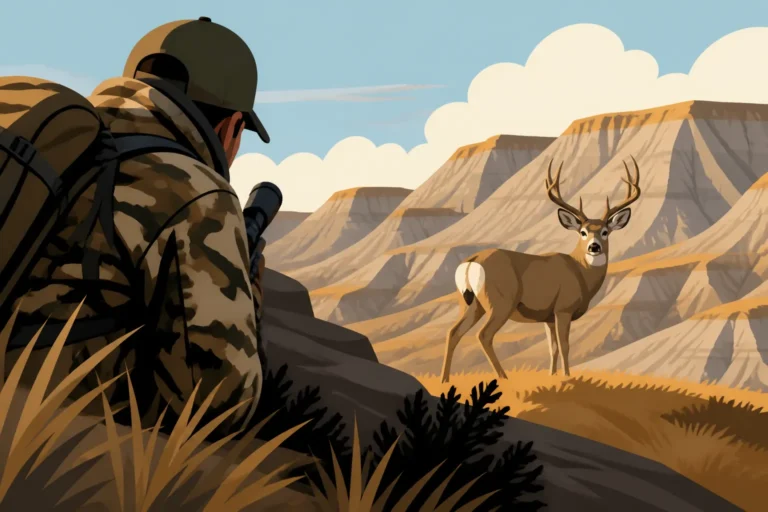
While both white-tailed deer and mule deer frequent coulees, their preferences and how they utilize these habitats can differ slightly. Mule deer are often the kings of the deeper, more rugged coulees, especially those with good escape routes up steep slopes. They are masters of using broken terrain to their advantage, often bedding high on a coulee side where they can observe their surroundings. You'll often find them working their way down to the bottom for water or to browse on the richer vegetation. To learn more about targeting these majestic animals, check out our guide on Mule Deer Hunting Alberta's Prairie and Badlands.
Whitetails, on the other hand, might stick more to coulees that offer denser timber pockets or thicker brush, especially those that connect to larger bluffs or river systems. They love the security of thick cover, and a brushy coulee bottom provides exactly that. During the rut, these coulees become major travel corridors for bucks cruising for does. But it's not just deer; you'll also find plenty of other wildlife. Coyotes frequently patrol coulee bottoms, following deer trails and looking for small game. During specific seasons, game birds like Hungarian partridge or sharp-tailed grouse might also seek shelter in the dense cover of a coulee.
Seasonal Changes and Animal Movement
The way deer use coulees shifts dramatically with the seasons, and understanding this can be your biggest asset. In the mild days of early archery season, deer might be spread out, utilizing coulees but also feeding heavily in adjacent crop fields. As the weather cools and rifle season approaches, and especially as the rut kicks in, coulees become major highways. Bucks will travel these protected corridors, scent checking and laying down sign. This is when understanding Hunting the Rut in Early November can pay huge dividends.
As deep winter sets in, and the snow piles up, coulees become critical wintering grounds. The sheltered bottoms offer a respite from blizzards, and deer will conserve energy by staying put, relying on the browse within the coulee itself. Identifying Where Alberta Whitetails Bed in Deep Snow within these coulees is key to late-season success. However, be mindful that these are vital survival areas for deer, and excessive pressure can be detrimental to wintering herds. Understanding these seasonal shifts allows you to adapt your hunting strategy, choosing the right coulee at the right time.
Scouting and Reading the Coulee
Successfully hunting a prairie coulee isn't about aimlessly wandering; it's about meticulous preparation and keen observation. Just like reading a book, you need to learn how to read the subtle clues the deer leave behind and understand the natural forces at play.
Pre-Season Scouting Strategies
Long before opening day, your scouting efforts begin at home. Start with high-quality topographical maps and satellite imagery. Tools like GoHunt mapping layers can reveal the intricate network of coulees, distinguishing between shallow depressions and deep, timbered cuts. Look for where several coulees converge, areas where coulees meet a river system, or where they funnel down to a single crossing point. These are often high-traffic zones. Pay attention to fence lines, water sources, and adjacent crop fields (especially standing corn or peas) that provide food and cover. Our article on Scouting With Satellite Imagery in Alberta delves deeper into these digital tactics.
Once you’ve identified promising areas from your armchair, it's time for boots on the ground. During the off-season or well before hunting pressure starts, walk these coulees. Look for old rub lines, established trails, and potential bedding areas. These early season trips allow you to learn the lay of the land without disturbing game. Take photos, drop pins on your GPS or GoHunt app, and note potential ambush spots or vantage points for glassing. This intimate knowledge of the terrain will be invaluable when the season opens. Remember to always respect private land boundaries and seek permission when necessary.
Interpreting Deer Sign in Coulee Bottoms
When you're actually in a coulee, every broken branch, every disturbed leaf, tells a story. Fresh deer trails are often worn smooth, distinct from game trails used by smaller animals. Look for tracks – paying attention to their freshness, direction of travel, and size can give you an idea of what animals are using the coulee and when. During the rut, rubs and scrapes are your goldmine. Rubs, where bucks strip bark from trees, indicate their presence and can show their travel routes. Scrapes, patches of bare earth with an overhead licking branch, are communication hubs for deer. Freshly pawed earth, strong urine smell, and recent chew marks on the licking branch are all indicators of active deer.
Bedding areas in coulees are usually found in spots that offer security, thermal protection, and a good vantage point. Look for flattened grass or depressions in the snow, often on a slight rise or against a thicket, giving the deer cover while allowing them to see or smell approaching danger. Feeding zones will be identified by browsed plants – fresh bites on willows or saskatoons, or deer droppings. Learning to differentiate old sign from fresh is paramount. A good rule of thumb: if it looks like it happened within the last 24-48 hours, it's worth investigating further.
Wind and Thermals in Broken Terrain
Understanding wind and thermals is perhaps the most critical, yet often overlooked, aspect of hunting coulees. In open prairie, wind direction is usually straightforward, but in broken terrain, it can swirl and eddy, carrying your scent in unpredictable ways. This is especially true in coulee bottoms where the wind can be funneled, blocked, or even reversed by the topography. Early in the morning, as the sun begins to warm the earth, thermals will typically rise, carrying scent upwards out of the coulee. In the evening, as the air cools, thermals will reverse and sink, drawing scent down into the coulee bottom.
Always consider these shifts when planning your approach. On a morning hunt, you might want to hunt from the top down, letting the rising thermals carry your scent away. In the evening, hunting from the bottom up could be more effective. Checking the wind constantly with a small puffer bottle or milkweed seeds is essential. Don’t just rely on a weather app for general wind direction; the micro-currents within a coulee can be entirely different. Misjudging the wind can blow your hunt before you even get close. For more general advice on dealing with atmospheric conditions, read up on Wind in Open Prairie Country.
Hunting Techniques for Coulee Bottoms
Once you've done your homework, it's time to put a plan into action. Coulees offer a variety of hunting opportunities, from solitary spot-and-stalk adventures to collaborative pushes with a group. Choosing the right technique for the specific coulee and your hunting style is crucial.
Spot-and-Stalk in Open Coulees
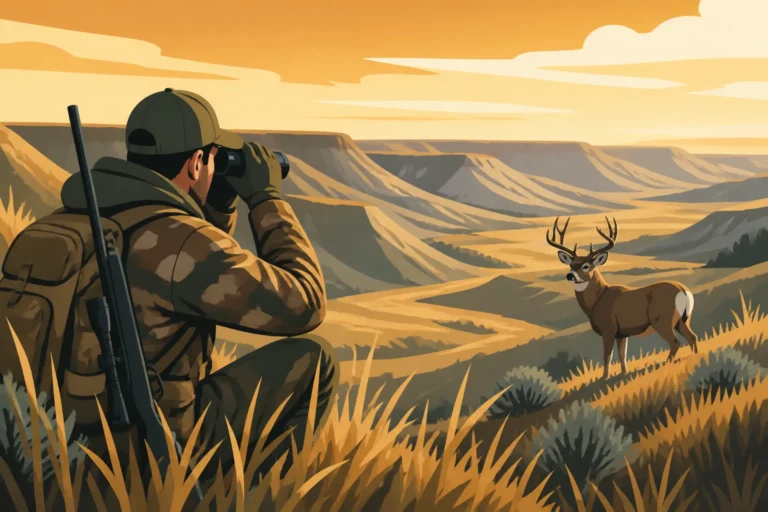
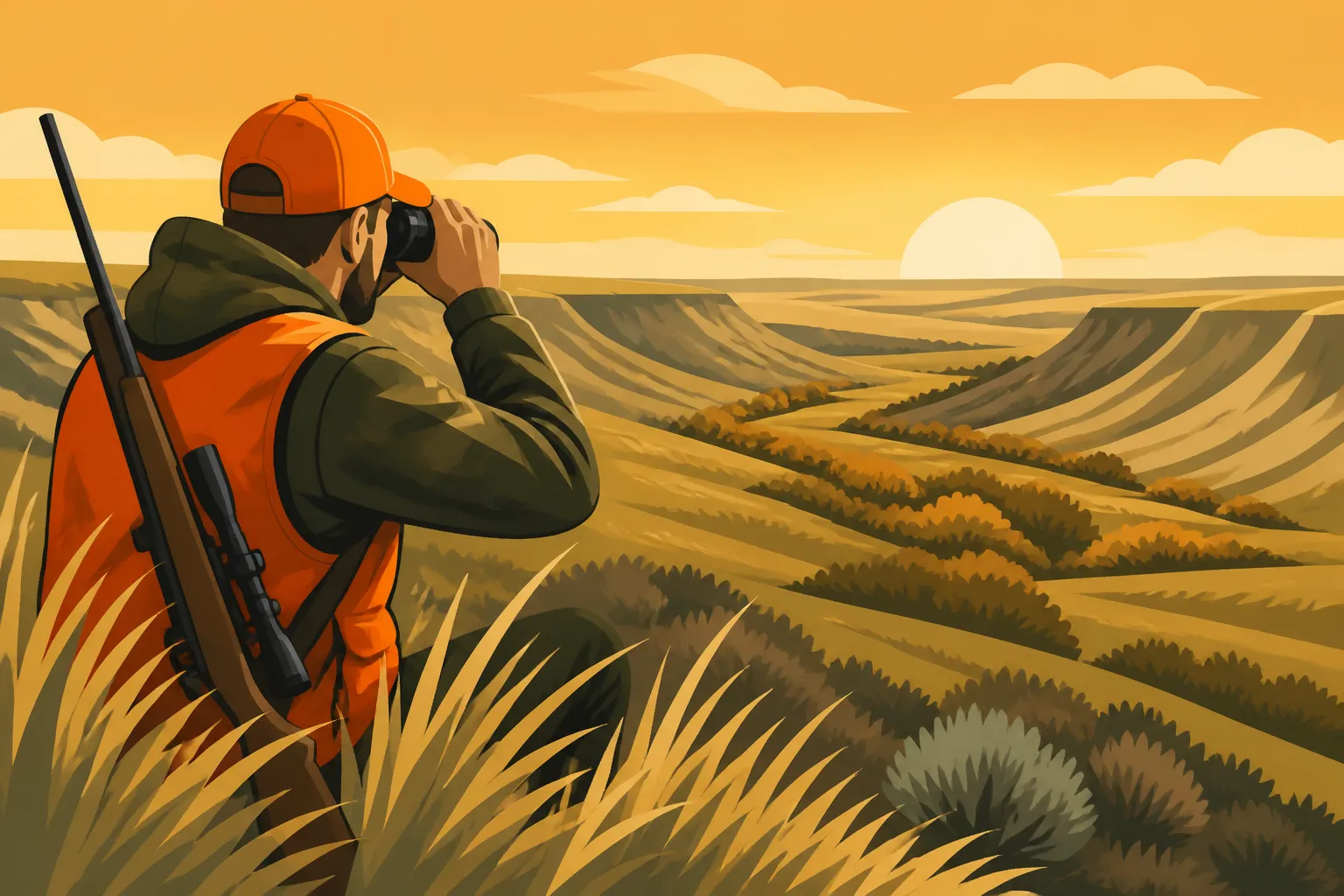
Spot-and-stalk hunting is incredibly rewarding in prairie coulees, especially for mule deer that often bed in more open, higher spots. The key is to use the terrain to your advantage. Start by getting to a high vantage point – a prairie ridge, a high point on the coulee rim, or even the top of a grain bin if you have permission – well before daylight. Use high-quality optics, like a good pair of 10×42 binoculars or a spotting scope, to meticulously glass every shadow, every cluster of brush, and every potential bedding area. Take your time; deer often blend in seamlessly. Our article on Glassing an Alberta Coulee for Mule Deer offers more detailed tips.
Once you spot an animal, the real work begins. Plan your stalk carefully, using the coulee's folds, benches, and vegetation for cover. Move slowly, deliberately, and always pay attention to the wind. Sometimes, a successful stalk might mean a long, circuitous route to get into position. You might have to belly crawl through stubble or use a slight rise for concealment. Patience is key. If the deer is bedded, observe its patterns. Does it stand up periodically to stretch or browse? Is there a time when it’s distracted? Wait for the opportune moment, often when the deer is feeding or looking away, to make your final approach and take your shot. This method can be challenging, but the satisfaction of a successful stalk is unmatched.
Stand Hunting and Ambush Points
Not all coulees lend themselves to spot-and-stalk. If a coulee is heavily timbered, particularly winding, or sees consistent deer movement along specific pathways, a well-placed stand or ground blind can be incredibly effective. Look for natural funnels – places where the coulee narrows, forcing deer into a smaller corridor. These might be tight bends, pinch points where a piece of timber extends into the coulee bottom, or crossings where deer move between feeding areas and bedding cover. Focus on areas where multiple trails converge.
When setting up, consider prevailing winds and thermals. Your stand or blind should be positioned downwind of the expected deer travel path. A mature buck might only present a shot for a brief window as it cruises through, so having clear shooting lanes is essential. Ground blinds can be particularly effective in brushy coulee bottoms, offering concealment and scent containment. Set them up well in advance if possible, allowing deer to get accustomed to their presence. For whitetails, specifically, understanding Hanging a Stand on an Alberta Bush Edge can provide valuable insights, even if it's applied to the edge of a coulee.
Driving and Pushing Coulees
For larger, complex coulee systems, or when hunting with a group, a well-executed drive or push can be an excellent strategy. This involves a combination of "pushers" who slowly walk through the coulee, and "blockers" or "standers" who position themselves at known escape routes or pinch points. Communication is absolutely critical for safety and success. Everyone involved needs to know the plan, the boundaries of the push, and clear safety zones for shooting.
The pushers should move slowly and deliberately, trying to funnel deer towards the standers. They shouldn't be running or making excessive noise, but rather moving at a pace that allows deer to get up and move ahead naturally, rather than bolting. Standers should be concealed and ready, focusing on areas where deer are likely to cross or pause before exiting the coulee. This could be a low saddle, a gap in a fence line, or a well-used trail leading to another piece of cover. This method is particularly effective in late season or when deer are holding tight in thick cover. Always ensure all participants are aware of all safety protocols and regulations for group hunting.
Essential Gear and Safety Considerations
Hunting in Alberta’s prairie coulees, while immensely rewarding, comes with its own set of challenges. Being properly equipped and prepared for anything the unpredictable prairie weather throws your way is paramount, not just for success, but for your safety.
Optics, Footwear, and Clothing
Good optics are non-negotiable for coulee hunting. A quality pair of 10x or 12x binoculars is your best friend for long-range glassing from a coulee rim, helping you pick out that subtle ear twitch or flick of a tail against a drab background. If you plan on doing a lot of spot-and-stalk, especially for mule deer, a spotting scope can save you countless steps and help you judge animals from a distance without putting pressure on them.
Your feet will take a beating traversing steep coulee sides, slippery bottoms, and potentially frozen ground. Invest in sturdy, comfortable, waterproof boots with good ankle support. Nothing ruins a hunt faster than sore, wet feet. For clothing, layers are key. Alberta weather can swing wildly, from crisp, sunny mornings to biting winds and sudden snow squalls in a matter of hours. Start with a moisture-wicking base layer, add insulating layers like fleece or down, and top it off with a quiet, windproof, and waterproof outer shell. Blaze orange requirements are also vital for safety, particularly during rifle seasons or when hunting with a group.
Navigation and Communication
Getting turned around in a maze of coulees can happen surprisingly easily, especially if the weather rolls in. A reliable GPS unit or a smartphone with a hunting app like GoHunt, loaded with your pre-scouted waypoints and property boundaries, is absolutely essential. Don't rely solely on your phone; always carry a physical map and compass as a backup, and know how to use them. Mark your truck, key coulee entrances, and any property lines you need to be aware of. To enhance your navigation skills, consider Reading an Alberta WMU Map Before You Go.
Cell service can be spotty or non-existent in many coulee bottoms, especially in the deeper cuts. For emergencies, a satellite messenger or personal locator beacon (PLB) is a wise investment, allowing you to call for help even without cell signal. Always tell someone back home your hunting plan, including your route, where you’ll be hunting, and when you expect to return. This simple step can be a lifesaver if you run into trouble.
Weather Preparedness and Emergency Planning
Alberta’s prairie weather is notorious for its sudden changes. A mild autumn day can quickly turn into a full-blown blizzard. Always check the forecast, but be prepared for the unexpected. Carry extra layers, even if you don't think you'll need them. A small backpack with essentials like a fire starter, emergency blanket, basic first-aid kit, high-energy snacks, and extra water can make a huge difference if you get stuck or stranded. This is particularly crucial if you are Hunting Alberta Winter Weather Safely.
If you're hunting alone, be extra cautious. Avoid taking unnecessary risks, especially when traversing steep or slippery terrain. If you get an animal down late in the day, especially in cold weather, prioritize getting yourself and the meat out safely. Having a plan for Field Dressing in Alberta's Deep Cold and getting your animal out of a remote coulee is part of being a responsible hunter. Always think about "what if" scenarios before you head out, and pack accordingly.
Disclaimer
Hunting is an inherently risky activity. The information provided in this guide is for informational purposes only and should not be considered a substitute for professional training, official regulations, or personal judgment. Always prioritize safety, adhere to all local, provincial, and federal hunting laws and regulations, and obtain appropriate licenses and permissions before hunting. The author and publisher are not responsible for any accidents, injuries, or legal issues that may arise from the use of this information.