Rattling and Calling Whitetails in Farm Country
There’s nothing quite as frustrating as sitting patiently in your stand or blind, watching deer ghosts flit through the distant tree lines, and feeling completely helpless to bring them closer. You know those big Alberta whitetails are around, especially in farm country where cover can be sparse and their movements feel predictable, yet out of reach. This comprehensive guide is dedicated to demystifying the art of rattling and calling whitetails, specifically tailored for the unique challenges and opportunities found in Alberta’s agricultural landscapes.
Understanding Whitetail Behavior in Alberta Farm Country
Hunting whitetails in Alberta's vast farm country can be a completely different ballgame than tackling dense bush or mountain foothills. Here, deer often live by a different rulebook, adapting to the open spaces, abundant food sources, and sporadic patches of cover that define these agricultural zones. To effectively rattle and call them in, you first need a solid grasp of how these specific whitetails operate, their daily routines, and the social cues that drive their responses.
Daily Movements and Habitat Use in Open Terrain
In Alberta's farm country, whitetails have an almost uncanny ability to vanish into what seems like minimal cover. Their daily movements are heavily dictated by the distribution of food, water, and bedding areas. During the early morning and late evening, you'll often find them transitioning between bedding cover – which could be a small aspen bluff, a willow run along a creek, or even a thick shelterbelt – and their feeding grounds in stubble fields, standing canola, or freshly cut hay. The wide-open nature of these landscapes means deer are constantly on alert. They might travel significant distances across open fields under the cover of darkness or use the slightest dip in topography to remain unseen.
One of the biggest frustrations for hunters is watching deer filter out of a distant bluff, only to disappear into another one before they're ever within range. That's why understanding their travel corridors is crucial. Look for well-worn trails leading from heavier cover to feeding areas, especially those that follow natural contours, fence lines, or drainages. These are the arteries of deer movement in farm country, and positioning yourself along one can be far more effective than just picking a random field edge. During the middle of the day, particularly during the rut, bucks might be actively cruising these same corridors, looking for does, making them prime spots for a strategic calling sequence.
Social Structure and Communication in Farm Deer Herds
Alberta's farm country whitetails maintain a complex social structure, especially within their family groups and during the breeding season. Does live in matriarchal groups, often with their fawns and yearling offspring. Bucks, outside of the rut, typically form bachelor groups, but as soon as the hormones start flowing, these groups disband, and a more aggressive, competitive hierarchy takes over. This social dynamic is precisely what makes rattling and calling so effective. You're essentially tapping into their innate need to communicate, assert dominance, or locate a potential mate.
Understanding the "mood" of the deer herd at any given time is paramount. Are you hearing natural deer vocalizations? Are there fresh rubs and scrapes indicating active buck sign? If you're seeing small bucks chasing does, but not the big mature ones, it might suggest the peak of the rut is still a little way off, or that the dominant bucks are busy with other does. GoHunt and similar mapping tools can be invaluable for identifying potential bedding areas and travel corridors, helping you visualize how deer might move and interact across larger tracts of land, even before you step foot in the field. This insight helps you tailor your calling strategy, whether you're trying to simulate a territorial challenge or a doe in estrus.
The Art of Rattling Antlers for Alberta Whitetails
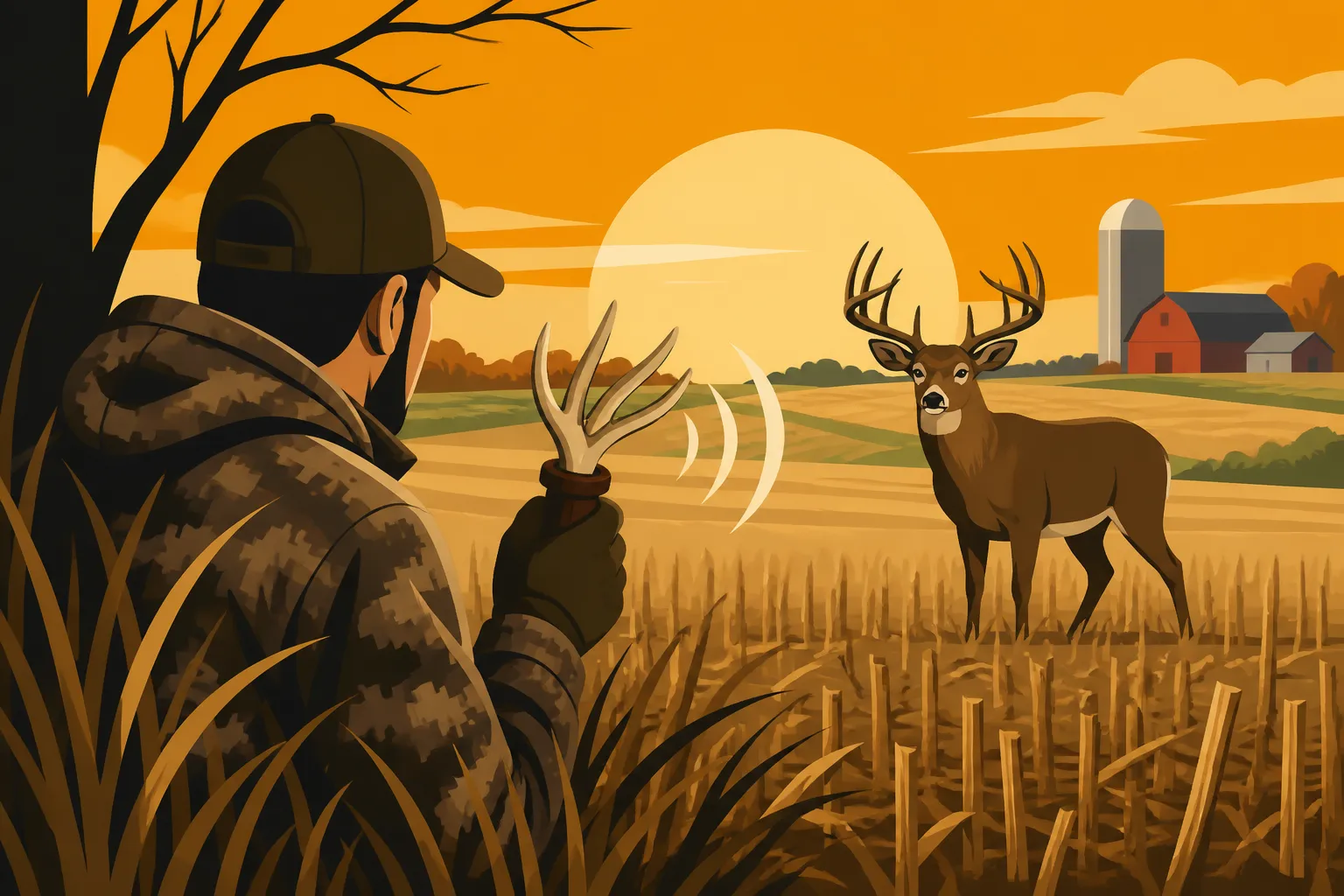
Rattling is one of the most exciting and effective tactics for calling in whitetails, particularly during the rut. It's an aggressive strategy that seeks to mimic the sound of two bucks fighting, tapping into the competitive nature of whitetails and often provoking an investigation. But rattling in farm country comes with its own set of nuances that you need to master.
Choosing the Right Rattle Strategy: Aggressive vs. Subtle
The key to successful rattling is knowing when to go all-out and when to hold back. In Alberta's farm country, where visibility can be extensive, an overly aggressive rattling sequence at the wrong time might just spook deer, sending them scampering across open fields.
-
Aggressive Rattling: This is your go-to during the peak of the rut, especially when you suspect a dominant buck is in the area or when you've seen bucks sparring. Start with light sparring, then build into a full-blown, violent clash of antlers. Think broken branches, grunts, and heavy breathing. This sequence is meant to convey a serious fight, suggesting a rival buck is either defending territory or a hot doe. After a minute or two of intense rattling, go completely silent for 5-10 minutes, listening intently for approaching deer. Then repeat the sequence, perhaps softening it a bit. The long silent periods are crucial; deer will often approach cautiously, trying to pinpoint the source of the commotion before committing. You might be surprised how often a buck appears from an unexpected direction during these quiet phases. When thinking about Rattling Volume in Open Parkland, remember sound carries far.
-
Subtle Rattling: Early in the season, or if the rut isn't in full swing, a softer approach is usually better. Mimic light sparring, like two young bucks testing each other, or the sounds of a buck raking a tree branch. This can pique curiosity without immediately alarming deer. Sometimes, simply ticking antlers together, or rubbing them against a small sapling, can be enough to draw a response from a cautious buck. This softer approach is also good if you're hunting in areas with less cover or if you've had little success with aggressive sequences. It's all about reading the mood of the deer and the time of year.
When and Where to Rattle in Farm Country
Timing and location are absolutely critical for rattling success in farm country. You can have the best rattling sequence in the world, but if you're rattling in the wrong place at the wrong time, you'll be met with silence.
-
Timing: The peak of the rut, typically from late October through mid-November in Alberta, is prime time for aggressive rattling. This is when bucks are most competitive and looking for a fight. However, don't discount the pre-rut (early October) and even the post-rut (late November) for more subtle rattling. During the pre-rut, bucks are establishing dominance and light sparring is common. In the post-rut, lone bucks might respond out of curiosity or a lingering desire to find any last receptive does. Early morning and late afternoon are generally the best times, as this is when deer are most active. Overcast, drizzly days can also be excellent, as they often reduce human activity and deer feel more secure moving.
-
Location: In farm country, concentrate your rattling efforts around known travel corridors, edges of thick cover (like shelterbelts, bush pockets, or river bottoms), and especially near scrapes and rubs. These are areas where bucks are naturally asserting their presence and are more likely to respond to a challenge. Consider the wind direction carefully; you want your scent to blow away from where you expect deer to approach, and the rattling sounds to carry into their suspected bedding areas. Setting up on a knoll or a rise overlooking a field, with cover at your back, can give you good visibility while still allowing you to conceal your movements. If you’re hunting a specific feature like Hunting a Shelterbelt Between Two Fields, that’s an ideal rattling location as deer will use it for travel and cover.
| Rattling Strategy | Time of Season | Deer Activity | Approach | Expected Response |
|---|---|---|---|---|
| Aggressive | Peak Rut | Bucks actively chasing, sparring, establishing dominance | Loud, violent clashes, grunts, pauses (5-10 min) | Dominant bucks approaching aggressively |
| Subtle/Light | Pre-Rut, Post-Rut | Bucks exploring, light sparring, curiosity | Ticking antlers, light rubbing, short sequences, soft grunts | Cautious investigation, curiosity |
| Raking | Early Rut | Bucks marking territory, fresh rubs | Rubbing antlers on small saplings, breaking branches, light grunts | Curiosity, territorial investigation |
Mastering Whitetail Vocalizations: Grunts, Snorts, and Bleats
Beyond rattling, understanding and mimicking whitetail vocalizations can be incredibly effective, often working in situations where rattling might be too aggressive or simply not drawing a response. These calls tap into different aspects of a whitetail’s communication, from social interactions to breeding cues.
The Power of the Grunt Call
The grunt call is arguably the most versatile and important call in a whitetail hunter's arsenal. Bucks, does, and even fawns make various grunts, each conveying a different message. In farm country, where deer might be spread out, a well-placed grunt can carry a long way and get a buck's attention.
-
Buck Grunts: These are typically low-pitched, guttural sounds. A "trailing grunt" is a series of short, soft grunts made by a buck trailing a hot doe. This call often works well to pique the curiosity of other bucks or even bring a lone doe closer. A more aggressive "assertive grunt" is louder, deeper, and indicates a buck asserting dominance or challenging a rival. This often pairs perfectly with an aggressive rattling sequence. Finally, the "grunt-snort-wheeze" is the ultimate challenge call. It’s an unmistakable, aggressive vocalization that signals a buck is ready to fight. Use this sparingly and confidently when you see a buck at a distance that's not responding, or to finish off an aggressive rattling sequence. For more on this, check out Grunt Calls Late in Alberta's Rut.
-
Doe Grunts and Bleats: These calls are designed to attract bucks. A "doe bleat" is a soft, nasal sound, often used by a doe to communicate with her fawns. An "estrus bleat" or "bawl" is a longer, louder, and more pleading version, signaling a doe in heat. This can be incredibly effective during the rut, especially if you're not seeing much buck activity. It appeals to a buck’s primal urge to breed. Often, combining a few soft doe bleats with a subtle buck grunt can mimic a small deer interaction that a curious buck might investigate. You can find many different types of grunt calls on the market, from simple mouth calls to more complex tube calls, allowing you to vary pitch and volume.
The Snort-Wheeze and Other Communication Cues
While the grunt is a staple, other vocalizations can be game-changers in the right situation. Understanding these nuanced calls can greatly enhance your overall calling strategy.
-
The Snort-Wheeze: This is the sound of an angry, dominant buck issuing a direct challenge. It’s a three-part call: a short, sharp snort, followed by a long, drawn-out wheeze, and then often another short snort. As mentioned, it's an aggressive call and should be used with caution. It's usually best reserved for bucks you've spotted that are out of range or not responding to other calls, or immediately after an intense rattling session to challenge any approaching buck. The goal is to make him believe a rival buck is not just present, but spoiling for a fight.
-
Fawn Bleats: While primarily used to communicate distress or hunger to does, a fawn bleat can sometimes attract a curious doe or even a buck looking for a potential receptive doe in the vicinity. It’s a softer, higher-pitched bleat than an adult doe’s. Use it sparingly, perhaps if you’re trying to draw a doe closer for a more general hunting scenario, or to bring in a nervous doe that might have a buck trailing her. Be aware that it can also attract predators, so always be vigilant. The key to all these vocalizations is realism; practice different calls and volumes to ensure you're mimicking natural deer sounds, which can vary subtly depending on the specific subspecies of whitetail found in Alberta.
Strategic Setups and Decoy Use for Calling Success
Calling whitetails in open farm country presents unique challenges due to limited cover and expansive sightlines. Your setup location and how you incorporate decoys can make or break your success. It's not just about making the right sounds; it's about presenting a convincing visual and auditory scene.
Positioning for Optimal Sound and Visual Impact
In Alberta's farm country, deer have excellent eyesight and are acutely aware of their surroundings. You need to pick a setup that not only allows your calls to carry effectively but also provides you with concealment and a clear shot opportunity.
- Wind is King: Always, always, always hunt the wind. Your scent will carry much further in open country. Set up so the wind is blowing away from where you expect the deer to approach. This often means having the wind at your back or quartering away from your front.
- Cover and Backdrops: Even small patches of cover become invaluable. A thick shelterbelt, the edge of an aspen bluff, a draw or coulee, or even a large round bale can serve as a suitable backdrop. This cover helps break up your silhouette, conceals your movements, and allows deer to feel more comfortable approaching. Positioning yourself high enough to see, but with a natural background to disappear into, is key. Consider setting up where a deer might naturally stop to scent-check or assess the situation before exposing themselves fully.
- Controlling the Approach: Think about how a buck might approach your calls. They will almost always try to circle downwind to get your scent. Position yourself to intercept them before they can get directly downwind of your exact location. This might mean setting up 20-30 yards downwind of your decoy, or facing a dominant trail with the wind quartering to your side. The goal is to force them into a shooting lane as they try to get a better read on the situation. For spotting good ambush points, look at articles like Hunting a Cutline Intersection for Whitetails or Hunting a Willow Run in Farm Country.
Decoying Whitetails in Open Country
Decoys can be incredibly effective in farm country, adding a crucial visual element to your calling sequence. A well-placed decoy, especially during the rut, can act as a magnet, drawing a buck's attention away from you and providing a target for him to focus on.
- Types of Decoys:
- Buck Decoys: These are the most common for rattling and aggressive calling. A quarter-strut or full-strut buck decoy can challenge a dominant buck. Position it facing away from you, as if it's looking into the wind or staring down a doe, inviting an approaching buck to present a broadside shot as he circles to confront it.
- Doe Decoys: These are excellent for attracting bucks looking for a mate. They work well with estrus bleats or soft grunts. Position a doe decoy facing you, as if she's looking your way, inviting a buck to approach from behind her.
- Fawn Decoys: Less common for aggressive calling but can be useful to attract does or, occasionally, a buck curious about a small deer interaction.
- Decoy Placement: Place your decoy so that the wind carries your scent away from it, but allows the sound of your calls to travel towards it. Position it 20-30 yards from your stand or blind, ideally in an open area where it's highly visible. Ensure there are clear shooting lanes around it. Consider the sun's position – you want the sun at your back, illuminating the decoy and making it more visible, while keeping you in shadow. In open country, you might want to consider using a very realistic decoy, as deer will have ample time to scrutinize it. Companies like Montana Decoy offer lightweight, packable options that are great for covering ground in open fields.
- Scent and Movement: Always use deer scent on your decoy, especially estrus or dominant buck urine during the rut. This adds another layer of realism. If you have a decoy with a tail that moves in the wind, even better, as subtle movement can be a huge attractor. But be mindful of too much movement if it looks unnatural. GoHunt offers excellent resources on optimal decoy placement strategies for various terrain types, including open farm landscapes.
Timing Your Calls and Adapting to Conditions
Successful calling is as much about instinct and adaptation as it is about technique. No two days are the same, and what worked yesterday might fall flat today. Being able to read the conditions and adjust your calling strategy is a hallmark of a seasoned whitetail hunter in Alberta.
Reading the Deer and Environmental Cues
Deer are constantly communicating, even when they’re silent. Learning to interpret their body language and the environmental factors around you will tell you when to push the limits with your calls and when to hold back.
- Deer Body Language: When you see a buck, pay close attention to how he's behaving. Is he actively scent-checking, pacing, looking nervous, or aggressively making rubs? A buck with his hair bristled, walking stiff-legged, or grunting on his own is a prime candidate for an aggressive rattling or snort-wheeze sequence. A buck that’s casually feeding might respond better to a softer grunt or a doe bleat. If a buck stops and stares in your direction after a call, but doesn't commit, he's likely trying to pinpoint the source. That's when a soft follow-up grunt or bleat, or even a subtle antler tick, might just convince him to take a few more steps. Sometimes, a deer that simply stops and stares, ears rotating, might be confused, not necessarily alarmed. That’s your window to make a soft, reassuring call or a subtle rattle to draw them in.
- Weather and Wind: Wind is a huge factor in farm country. On calm days, sound travels far, but deer might be more skittish. On windy days, your calls might not carry as far, but the wind can also mask your movements and make deer less wary. Adjust your calling volume accordingly. Rain and snow can also affect deer activity. Often, deer move more before or after a weather front. Cold, crisp mornings, especially during the rut, are often ideal for aggressive calling, as deer are actively moving to stay warm and breed. After a fresh snowfall, deer movement often increases as they look for food, making it an excellent time to call them into Hunting a Standing Canola Field Edge or Hunting a Swathed Grain Field at Dusk.
Adapting Your Strategy for Different Rut Phases
The whitetail rut isn't a single event; it's a progression, and your calling tactics need to evolve with it. What works during the pre-rut will likely be less effective during the lockdown phase.
- Pre-Rut (Late September – Mid-October): Bucks are starting to feel the urge, rubbing trees, making scrapes, and establishing dominance. This is a great time for subtle rattling and light grunting to mimic sparring bucks or curious investigation. Bucks are still somewhat grouped up, but beginning to disperse. An occasional doe bleat can draw their attention if they are cruising. Focus on fresh Reading Whitetail Sign in Alberta Aspen Bluffs.
- Early Rut/Seeking Phase (Late October – Early November): Bucks are actively seeking does. Aggressive rattling and persistent grunting can be very effective now. Bucks are covering a lot of ground, looking for the first does to come into estrus. The grunt-snort-wheeze can work well if you spot a cruising buck from a distance. This is an ideal time for Hunting Alberta's November Whitetail Rut.
- Peak Rut/Chasing Phase (Mid-November): This is the most intense period. Bucks are relentlessly chasing and breeding does. Aggressive rattling and estrus bleats are your best bet. Bucks might come in quickly and aggressively, often ignoring safety. Don't be afraid to be loud and persistent. However, during the "lockdown" phase within the peak rut, bucks might be holed up with a receptive doe and less responsive to calls. If activity slows down, try a more subtle approach or target travel corridors for a buck looking for his next doe.
- Post-Rut (Late November – December): Buck activity drops off significantly. Some does may have a second estrus, but most breeding is done. Bucks are tired and focusing on replenishing energy. Subtle grunts and doe bleats might still pull in a lonely, tired buck, but aggressive tactics are usually less effective. This is when patience and targeting feeding areas become paramount. Sometimes, a simple Hanging a Stand on an Alberta Bush Edge near a food source and making soft calls can be productive.
Remember, every situation is unique. The true art of calling and rattling whitetails in Alberta’s farm country lies in your ability to adapt, observe, and learn from every encounter. Don't be discouraged by a lack of immediate response; sometimes, the deer are just playing hard to get, and the next call sequence might be the one that brings that big buck crashing in.
Disclaimer
Hunting involves inherent risks, and conditions in Alberta can be unpredictable. Always prioritize safety, follow all local, provincial, and federal hunting regulations, and ensure you have the necessary licenses and permits. This guide is for informational purposes only and does not endorse unsafe or illegal hunting practices. Always hunt ethically and respectfully.