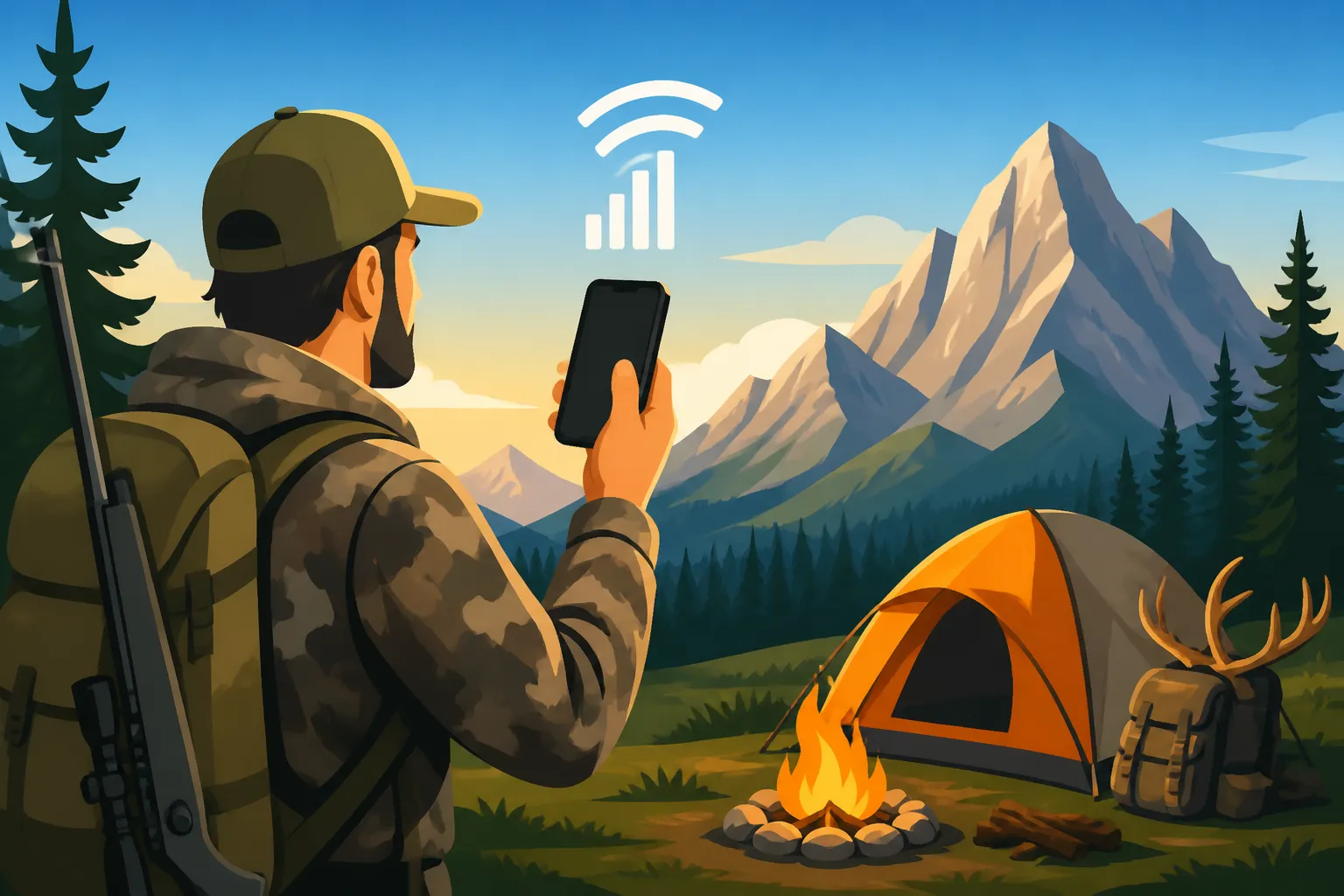
Cell Service in a Backcountry Camp
There’s nothing quite like heading deep into Alberta’s vast wilderness, away from the hustle and bustle, but let’s be honest, that feeling of isolation can turn to frustration pretty quickly when you realize your cell phone is just a fancy brick. Many of us head out expecting at least some spotty service, only to be met with constant "No Service" notifications, leaving us feeling disconnected and, frankly, a little uneasy. This guide is here to help you navigate the tricky world of cell service in Alberta’s backcountry camps, setting realistic expectations and exploring reliable communication alternatives to keep you safe and connected when it truly matters.
The Reality of Cell Service in Alberta's Backcountry
Stepping into Alberta's backcountry is an immersion into nature, but it often means leaving modern conveniences like reliable cell service behind. It's a rude awakening for many, especially those accustomed to constant connectivity. The vastness and ruggedness of our province simply aren't designed for seamless cell coverage.
Why Coverage Drops Off
When you drive away from towns and major highways in Alberta, you quickly enter areas where cell signal becomes a rare commodity. This isn't just bad luck; it's a combination of geography and infrastructure. Our incredible Rocky Mountains, the expansive Boreal Forest, and even the rolling foothills are natural signal blockers. Imagine a signal trying to bounce over towering peaks, dense timber, or deep river valleys – it’s just not going to happen reliably. Cell towers need line-of-sight to transmit signals effectively, and in broken, rugged terrain, that line-of-sight is constantly interrupted.
Beyond the natural barriers, there's the simple economics of it all. Cell providers build towers where there are enough people to justify the immense cost of installation and maintenance. In remote hunting zones, where a few dozen hunters might pass through each year, the financial incentive just isn't there to blanket the area with coverage. So, while you might get lucky with a tower near a small highway community, venturing even a few kilometers off the beaten path will likely put you in a cellular desert. This is a common challenge when you're Hunting Alberta's Mountain WMUs and Their Access or Hunting Alberta's Boreal Forest Country.
Understanding Coverage Maps
Most cell phone providers offer online coverage maps that show where their service is available. These maps can be helpful for a general overview, but they often present an optimistic picture that doesn't quite match reality in the backcountry. Think of them as a "best-case scenario" rather than a guaranteed signal. These maps are typically generated using theoretical models that don't account for every nuance of terrain, such as a localized dip in the land, a particularly dense stand of spruce, or even thick fog.
What might show as "fair" coverage on a map could, in practice, be non-existent once you're on the ground. A good rule of thumb is to assume that any shaded area showing "limited" or "spotty" coverage will likely be a complete dead zone in real-world conditions. Even areas marked "good" can be surprisingly unreliable, with signal strength fluctuating wildly based on your exact position, elevation, and even weather conditions. Relying solely on these maps for your backcountry communication plan is a recipe for disappointment and potential safety risks.
The Unexpected Dead Zones
One of the most frustrating aspects of backcountry cell service is encountering unexpected dead zones. You might have signal at your truck, at the trailhead, or even a few kilometers into your hike, only for it to vanish completely when you drop into a valley or step behind a ridge. These pockets are often not accurately depicted on coverage maps because they are hyper-local. I've been in camps where moving my phone three feet to the left or holding it at a certain angle made the difference between one bar and no service at all.
These dead zones become critical when you need to make a quick check-in call with family, confirm a hunting regulation, or, most importantly, signal for help. It’s not just about convenience; it’s about preparedness. Even if you briefly find a signal, don't assume it will last. Always treat any cell service in the deep backcountry as a bonus, not a given. It's why seasoned hunters always have a backup plan, particularly when Backpacking Into Alberta Sheep Country or exploring remote areas.
Managing Expectations for Communication
Before you even pack your bags for an Alberta backcountry hunt, it's crucial to adjust your mindset about communication. This isn't a trip to a resort where Wi-Fi is readily available. Embracing the disconnect is part of the experience, but doing so responsibly means planning for the moments when connection truly matters.
Prioritizing Essential Communication
In the backcountry, every ounce of battery life and every attempt to send a message needs to be strategic. Forget endless scrolling or casual chats. Your communication priorities should distill down to two main categories: emergencies and critical check-ins. An emergency, of course, means injury, getting lost, encountering dangerous wildlife, or severe weather that impacts safety. In these situations, getting a message out could be life-saving.
Critical check-ins are for family or friends who need to know you’re safe, or for coordinating logistics with your hunting party or guide. Perhaps you promised your spouse a daily text, or you need to confirm a rendezvous point with your hunting partners. These aren't frivolous calls; they provide peace of mind and ensure your absence doesn't cause unnecessary alarm. Any other communication is a luxury, not a necessity. This focus also helps manage battery life on devices that might get used for communication.
Preparing for a Disconnected Hunt
The best way to handle poor cell service is to assume you'll have none at all. Informing loved ones back home about your itinerary, expected return date, and what to do if they don't hear from you is paramount. Provide them with contact information for your hunting partners, your outfitter, or a local emergency contact if possible. Let them know not to expect regular updates and that "no news is good news." This proactive communication reduces anxiety for everyone involved.
For your hunting party, establish clear communication protocols before you even leave cell range. What's the plan if someone gets separated? What's the schedule for group check-ins? Who carries the emergency communication device, and does everyone know how to use it? These aren’t conversations to have while fumbling for signal in the dark; they should happen around a kitchen table or campfire well in advance. Understanding these contingencies is vital, especially when dealing with the vastness of Alberta's Wildlife Management Units.
Mental Prep for Being Off-Grid
Let's face it, we live in a hyper-connected world, and unplugging can feel unsettling at first. There's an initial urge to check your phone, to scroll, to see what you're missing. But a backcountry hunt is an opportunity to truly disconnect, to immerse yourself in the natural world without the constant distractions of notifications and emails. Mentally prepare yourself for this digital detox. Embrace the quiet. Enjoy the focus it brings to your hunting and the companionship of your fellow hunters.
Think of it as a forced vacation from technology. The initial discomfort will likely give way to a sense of freedom and heightened awareness of your surroundings. This mental shift isn't just about coping; it's about enhancing your entire hunting experience. By accepting that your phone might be useless, you free yourself to fully engage with the wilderness, honing your skills and deepening your appreciation for the challenge of the hunt. This mindful approach can even lead to better scouting and decision-making, whether you're Hunting a Frozen Slough Crossing or patiently Glassing an Alberta Coulee for Mule Deer.
Alternative Communication Methods in the Backcountry
Since relying on cell service is generally a lost cause in Alberta's remote hunting areas, having reliable alternative communication methods isn't just a good idea—it's a critical safety measure. These tools can literally be the difference between a minor inconvenience and a life-threatening situation.
Satellite Messengers and Phones
For reliable communication beyond cell range, satellite devices are your best friend. These devices connect directly to satellites orbiting the Earth, allowing you to send messages or make calls from virtually anywhere with a clear view of the sky.
Satellite Messengers: These are typically smaller, lighter, and more affordable than full satellite phones. Devices like Garmin inReach or Zoleo offer two-way text messaging, GPS tracking, and most importantly, an SOS function that connects you directly to emergency services. You can send predefined messages to contacts, share your location, and even receive weather updates. They operate on a subscription plan, which is an ongoing cost, but the peace of mind they offer is invaluable. They're perfect for hunters who want to stay in touch with family (e.g., sending an "I'm okay" message daily) and have a robust emergency backup. Their battery life is also generally very good, lasting for days or even weeks depending on usage.
Satellite Phones: For more extensive communication, a satellite phone provides voice call capabilities in addition to messaging. These are typically larger, more expensive to purchase, and have higher subscription costs and per-minute usage fees. However, if you need to have detailed conversations with an outfitter, coordinate complex logistics, or speak directly with emergency personnel, a satellite phone offers that capability. They are often favored by professional guides or those on extended, highly remote trips.
When considering a satellite device, think about your specific needs. Do you just need to send short "I'm okay" texts and have an SOS button? A messenger is likely sufficient. Do you need to make actual phone calls? Then a satellite phone is your choice. Both require a clear view of the sky, so dense forest or deep canyons can still obstruct their signal, but they are infinitely more reliable than cell service. This kind of planning is essential for any hunter venturing into the deep wilderness, particularly when considering Emergency Plans in Alberta's Backcountry.
Two-Way Radios and Walkie-Talkies
While satellite devices connect you to the outside world, two-way radios (often called walkie-talkies) are fantastic for intra-party communication. If you're hunting with a partner or a group, these devices allow you to stay in touch over short to medium distances without needing any external network. This is incredibly useful for coordinating movements, sharing observations about game, or simply checking in if someone separates to still-hunt a ridge.
There are different types of radios, from basic FRS (Family Radio Service) units with a range of a few kilometers in ideal conditions, to more powerful GMRS (General Mobile Radio Service) radios (which might require a license) or even professional-grade VHF/UHF radios used by outfitters, which can offer greater range and clarity. For most hunting groups, a good set of FRS/GMRS radios will suffice. Look for models that are rugged, waterproof, and have decent battery life.
The key to using these effectively is to understand their limitations. Terrain, especially thick bush and hills, significantly reduces their effective range. Always test your radios before leaving cell service, and establish clear call signs and communication protocols with your group. They're not for contacting help from home, but they are invaluable for internal group safety and coordination. This is especially true when you are working as a team, such as for Bugling Elk in Alberta's Foothills or attempting to call in a bull during Calling Moose in Alberta's Boreal Forest.
Emergency Beacons (PLBs, SPOT)
For situations where all other communication fails, or if you find yourself alone in a dire emergency, a Personal Locator Beacon (PLB) or a SPOT device can be a lifesaver. These devices are designed for one primary purpose: to send an emergency signal to rescue authorities.
PLBs (Personal Locator Beacons): These are purely emergency devices. When activated, they transmit a distress signal to a satellite system (Cospas-Sarsat) that is monitored by international rescue coordination centers. They provide your exact location to rescuers. PLBs typically require registration, and once activated, they initiate a full-scale rescue operation. They have no messaging capabilities; they are purely for "mayday" situations. They are incredibly reliable and have a long battery life in emergency mode, often transmitting for 24-48 hours.
SPOT Devices: Similar to PLBs in their emergency function, many SPOT devices also offer a limited "OK" or "Custom Message" function that allows you to send a pre-programmed message to contacts, often along with your GPS coordinates. This is a step up from a pure PLB if you want some non-emergency messaging capability, but their primary strength remains their SOS button for emergencies. Like satellite messengers, they often require a subscription plan.
Both PLBs and SPOT devices are essential additions to any hunter's backcountry safety kit, especially if you venture out alone or into truly remote areas. They should be considered a last resort, activated only when you genuinely need emergency assistance. Knowing you have that lifeline can provide immense peace of mind.
Here's a quick comparison of communication methods for Alberta's backcountry:
| Method | Best Use Case | Range/Connectivity | Pros | Cons |
|---|---|---|---|---|
| Cell Phone | Near towns, major highways, known coverage spots | Limited; line-of-sight | Convenient, multi-functional, no extra cost (if already have plan) | Almost useless in true backcountry, unreliable |
| Satellite Messenger | External messaging, GPS tracking, SOS | Global (with clear sky) | Two-way texting, location sharing, dedicated SOS button | Subscription cost, no voice calls, requires clear sky |
| Satellite Phone | External voice calls, messaging, SOS | Global (with clear sky) | Voice communication, comprehensive, dedicated SOS button | High cost (device & subscription), bulky, requires clear sky |
| Two-Way Radio | Intra-group communication, short-range coordination | Short-medium (terrain dependent) | No subscription, instant group comms, rugged | Limited range, no external contact, battery dependent |
| PLB / SPOT Device | Emergency SOS signaling (last resort) | Global (PLB), Near-global (SPOT) | Life-saving emergency signal, highly reliable, compact | Purely emergency (PLB), subscription (SPOT), no casual comms |
The key takeaway for any Alberta hunter is that while cell service is likely a bust in the backcountry, there are excellent, reliable alternatives available. Investing in one of these devices, understanding its operation, and having a communication plan are just as vital as having your rifle, bow, or a good pair of boots when heading into the wilderness. Whether you're planning for Alberta Hunting Licences and What They Cost or preparing for Hunting Alberta Winter Weather Safely, good communication is part of a responsible hunt.
Disclaimer
This article is for general informational purposes only and does not constitute professional advice. Laws, prices and regulations vary by location and change over time. Consult a qualified professional for guidance on your specific situation.