Booking an Alberta Hunt for a Group
Planning a hunting trip to Alberta with a group of friends or family can seem like a logistical nightmare, right? Between coordinating everyone's schedules, finding an outfitter or land that can accommodate multiple hunters, and making sure everyone's on the same page about what kind of hunt they're even looking for, it's enough to make you consider going solo. But there's something truly special about sharing the highs and lows of the hunt with your crew. This guide is going to walk you through everything you need to consider to make booking an Alberta group hunt a smooth, successful, and memorable experience for everyone involved.
The Unique Dynamics of Group Hunting in Alberta
Let's face it, hunting solo has its merits – total freedom, no compromises on your schedule or preferred species, and absolute peace and quiet. But bringing a group into the mix, especially in a diverse hunting landscape like Alberta, introduces a whole new set of considerations. It's not just about more gear or bigger tents; it's about managing expectations, coordinating logistics, and ensuring everyone feels valued and enjoys the experience.
Benefits and Challenges of Hunting with a Crew
When you decide to tackle an Alberta hunting adventure with your buddies or family, you're signing up for an experience that's rich in camaraderie and shared memories. But it's also important to be realistic about the potential speed bumps.
The Upsides: More Hands, More Fun, Shared Burden
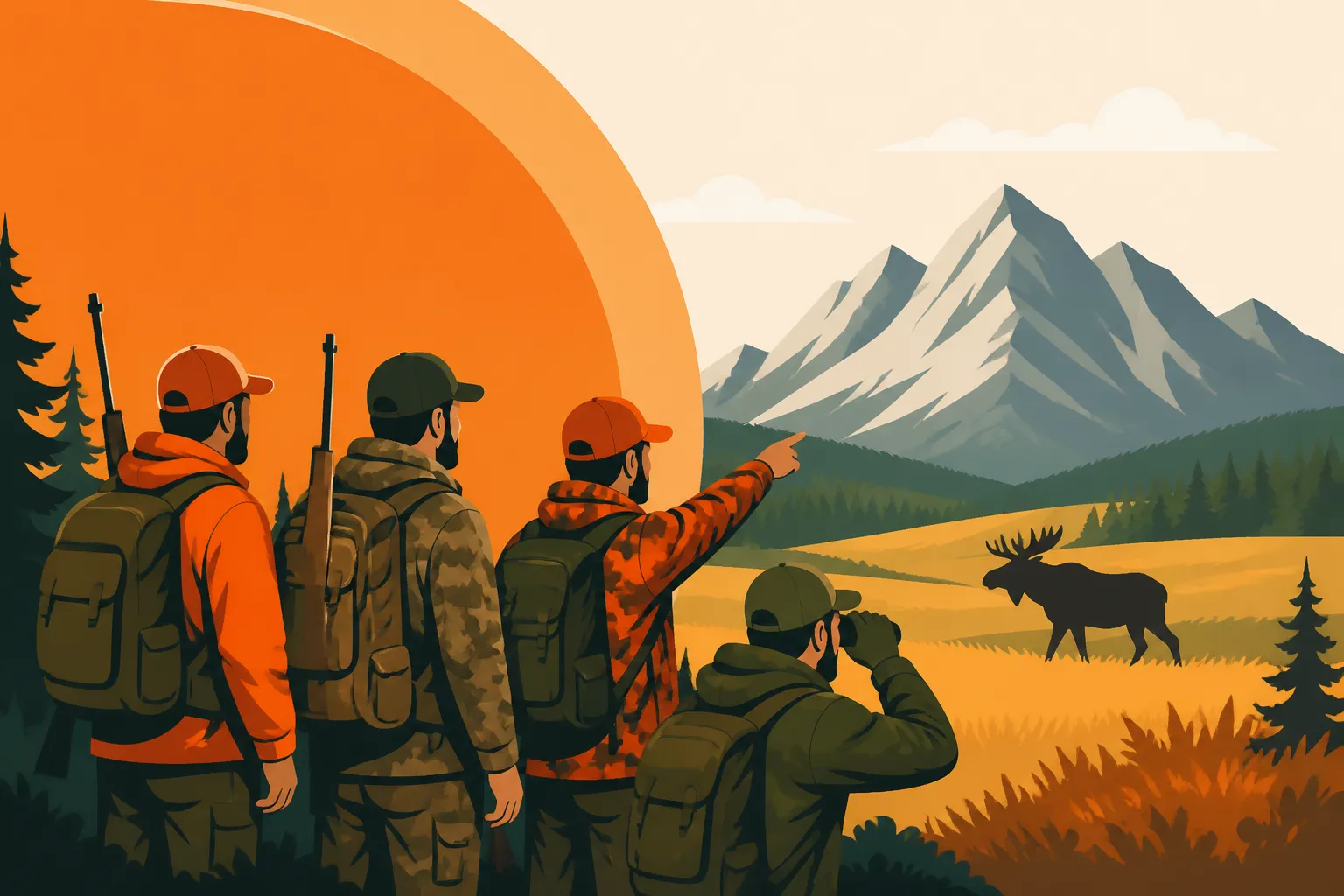
One of the biggest advantages of a group hunt is the shared experience. Imagine the storytelling around the campfire after a long day in the bush, the collective excitement of spotting a trophy animal, or the shared relief of packing out a heavy moose. You're building bonds and memories that last a lifetime. Beyond the emotional benefits, there are practical advantages too. Costs can be shared, from fuel and camp supplies to potentially even outfitter fees. The workload, whether it's setting up camp, cooking meals, scouting new areas, or quartering an animal, becomes much lighter with more hands. For example, if you're planning a trip deep into the Boreal Forest for moose, having multiple people to help with a pack-out or even just to set up a comfortable camp after a long drive can be a game-changer. Plus, more eyes and ears in the field often mean better chances of locating game, especially when you're Spot-and-Stalk Mule Deer in Alberta or trying to locate a bugling bull in the foothills.
The Downsides: Juggling Schedules, Expectations, and Decisions
Now for the real talk. Coordinating multiple schedules is often the first hurdle. Everyone has work, family commitments, and other plans, making it tough to find a common block of time that works for all. Then there are the differing expectations. One person might be after a record-book whitetail, another just wants to fill their freezer with venison, and someone else might primarily be there for the experience of being outdoors with friends. These different goals can lead to frustration if not addressed upfront. Decision-making can also become a challenge. Who decides where to hunt? What species to prioritize? When to call it a day? Without clear communication and a willingness to compromise, these small decisions can quickly become sources of friction. For non-resident groups, understanding Rules for Non-Residents Hunting Alberta and coordinating multiple licences and potentially a hunter host adds another layer of complexity.
Defining Your Group's Hunting Style and Goals
Before you even start looking at dates or destinations, the single most important thing your group can do is have an honest, in-depth conversation about what everyone wants out of this hunt. This isn't just a casual chat; it's a critical pre-planning session.
Trophy Versus Meat, Comfort Versus Challenge
Is the primary goal to harvest a trophy animal, or is filling the freezer the main objective? These two goals can dictate everything from the WMU you choose to the type of hunt (e.g., waiting for a specific buck versus taking the first legal animal). Your group's preferred comfort level is another huge factor. Does everyone want the amenities of a lodge, or are you all keen to spike camp in the backcountry, sleeping in wall tents and living off dehydrated meals? What about the physical challenge? Are you looking for an easy-access road hunt, or does the idea of backpacking into bighorn sheep country appeal to the entire group? These are fundamental questions that will narrow down your options significantly. If some members prefer creature comforts while others crave a rugged backcountry experience, you might need to find a middle ground or consider splitting up for certain parts of the trip.
Budget, Species, and Experience Level: Getting on the Same Page
Let's talk money, because it's always a factor. What's the realistic budget for each individual? This will influence whether you're looking at a self-guided trip on public land, which is often more budget-friendly, or a fully outfitted experience. Different species also come with different costs and permit requirements. For example, draw-only species like moose or elk often require more planning and potentially higher costs if you opt for an outfitter with an allocation. You can learn more about this by reading Alberta's Special Licence Draws. Also consider the experience level of each hunter. Does the group have seasoned veterans and complete novices? The hunt plan will need to accommodate everyone, perhaps by pairing experienced hunters with less experienced ones, or choosing a hunt style that isn't overly demanding for beginners. Sites like GoHunt can be invaluable for researching specific WMUs, draw odds, and general information to help guide these group discussions.
Navigating Alberta's Regulations and Logistics as a Group
Once your group has a clearer vision of your ideal hunt, it's time to dive into the nitty-gritty details of Alberta's hunting regulations and the practical logistics of getting your group into the field. This is where careful planning pays off big time.
Understanding Licensing and Draw Applications for Multiple Hunters
Alberta has a well-structured system for licences and draws, and understanding how it applies to groups is crucial, especially if you're coming from outside the province.
WIN Cards, Wildlife Certificates, and Party Applications
Every hunter in Alberta, resident or non-resident, needs a Wildlife Identification Number (WIN) card and an annual Wildlife Certificate. If you're a group of non-residents, you'll also need to consider the Alberta's WIN Card and Wildlife Certificate. Make sure everyone in your group applies for and receives these well in advance of the hunting season. For species that require a draw (like many antlered moose, elk, and some deer licences), Alberta allows for party applications. This means your group can apply together, and if one member of the party is drawn, everyone in the party receives the licence. This can be a huge advantage for groups hoping to hunt together. However, it also means that your priority points are pooled, and if any member of the party gets drawn, everyone's individual priority points for that species reset. This is a common point of discussion for groups, as some members might have higher priority than others and need to decide if they're willing to risk their higher points for a group draw. Understanding How Alberta's Draw Application Works is vital here.
Non-Resident Rules and Hunter Hosts
For non-resident Canadian hunters (from other provinces) or non-resident aliens (from other countries), the rules are different. Non-resident Canadians can generally hunt general season species with the appropriate licences. However, non-resident aliens must hunt with an Alberta-licensed outfitter or be accompanied by an eligible Alberta resident hunter host. If your group includes non-resident aliens, this is a non-negotiable requirement. This means either everyone books through an outfitter or a resident in your group takes on the significant responsibilities of being a hunter host for the entire non-resident alien contingent. The role of a hunter host is comprehensive, covering everything from ensuring legal hunting practices to proper game handling, and is detailed in What a Hunter Host Is Responsible For. This choice profoundly impacts the planning, cost, and logistics of your group hunt.
Group Considerations for Gear, Transportation, and Camp
Once the paperwork is sorted, the practicalities of a group hunt come into play. Sharing gear, coordinating vehicles, and setting up a comfortable camp are all part of the adventure.
Pooling Resources: Shared Gear and Vehicle Logistics
One of the great advantages of hunting in a group is the ability to share specialized (and often expensive) gear. Does everyone need their own large wall tent or can two families share? Can one person bring the quad while another brings the trailer for hauling game? Think about items like cooking stoves, coolers for meat, GPS units, first-aid kits, and communication devices like satellite phones or inReach devices, especially if you're venturing into areas with no cell service. Creating a shared gear list and assigning responsibility for each item can prevent duplication and ensure nothing important is forgotten. When it comes to transportation, consider how many vehicles your group will need to comfortably transport hunters, gear, and potentially game meat. If you're heading to a remote area, having multiple 4×4 vehicles might be wise, and carpooling can save on fuel costs.
Camp Life and In-Field Communication
Camp setup for a group needs thought. Will it be a "main camp" with individual sleeping arrangements, or one large communal space? Who's responsible for cooking, cleaning, and general camp maintenance? Having a rotating schedule for chores can prevent burnout and resentment. Consider bringing a robust first-aid kit that's easily accessible and ensure at least one person in the group has advanced first aid training. For communication in the field, especially if your group plans to split up, two-way radios are invaluable for short distances. For longer range or emergency situations, satellite communicators are essential, especially in Alberta's more remote WMUs. GoHunt also offers tools that allow you to layer public land maps and identify potential access points, which is invaluable for a group trying to coordinate movements and meet-up points in unfamiliar territory.
| Feature | Self-Guided Group Hunt | Guided Group Hunt |
|---|---|---|
| Cost | Generally lower (licences, gear, food, fuel) | Generally higher (outfitter fees, tips, allocations) |
| Logistics | Group responsible for all planning, gear, and camp | Outfitter handles most logistics, gear, and camp |
| Local Expertise | Relies on group's research & experience | Access to outfitter's in-depth local knowledge |
| Access | Primarily public land; private land requires permission | Often includes access to private land & allocations |
| Effort | High group effort for scouting, setup, and pack-out | Less physical effort for group (guides do heavy lifting) |
| Flexibility | High for decision-making (species, locations, pace) | Less flexible (set schedule, specific areas/species) |
| Success Rate | Dependent on group's skill, knowledge, and luck | Often higher due to outfitter's expertise & resources |
| Non-Residents | Hunter host required for non-resident aliens | Outfitter fulfills non-resident alien requirement |
Working with Outfitters and Hosts for a Group Hunt
For many groups, especially those new to Alberta or those seeking a specific type of hunt, engaging an outfitter or leveraging a hunter host is the most straightforward path to success. The decision often boils down to budget, experience, and the desired level of adventure.
When a Guided Group Hunt Makes Sense
There are definite scenarios where paying for an outfitter, even for a group, is not just a luxury but a wise investment. It streamlines many of the complexities and can significantly increase your chances of a successful and enjoyable hunt.
Ease of Planning, Local Expertise, and Access
One of the biggest headaches for any group hunt is the sheer amount of planning required. An outfitter can take almost all of that burden off your shoulders. They handle everything from securing Alberta Hunting Licences and What They Cost and specific tags (if they have allocations) to providing food, lodging, and guides who know the land intimately. Their local expertise is invaluable; they've scouted the area, know game patterns, and understand the nuances of the local weather and terrain. For group hunts, this means less time spent researching and more time actually hunting. Furthermore, many outfitters have access to prime private land that would otherwise be inaccessible, or they hold specific allocations for highly sought-after species like moose, sheep, or large elk, which can be difficult to access on your own. If your group is targeting one of these species, or if you have non-resident alien hunters in your party, an outfitted hunt can be the most practical solution. Sites like BookYourHunt are excellent resources for finding and comparing outfitters who specialize in group bookings.
Specific Species and Non-Resident Requirements
Certain species in Alberta, particularly mountain sheep or high-demand moose and elk, are often best pursued with a guide, especially for groups. The terrain can be challenging, the animals elusive, and the local knowledge of a seasoned guide can be the difference between success and a frustrating trip. As mentioned earlier, if your group includes non-resident alien hunters, an outfitter legally fulfills the requirement for them to hunt in Alberta. This means no one in your group has to take on the significant responsibilities of being a hunter host, simplifying the trip immensely for everyone. When looking at outfitters on BookYourHunt, you can often filter by species, hunting method, and whether they cater to groups, making your search much more efficient.
Vetting Outfitters for Group Compatibility and Services
Once you've decided to go the outfitter route, the next crucial step is finding the right one for your group. Not all outfitters are created equal, and what works for a solo hunter might not work for your crew.
Questions to Ask to Ensure a Good Fit
Before you commit, bombard potential outfitters with questions. Start with the basics: What is their maximum group size? What is their hunter-to-guide ratio (e.g., one-on-one, two-on-one)? For a group, a higher hunter-to-guide ratio might mean less individual attention, which could be a deal-breaker for some. Ask about their camp setup: Is it a comfortable lodge, spike camps, or wall tents? Will your group have exclusive use of the camp, or will you be sharing with other hunters? Inquire about the food and amenities, especially if some members have dietary restrictions or specific comfort needs. Crucially, ask about their success rates for the species and weapon type your group is targeting, but understand that "success" can be defined differently by different outfitters. It's also important to understand What an Alberta Guided Hunt Costs and what is explicitly included versus what are extra expenses (like meat processing, taxidermy, or tips). Get a breakdown of all potential costs.
References, Reviews, and Setting Clear Expectations
Always ask for references from past group clients. A reputable outfitter should be happy to provide contact information for several groups they've guided. Speaking directly with these past clients can give you invaluable insights into the actual experience, the guides' professionalism, the camp dynamics, and how the outfitter handles challenges. Check online reviews, but take them with a grain of salt, as every experience is subjective. The key here is open communication with the outfitter about your group's specific goals, expectations, and any unique needs or limitations. Being upfront about these details helps the outfitter tailor the experience and prevents disappointment down the line. Remember, finding the right guide is like Choosing the Right Alberta Outfitter for a solo trip, but multiplied by the number of people in your group – everyone needs to feel comfortable and confident in the choice.
Financial Planning and Managing Expectations for Group Hunts
The financial aspect and managing individual expectations are two areas where group hunts often hit snags. Addressing these head-on, with transparency and a spirit of compromise, is essential for a harmonious and successful trip.
Breaking Down the Costs: Licenses, Travel, Outfitter Fees, and Extras
Hunting in Alberta, especially for big game, is an investment. When you multiply that by a group, the costs can escalate quickly. A detailed budget is your best friend.
Beyond the Tag: A Comprehensive Budget for Every Hunter
First, every hunter will need to budget for their individual Alberta Resident Deer Licence Cost or Alberta Non-Resident Deer Licence Cost, depending on their status and target species. Then there's the cost of the WIN card and Wildlife Certificate. If opting for an outfitted hunt, the outfitter fees will likely be the largest expense. This is where clarity is paramount: what exactly do those fees cover? Does it include transportation from the nearest airport? Meat processing? Taxidermy? It's rare for everything to be included, so budget for those potential extras. Beyond that, consider travel costs (flights, fuel, vehicle wear and tear), food and drink (if self-guided), specialized gear (if not pooling), and potentially lodging before or after the hunt. Don't forget the often-overlooked expenses like tips for guides and camp staff, which are customary and important to budget for.
How to Split Costs Fairly and Transparently
Deciding how to split communal costs needs a plan. Will everyone pay an equal share, or will some costs be divided based on usage (e.g., those who drive the quad chip in more for fuel)? Setting up a shared spreadsheet or using a group payment app can help track who has paid what and for what expenses. For instance, if one person is responsible for booking and paying for the bulk of the outfitter deposit, how will the group reimburse them? Establishing these agreements upfront prevents awkward conversations later in camp. For groups needing to get Getting Permission for a Goose Field or Asking an Alberta Landowner for Permission for a self-guided hunt, there may be small "access fees" or gifts for landowners, which should also be factored into the shared costs.
Communicating Openly to Avoid Common Group Pitfalls
Even with the best planning, group dynamics can be tricky. Open and honest communication is the single most effective tool to navigate potential disagreements and ensure everyone has a positive experience.
Pre-Trip Meetings and Clear Roles
Host regular group meetings in the months leading up to the hunt. These can be virtual or in-person. Use these meetings to finalize dates, discuss gear, review regulations, confirm responsibilities, and address any lingering questions or concerns. Assign clear roles if helpful: one person might be the "camp chef," another the "logistics coordinator," and another the "first aid lead." This distributes the workload and gives everyone ownership. Discuss safety protocols, like Alberta Blaze Orange Requirements and what to do in case of an emergency. Talk about what happens if someone fills their tag early – do they help others, or do they have alternative activities planned? This is also a good time to make sure everyone has reviewed the specific WMU regulations for the areas you'll be hunting. You don't want surprises when you're in the field. Remember, booking an Alberta hunt a year ahead, as discussed in Booking an Alberta Hunt a Year Ahead, allows ample time for these crucial group discussions.
Realistic Expectations for Success and Enjoyment
Finally, manage expectations. Hunting, by its very nature, involves uncertainty. There are no guarantees of harvesting an animal, especially a trophy. Weather can change drastically, animals can move, and sometimes, despite your best efforts, you just don't punch a tag. Emphasize that the success of a group hunt isn't solely measured by the game taken, but by the shared experience, the time spent outdoors, and the memories made. Acknowledge that there will likely be moments of frustration or disagreement, but agree on a respectful way to address them. The goal is for everyone to come away from the Alberta wilderness with a smile, already talking about the next group adventure.
Disclaimer
This article is for general informational purposes only and does not constitute professional advice. Laws, prices and regulations vary by location and change over time. Consult a qualified professional for guidance on your specific situation.