Telling a Ruffed Grouse From a Spruce Grouse
Few things are as frustrating for an upland bird hunter as spotting a flash of feathers in the undergrowth, getting a quick shot off, and then realizing you've harvested a bird you weren't actually targeting, or worse, one that's out of season or protected. It's a moment that can deflate even the most seasoned hunter's spirits. This guide is all about helping you confidently tell the difference between two common yet distinct Alberta forest dwellers: the Ruffed Grouse and the Spruce Grouse.
The Tricky Business of Upland Bird Identification
Hunting upland birds in Alberta's diverse landscapes is a truly rewarding experience, whether you're walking through golden aspen stands or pushing through dense evergreen forests. But let's be honest, those quick glimpses and sudden flushes often don't give you much time to make a positive ID. It can be a real challenge, especially when two species share similar habitats or general coloration. The last thing any ethical hunter wants is to misidentify a bird, leading to a regrettable error.
Why Field Identification is So Crucial
For starters, proper identification is a cornerstone of responsible hunting. It ensures you're only harvesting legal game within the designated seasons and limits. Beyond the legalities, there's a deep satisfaction in knowing your quarry, understanding its habits, and appreciating the unique characteristics that make each bird special. It adds another layer of connection to the hunt, moving beyond just the shot to a deeper understanding of the wild. Alberta's regulations are in place for a reason, to ensure healthy populations for future generations, and your accurate identification plays a direct role in that. Imagine the pride of bringing home a beautifully plumed Ruffed Grouse, knowing you correctly identified it in a split second, rather than a "well, I think it was a grouse" moment.
The Nuances That Separate Similar Species
While Ruffed Grouse and Spruce Grouse both fall under the general "grouse" umbrella and can sometimes be found in overlapping areas, they each have distinct physical features, preferred habitats, and behavioral quirks that, once you know them, make telling them apart much easier. It's not just about broad strokes; it's about paying attention to the details. Are their tail feathers banded or barred? Do they have a prominent crest or a bright red comb? How do they react when approached? These aren't just academic questions; they are practical tools in your upland hunting toolkit. When you're out there on a crisp autumn morning, often moving quickly or focusing on your dog, these subtle cues become incredibly important for making informed decisions on the fly. Many hunters rely on tools like the GoHunt app for scouting, but even the best digital maps can't replace on-the-ground ID skills.
Ruffed Grouse: The Drummer of the Aspen
The Ruffed Grouse is arguably Alberta's most iconic upland game bird. Known for its explosive flush and the drumming sound males make during breeding season, it's a favorite among bird hunters. You'll primarily find these birds in younger forests and mixed woodlands, especially those with plenty of aspen and willow thickets.
Physical Characteristics
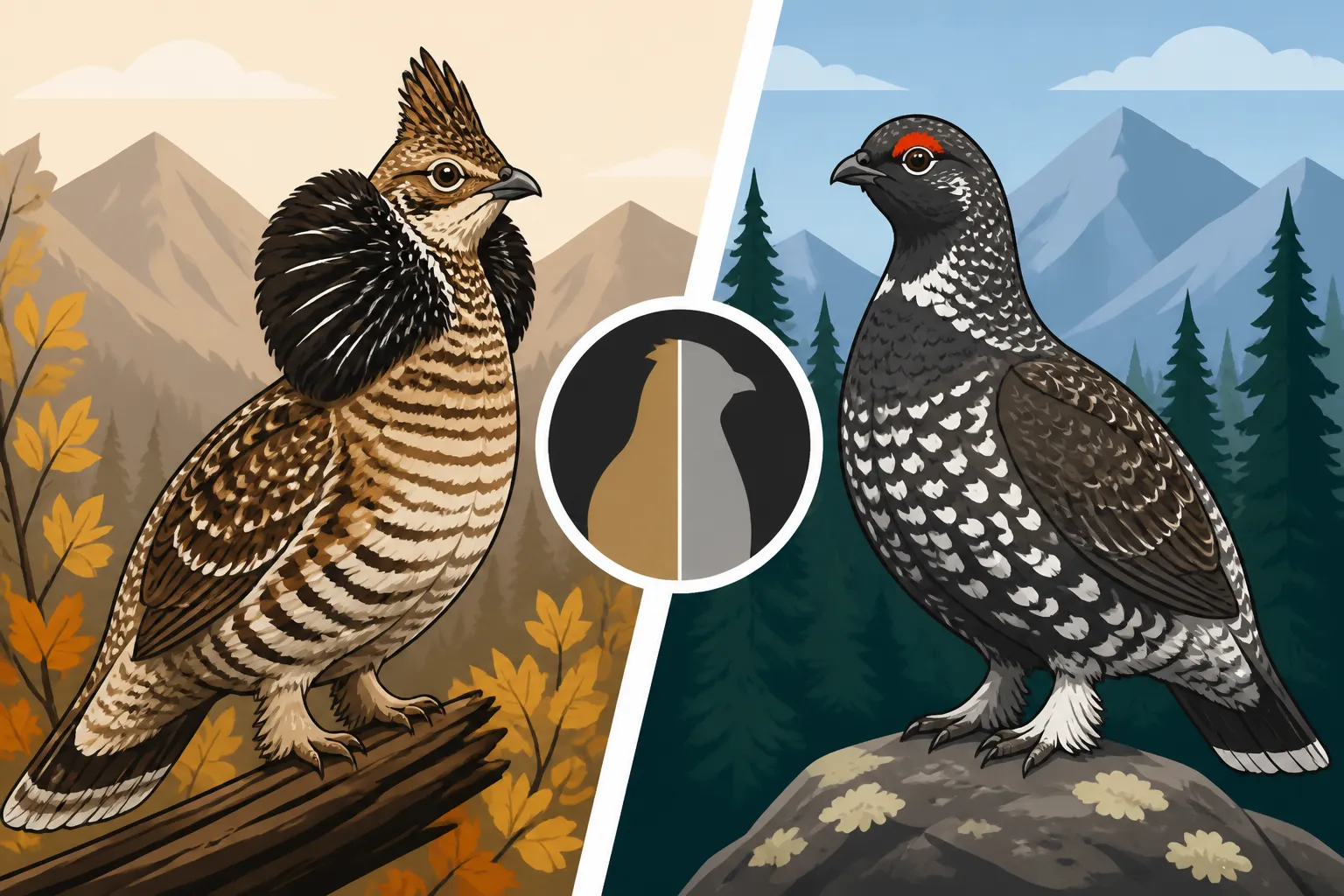
When you get a good look at a Ruffed Grouse, several features immediately stand out. They are typically medium-sized grouse, often appearing a bit chunkier than a Spruce Grouse. Their plumage is a beautiful mosaic of browns, greys, and blacks, providing excellent camouflage in dappled sunlight. What truly sets them apart is the prominent fan-shaped tail, which features a broad, dark band near the tip. This band is a dead giveaway, almost like a signature. In some individuals, especially the "red-phase" birds, this band can have a rusty hue, but the dark, distinct band is always there.
Then there are the "ruffs" themselves – tufts of iridescent black or dark brown feathers on the sides of their neck. These ruffs are usually laid flat but can be dramatically flared during courtship displays or when the bird feels threatened, making them look much larger. Males tend to have more pronounced ruffs. They also often have a small, almost unnoticeable crest on their head, but it's not nearly as prominent as some other grouse species. Their legs are feathered right down to their feet, providing insulation in colder weather, which is pretty standard for many grouse.
| Feature | Ruffed Grouse | Spruce Grouse |
|---|---|---|
| Tail | Fan-shaped with broad, dark subterminal band | Barred (black and brown/grey), often rust-tipped |
| Neck Ruff | Prominent, iridescent black/brown tufts | Absent |
| Head Comb | Small, often inconspicuous crest | Bright red (males), less visible (females) |
| Plumage | Mottled browns, greys, blacks, two color phases | Densely barred, dark grey/black, white spots |
| Habitat | Mixed woodlands, aspen, willow, forest edges | Dense coniferous forests, spruce, pine |
| Behavior | Explosive flusher, "drumming" display | "Fool Hen" – often tame, walks, flies short |
Habitat and Behavior Cues
Ruffed Grouse are creatures of the edge and young successional forests. They love areas where deciduous trees like aspen and birch mix with conifers, providing both food and cover. Think thick regenerating clearcuts, creek bottoms with dense willow, or the edges of old logging roads. When you're Ruffed Grouse Hunting Alberta's Bush Trails, you'll often find them lurking just off the path. These birds are renowned for their incredible flushing power. When startled, they erupt from cover with a thunderous beat of wings, often darting through dense timber, making for a challenging shot. This explosive flush is a key behavioral identifier; a Ruffed Grouse is rarely "tame." They'll typically fly a good distance before pitching into new cover. You can also listen for the distinctive "drumming" sound made by males, a low-frequency thumping created by rapidly beating their wings against the air. This drumming is most common in spring but can sometimes be heard into the early fall. They'll often feed on buds, catkins, and berries, which is why you find them in areas with a mix of cover and food sources. They thrive in Alberta's Parkland Country and Its WMUs as well as mixed forest areas.
Spruce Grouse: The Fool Hen of the Conifers
The Spruce Grouse, often affectionately (or sometimes frustratingly) called the "fool hen," is a very different character from its ruffed cousin. As its name suggests, this bird is a true resident of Alberta's coniferous forests. If you're Hunting Spruce Grouse in Black Timber, you're in their prime domain.
Physical Characteristics
Spruce Grouse tend to be slightly smaller and often appear more compactly built than Ruffed Grouse. Their plumage is generally much darker, favoring deep greys, blacks, and browns, with distinct white barring and spotting, especially on their undersides. This coloration is a fantastic camouflage within the shadows and needles of dense conifer stands.
The males are particularly striking. They possess a bright red comb above each eye, which becomes quite prominent during breeding season but is often still visible throughout the hunting months. This red comb is a key visual identifier and one of the most reliable ways to distinguish a male Spruce Grouse from a Ruffed Grouse. Their tail feathers are also different: instead of a single broad band, they are often heavily barred with black and rusty brown, and they typically lack the distinct fan shape, appearing more rounded. Females are duller, with more mottled brown and grey, making them harder to spot, but still lack the prominent ruff and distinct tail band of the Ruffed Grouse. Like the Ruffed Grouse, their legs are feathered, helping them navigate cold, snowy environments.
Habitat and Behavior Cues
Spruce Grouse are absolute specialists when it comes to habitat. You will find them almost exclusively in dense coniferous forests, particularly those dominated by black spruce, white spruce, balsam fir, and lodgepole pine. They prefer mature stands with thick canopies and often wet, mossy undergrowth. If you're exploring Alberta's Boreal Forest Country, you're in prime Spruce Grouse territory. Unlike the Ruffed Grouse, which explodes from cover, the Spruce Grouse lives up to its "fool hen" moniker. They are famously unafraid of humans, often allowing hunters to approach within feet, or even step over them, before they decide to casually walk away or take a short, reluctant flight to a nearby tree branch.
Their flight is typically short and direct, rarely as powerful or evasive as a Ruffed Grouse. They'll often land on a low branch, watching you curiously. This calm, unhurried demeanor is a huge behavioral clue. They primarily feed on conifer needles, particularly spruce and pine, especially in winter. This diet gives their meat a distinct, sometimes resinous, flavor that some hunters enjoy and others find a bit strong. Their tameness makes them relatively easy targets, which means it's even more crucial to ensure you're making a positive ID before taking a shot.
Beyond the Binoculars: Practical Tips for Field Identification
Being able to differentiate these two grouse species confidently in the field comes down to a combination of observation, knowing their preferred haunts, and understanding their typical reactions to human presence. It's a skill that develops with experience, but you can accelerate your learning by focusing on key indicators. Using tools like GoHunt, which can show you satellite imagery and habitat types, can help you scout for the right zones before you even step foot in the woods.
Observe Habitat Closely
One of the most immediate and reliable indicators is the environment itself. Before you even see a feather, the type of forest you're in should give you a strong hint. If you're pushing through a dense stand of dark, mature spruce and pine, especially in the northern parts of the province or at higher elevations in the foothills, you should be thinking "Spruce Grouse." This is classic Hunting Spruce Grouse in Black Timber country. Conversely, if you're walking through a younger, mixed forest, rich with regenerating aspen, birch, and thick berry bushes, with a few scattered conifers, then "Ruffed Grouse" should be at the forefront of your mind. Think of the edge habitat often found near old Hunting an Old Logging Road in the Foothills or along Ruffed Grouse Hunting Alberta's Bush Trails.
It's not a foolproof method, as some fringe areas might have both, but it significantly narrows down the possibilities. Take a moment to truly Reading an Alberta WMU Map Before You Go and understand the dominant forest types in your chosen WMU. This kind of preparation, perhaps even using Scouting With Satellite Imagery in Alberta to identify transitions between forest types, can be invaluable.
Note Behavior and Flight Patterns
Behavior is perhaps the second most critical identifier. This is where the "fool hen" reputation of the Spruce Grouse really comes into play. If you approach a grouse and it sits calmly, allowing you to walk right up to it, or merely walks a few steps and perhaps takes a short, low flight to a nearby branch, you are almost certainly looking at a Spruce Grouse. Their lack of fear is uncanny.
A Ruffed Grouse, on the other hand, will typically flush with explosive power at your approach, especially if you're walking without a dog. The sudden roar of wings and their zig-zagging flight through the trees is unmistakable. They will usually fly a greater distance, putting significant cover between themselves and the perceived threat. This difference in flight and reaction is often the first and most telling clue you'll get in the field. When Using a Flushing Dog in Thick Cover, pay attention to how the dog reacts and how the bird behaves once flushed.
Listen for Calls and Sounds
While not always present, listening for calls can also provide clues, especially during certain times of the year. As mentioned, the male Ruffed Grouse's drumming display is very distinctive and can be heard in the woods, particularly in spring but sometimes into fall. It's a rapid series of low thumps that grows in intensity. Spruce Grouse have a softer, quieter repertoire, including soft hoots and clucks, but these are far less commonly heard or used as a primary identification method for hunters. You're much more likely to identify a Ruffed Grouse by its explosive flush and the look of its tail, or a Spruce Grouse by its calm demeanor and bright red comb.
Mastering these identification skills takes time afield, but by focusing on habitat, behavior, and key physical markers, you'll soon be able to confidently tell these two wonderful Alberta grouse apart, making your upland hunting adventures more successful and ethical. Remember to always double-check your target against the current Ruffed Grouse Season Dates and Limits and other regulations for your specific WMU to ensure a responsible hunt.
Disclaimer
This article is for general informational purposes only and does not constitute professional advice. Laws, prices and regulations vary by location and change over time. Consult a qualified professional for guidance on your specific situation.