What Coyotes Do to Alberta Fawns
It's a tough truth out in the Alberta bush: for every beautiful, spotted fawn that bounces through the aspen bluffs, there's a predator looking for an easy meal. Many hunters worry about the health of our deer herds, and rightfully so, especially when they see a healthy fawn crop one year and a sparse one the next. One of the most significant natural challenges facing newborn deer in Alberta comes from coyotes, those intelligent and adaptable canids. This guide dives deep into exactly what coyotes do to Alberta fawns, exploring their hunting strategies and the wider impact on our deer populations.
The Cunning Hunter: Coyotes in Alberta's Ecosystem
Coyotes are an integral, and often misunderstood, part of Alberta's diverse wildlife tapestry. They’re incredibly adaptable, thriving in everything from the open prairies to the dense boreal forest, and even on the fringes of urban centres. This adaptability is precisely what makes them such effective predators, especially when it comes to vulnerable prey like newborn fawns. They are not merely scavengers; they are skilled hunters with a keen intellect. Understanding their general ecology helps shed light on their interactions with deer.
An Opportunistic Generalist
When you think of a coyote, you might picture it slinking through a farmer's field, perhaps chasing a rabbit or mousing in the grass. This image isn't wrong, but it only tells part of the story. Coyotes are true opportunistic generalists, meaning their diet is incredibly varied and depends heavily on what's available in their specific environment at any given time. In the summer months, insects, berries, and small rodents make up a significant portion of their intake. However, during the spring, when the landscape bursts with new life, their focus often shifts to larger prey, particularly the young of ungulates. This is when the fawns, fresh into the world, become a prime target. They are quick to capitalize on any advantage, and the sheer abundance of fawns in spring presents a substantial food source.
A coyote isn't picky, which is why they survive so well. They'll eat carrion, snatch a careless squirrel, or even pilfer from gardens if times are tough. But they're also constantly on the lookout for a bigger score. A newborn fawn, though potentially a riskier hunt than a mouse, offers a much more substantial and calorie-rich meal. This drive for efficiency and calories during the denning season, when they have pups to feed, sharply increases their predatory focus on deer fawns. Their hunting isn't just about personal sustenance; it's about providing for their litter, adding another layer of intensity to their pursuit.
Population Dynamics and Adaptability
Alberta boasts a robust coyote population, and their numbers can fluctuate depending on prey availability, human pressures, and other environmental factors. Their ability to reproduce quickly and adapt to changing conditions means they can bounce back even after periods of high mortality or removal efforts. This resilience ensures a consistent presence across most of the province, right where many of our deer herds also reside. A strong coyote population means a consistent predatory pressure on deer, particularly the fawns.
Coyotes exist in a delicate balance with their prey. When deer populations are high, coyote numbers can also increase as there's plenty of food to go around. Conversely, a dip in deer numbers due to harsh winters or disease might see a corresponding decline in coyote reproduction or survival. However, their adaptability often means they simply shift their focus to other prey species if deer become scarce. This dynamic interaction is a natural part of the ecosystem, but it also means that coyotes are always a factor in fawn survival. Understanding Why Alberta Has So Many Coyotes highlights their widespread influence. This constant presence means hunters and wildlife enthusiasts need to understand their role, especially regarding the vulnerable early weeks of a fawn's life.
The Vulnerability of Young Deer
The survival of a new generation of deer is critical for maintaining healthy populations. While adult deer are fast and wary, fawns are born with a completely different set of survival tools, primarily relying on camouflage and stillness rather than flight. This makes them incredibly vulnerable during their first few weeks of life, a period often referred to as the "neonatal stage."
The Fragile First Weeks of Life
A fawn, for all its adorable spots and wobbly legs, is born remarkably helpless in many ways. For the first few days, sometimes even up to a week or two, a fawn's primary defense is to lie perfectly still, concealed by tall grass, brush, or other cover. Its spotted coat provides excellent camouflage, blending seamlessly into dappled sunlight and shadows. When a doe gives birth, she typically leaves her fawn hidden while she goes off to feed, returning periodically to nurse. This "hiding strategy" minimizes the fawn's scent signature and movement, making it harder for predators to locate. However, it also means the fawn is alone and unable to flee effectively if discovered.
During this critical time, a fawn is essentially a sitting duck for any predator that stumbles upon it. Its muscles aren't yet developed for sustained flight, and its instincts compel it to freeze rather than run. This is a brilliant evolutionary tactic against sight-hunting predators but less effective against those, like coyotes, that primarily hunt by scent. The sheer fragility of these early weeks means that even minor environmental stressors, like cold, wet weather, or a lack of suitable hiding cover, can drastically reduce their chances of survival, let alone facing a determined coyote. For more on the species itself, check out White-Tailed Deer, Alberta's Most Hunted Big Game.
Hiding and Scent: A Fawn's Defense Mechanism
The fawn's spots are more than just pretty markings; they are nature's camouflage. Coupled with its innate ability to remain motionless for extended periods, this coloring makes them incredibly difficult to spot with the naked eye. Furthermore, fawns have very little body odour for the first week or two of their lives, a crucial adaptation to avoid detection by predators with keen senses of smell. This lack of scent, combined with the doe's practice of staying away from the fawn except for nursing, is designed to make the fawn virtually invisible and odourless in its hiding spot.
However, no defense is foolproof. While their scent is minimal, it's not entirely absent, especially up close or when a fawn has recently nursed. Coyotes, with their incredibly sensitive noses, are adept at picking up even the faintest of trails. A fawn's hiding spot might be perfect for a visual predator, but a coyote's nose can cut through the deception. A strong wind or rain can also carry a faint scent further, or a fawn moving even slightly can give away its position. It’s a constant cat-and-mouse game, and in Alberta's diverse habitats, from Hunting a Willow Run in Farm Country to Hunting a Shelterbelt Between Two Fields, suitable hiding cover is key, but so is the coyote's relentless search.
Coyote Strategies for Fawn Predation
Coyotes are remarkably intelligent and opportunistic hunters, and when it comes to locating and catching fawns, they employ a combination of senses and learned behaviors that make them highly successful. It's not usually a dramatic chase scene; it's often a methodical, patient search.
Scent Trails and Auditory Clues
The primary tool a coyote uses to find fawns is its incredible sense of smell. Despite a fawn's low scent signature, a coyote's nose is designed to detect minute traces. They will often crisscross areas known to be fawn bedding grounds, like dense brush, tall grass, or the edges of fields, constantly testing the air and ground for any indication of a fawn's presence. A doe's scent, while she's present, or the residual scent from a recent nursing session, can act as a beacon. Imagine a coyote systematically working a field, head down, nose to the ground, like a finely tuned detection device. They're not just wandering aimlessly; they are actively prospecting.
Beyond scent, auditory clues can also play a role, though less frequently. A startled bird, the rustle of a fawn shifting its weight in the grass, or even the soft bleats of a fawn calling for its mother – though fawns are typically very quiet – can alert a coyote to potential prey. While a fawn's instinct is to freeze and remain silent, sometimes circumstances lead to a noise, and a keen-eared coyote will pick up on it instantly. This combination of powerful senses makes them incredibly effective at uncovering hidden fawns. Hunters often use tools like GoHunt to scout areas that might hold both deer and predators, understanding these dynamics.
Systematic Searching and Flushing
Coyotes don't just wander hoping to stumble upon a fawn; they often engage in systematic searching patterns, especially during the spring birthing season. They might patrol the edges of cover where does are known to drop their fawns, or work through thickets, actively trying to "flush" hidden fawns from their concealment. This can sometimes involve a pair of coyotes working together, one pushing through a section of cover while the other waits at an advantageous position to intercept any fleeing fawn.
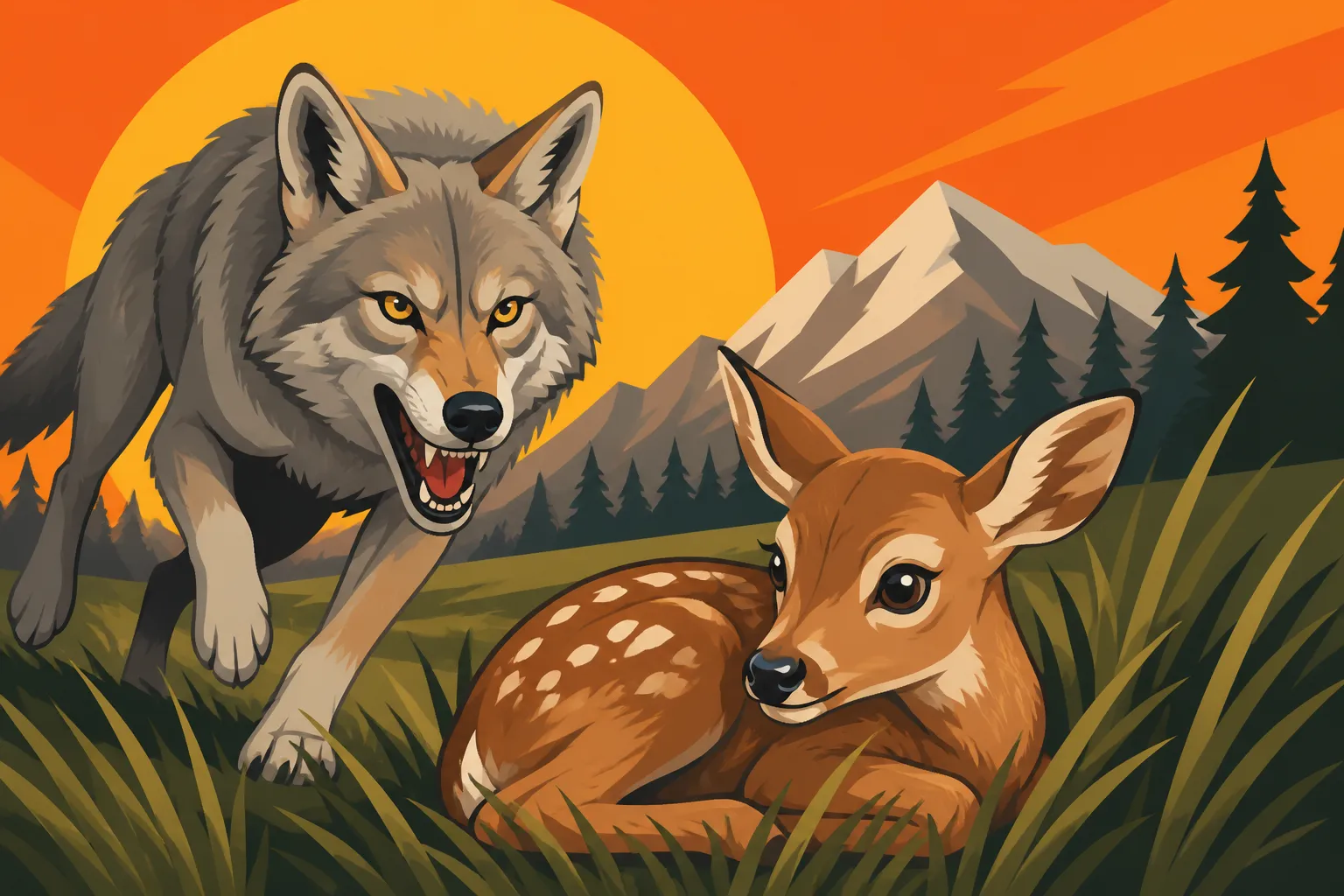
When a fawn is flushed, its instinct to freeze might temporarily give way to a desperate, clumsy flight. At this stage, it's typically no match for a chasing coyote. The coyote's agility and speed quickly overcome the fawn's underdeveloped running capabilities. The brief window of vulnerability, when a fawn breaks cover and attempts to escape, is precisely what the coyote capitalizes on. This systematic approach, coupled with their sharp senses, highlights why fawn predation is such a consistent factor in deer mortality.
Here's a quick comparison of fawn defense vs. coyote offense:
| Fawn Defense Mechanism | Coyote Hunting Tactic | Effectiveness |
|---|---|---|
| Camouflage (Spots) | Visual Search (less effective) | High against sight, less against scent/movement. |
| Stillness/Hiding | Scent-Tracking | High in dense cover, but not foolproof. |
| Minimal Scent | Persistent Scent-Trailing | Good initially, but can be overcome by keen nose. |
| Silent Behavior | Auditory Cues (if fawn moves) | Very high, but any noise is a severe risk. |
| Doe's Absence (lowers scent) | Tracking Doe's Residual Scent | Effective strategy, but leaves fawn vulnerable. |
| Flight (last resort) | Chasing & Cornering | Low, fawns are too slow and clumsy initially. |
Broader Impact on Alberta's Deer Populations
The loss of fawns to predators like coyotes is a natural part of any ecosystem. However, when combined with other factors, this predation can have a significant impact on overall deer population dynamics. It's not always just about the number of fawns lost, but also about the timing and the overall health of the herd.
Contributing to Neonatal Mortality Rates
Predation by coyotes is a major contributor to what biologists refer to as "neonatal mortality" – the death of young animals shortly after birth. Studies have shown that fawn mortality rates can be alarmingly high, with predators often accounting for a substantial percentage of these losses. While other factors like disease, starvation, and accidental deaths play a role, coyote predation frequently emerges as the leading cause of death in the critical first few weeks of a fawn's life. This reality is a harsh one for those hoping for a booming deer season, and it's a concern many hunters share.
If a severe winter has already weakened the doe population, leading to lower birth rates or weaker fawns, then even "average" coyote predation can have an amplified effect on the next generation. Conversely, in years with mild winters and abundant forage, does might be healthier, drop more fawns, and those fawns might be more robust, better able to survive. So, it's a complex interplay. What this means for hunters is that the number of deer they see in the fall is often a direct reflection of how successful those fawns were at evading coyotes and other threats in the spring. You might be able to read some Reading Whitetail Sign in Alberta Aspen Bluffs and see good numbers, but the fawns often tell the true story of the herd's health.
Regional Influences and Habitat Factors
The impact of coyote predation on fawns isn't uniform across Alberta. It varies significantly by region, influenced by factors such as habitat type, coyote density, and the presence of other predators. In areas with abundant, dense cover, fawns might have more places to hide, potentially reducing predation rates. Conversely, in open prairie or heavily fragmented agricultural landscapes where hiding spots are sparse, fawns can be more exposed and therefore more vulnerable. The type of cover—whether it's thick aspen bluffs, tangled willow runs, or dense shelterbelts—directly affects a fawn's chances.
Furthermore, the presence of other predators, such as wolves, bears, or even domestic dogs in some areas, can also influence coyote activity. Sometimes, increased wolf populations can lead to a decrease in coyote numbers, potentially offering fawns a slight reprieve. In other cases, a diverse predator guild might mean fawns face threats from multiple angles. For instance, in northern forested areas where moose are present, coyotes might switch their attention to moose calves. Meanwhile, in prairie zones, What Coyotes Do to Alberta Fawns remains a primary concern for deer herds. Wildlife managers often use tools like GoHunt to analyze regional data, allowing them to understand these localized dynamics and make informed decisions about deer and predator management.
Managing Predator-Prey Dynamics
Understanding the role of coyotes in fawn mortality is one thing; deciding how, or even if, to intervene is another. Wildlife management in Alberta aims for healthy ecosystems, which includes a natural balance between predators and prey. However, when deer populations face significant pressures, the question of managing predator-prey dynamics often arises among hunters and landowners.
Predator Control and Its Complexities
The idea of "predator control" often comes up in discussions about deer populations. This typically refers to efforts to reduce coyote numbers in specific areas to potentially boost fawn survival rates. These efforts can range from controlled hunting seasons for coyotes (which are open year-round for residents in most of Alberta, often without a licence requirement on private land with permission) to more targeted removal programs. While reducing predator numbers can lead to an increase in fawn survival in localized studies, it's a complex issue with many nuances. Coyotes are incredibly resilient and can quickly recolonize an area or increase their reproductive rates to compensate for losses.
Furthermore, intensive predator control can be costly, time-consuming, and might have unforeseen ripple effects on the broader ecosystem. It's not a simple one-to-one equation. For hunters interested in managing coyotes on their land, understanding Coyote Hunting Rules and Open Season is crucial. Many participate in ethical coyote hunting, which, while not a silver bullet for deer populations, can certainly help manage local coyote pressure. It's a method that requires careful consideration and an understanding of the long-term ecological implications.
Habitat Management for Fawn Survival
Perhaps a more sustainable and universally beneficial approach to supporting fawn survival is through habitat management. Healthy, diverse habitats provide fawns with better escape cover and hiding spots, making it harder for coyotes to find them. This can include maintaining thickets, promoting diverse undergrowth, and ensuring access to areas with dense vegetation for concealment. A doe that has good cover available to drop her fawn is giving that fawn a far better chance at life than one forced to drop her fawn in an exposed area.
Landowners and hunters can play a role in this. For example, leaving undisturbed brush piles, maintaining hedgerows, or managing field edges to allow for natural growth can create valuable fawn-hiding habitat. Beyond just hiding spots, ensuring ample food sources for does helps them be in better physical condition, leading to healthier fawns that are more robust and better equipped for survival. Ultimately, a strong and healthy deer herd, supported by quality habitat, is often the best defense against predation. This approach considers the entire ecosystem, including the needs of What Whitetails Eat Through Winter and how habitat provides shelter during challenging times, such as How Deep Snow Moves Deer Around.
Understanding the Natural Balance
The interaction between coyotes and fawns is a powerful example of nature's delicate balance. It's a cycle of life and death that shapes both predator and prey populations, ensuring that only the fittest survive and thrive. While it can be tough to witness or contemplate the struggles fawns face, it's a critical component of a healthy, functioning ecosystem.
For hunters, understanding these dynamics provides a deeper appreciation for the animals we pursue and the landscapes they inhabit. It highlights the importance of ethical hunting practices, habitat conservation, and contributing to well-managed wildlife populations. While coyotes certainly impact fawn numbers, they are one piece of a much larger puzzle that includes factors like winter severity, habitat quality, disease, and human activity. The overall Alberta's Deer Herd Trend Over Ten Years is influenced by all these elements working in concert. Embracing this complexity allows us to be more informed and responsible stewards of Alberta's incredible wild resources.
Disclaimer
This article is for general informational purposes only and does not constitute professional advice. Laws, prices and regulations vary by location and change over time. Consult a qualified professional for guidance on your specific situation.