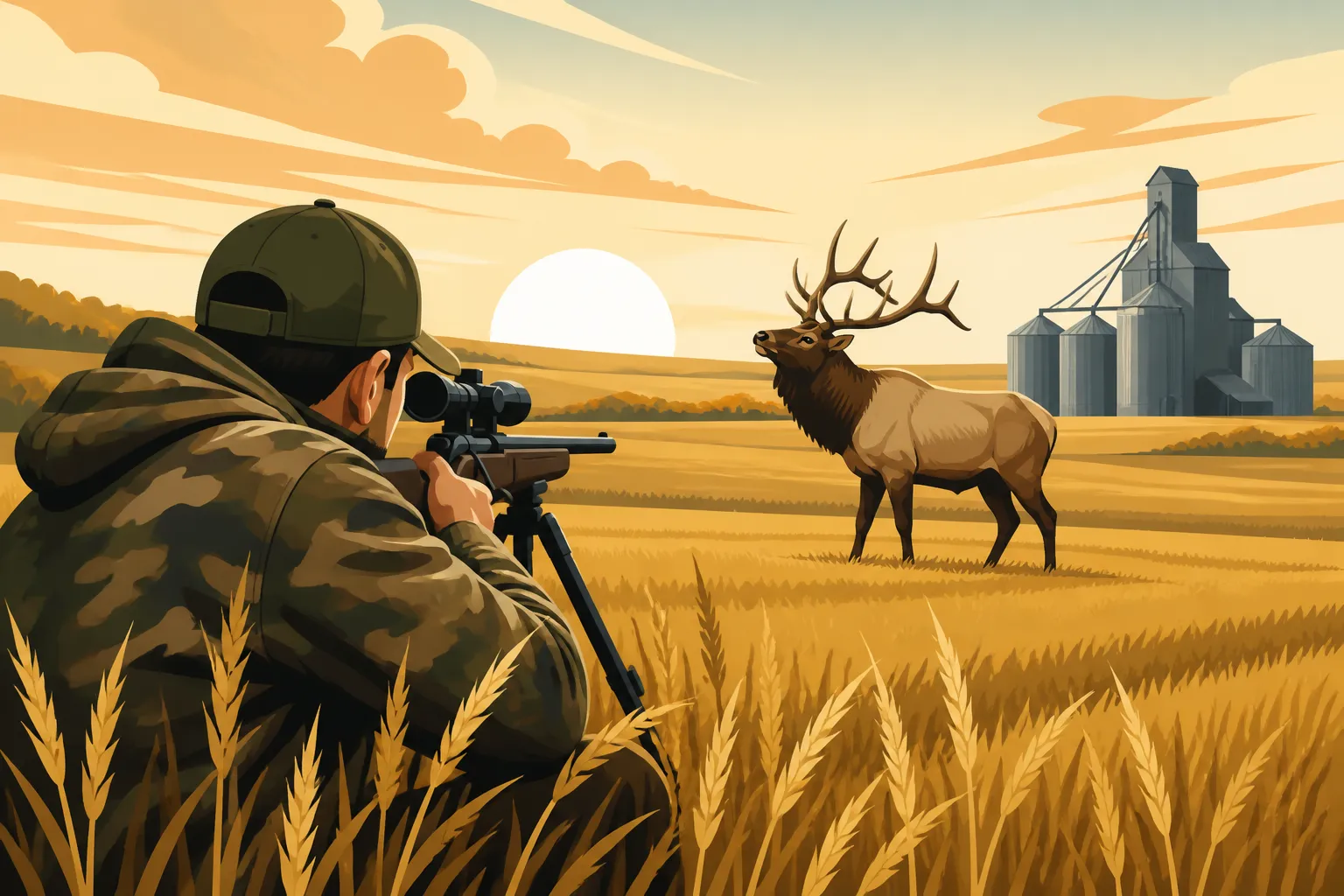
Hunting Elk on Alberta Grain Land
Hunting elk on Alberta's vast grain lands can be one of the most rewarding, yet equally frustrating, experiences a hunter can undertake. These wary animals thrive in the fertile agricultural belt, but their presence often means navigating tricky access, dealing with their keen senses, and adapting to ever-changing food sources. This guide aims to pull back the curtain on these challenges, providing you with a deep dive into understanding elk behaviour, effective scouting, gaining permission, and executing successful hunts in Alberta's grain country.
Understanding Elk Movement on Grain Land
When you're looking at a vast expanse of golden wheat or green canola, it's easy to wonder how a herd of elk could possibly hide, let alone how to get close to them. The truth is, these animals are master adapters, and their movements on agricultural land are a finely tuned dance between food, cover, and security.
Why Elk Are Drawn to Grain Fields
It's no secret that elk, like many other large herbivores, are attracted to highly nutritious food sources, and grain fields are essentially giant buffet lines. After the initial green-up, the tender shoots of young crops like barley, wheat, and oats provide a rich source of protein and energy. As the season progresses, and particularly after harvest, the waste grain left behind becomes an irresistible draw. Think about it: a concentrated, high-calorie meal without having to browse through dense timber for sparse forage. This makes a lot of sense, especially when you consider the energy demands of growing antlers for bulls or supporting calves for cows.
This attraction isn't just about nutrition; it's also about efficiency. Elk can feed in large groups, maximizing their caloric intake in a short amount of time before retreating to cover. They'll often target fields that are adjacent to good bedding habitat – dense bush, river bottom thickets, or deep coulees – allowing them quick access to both sustenance and sanctuary. You might see them hitting one field hard for a few days, then shifting to another as the palatability changes or hunting pressure increases. It’s a dynamic relationship, and understanding it is the first step toward putting together a successful hunt.
Daily and Seasonal Patterns
Elk in grain country tend to be highly nocturnal, especially when there's a lot of pressure from both agricultural activity and hunting. They'll typically emerge from their bedding areas in the late evening, just as the sun dips below the horizon, to feed throughout the night. Their movements during these hours can be extensive, covering several kilometres across multiple fields. As dawn approaches, they'll often grab a final bite before making their way back to their chosen sanctuary. This often means you'll see them at the very edge of legal shooting light, either coming out or going back in, making those first and last minutes of the day absolutely critical.
Seasonally, their patterns shift dramatically. In early archery season, elk might still be using lush green fields, but as crops mature and are swathed or combined, the focus shifts to the waste grain. Post-harvest, those stubble fields become prime feeding grounds. The rut in September and October can briefly change these patterns, as bulls become more preoccupied with cows and less cautious, sometimes being seen in fields during daylight hours. However, as the general rifle season opens and pressure mounts, they quickly revert to their nocturnal ways. When the snow flies deep, elk may congregate in sheltered areas, but they'll still venture out to paw through the snow for leftover grain, especially in areas with a history of feeding. For specific timing, you'll want to review Alberta Big Game Season Dates to align your efforts with peak activity windows.
Scouting Strategies for Grain Land Elk
Scouting for elk on grain land requires a blend of modern technology and old-fashioned legwork. These animals are notoriously elusive in open country, so being thorough and systematic in your approach is paramount. You can't just drive around hoping to spot them; you need to anticipate their movements and pinpoint their hideouts.
Utilizing Digital Tools and Satellite Imagery
In this day and age, neglecting the power of digital scouting is like trying to hunt with a flintlock when everyone else has a modern rifle. Tools like GoHunt are invaluable for pre-season scouting, allowing you to pour over high-resolution satellite imagery from the comfort of your home. You can identify potential bedding areas – those dense stands of timber, river breaks, or deep coulees that provide cover adjacent to feeding fields. Look for pinch points, natural travel corridors, and even subtle changes in elevation that might offer hidden pockets for elk. Mapping apps can also show you land ownership boundaries, which is absolutely critical when hunting private agricultural land, helping you identify potential access points and areas to focus your permission efforts.
Beyond basic satellite views, some platforms offer historical imagery, which can be gold. You might be able to see where crops were harvested in previous years, how water sources were utilized, or even where trails were established. This kind of data helps you build a more complete picture of an area's long-term potential, rather than just what it looks like today. Identifying these patterns before you ever set foot on the property can save you countless hours of unproductive walking. Using these digital tools also lets you mark potential blind locations, escape routes, and areas that require further on-the-ground investigation.
Boots-on-the-Ground Scouting and Sign Reading
While digital tools get you started, there's no substitute for getting your boots dirty. Once you've identified promising areas on your maps, it's time to verify them in person. This means walking fence lines (with permission, of course), checking field edges, and investigating those brushy areas or river bottoms you marked. Look for fresh tracks, droppings, and rubbed trees. Fresh sign is key; elk sign from last season is interesting, but current activity tells you where they are now. Pay particular attention to trails leading from heavy cover into fields, especially those showing heavy use and fresh tracks.
When scouting in person, always consider the wind. Elk have an incredible sense of smell, and they will detect you long before you see them if the wind is wrong. Try to scout during midday when elk are most likely bedded, minimizing your disturbance during their active feeding times. If you find fresh sign, back out quietly. You don't want to spook a herd you haven't even had a chance to hunt yet. Remember, the goal of scouting is not just to find elk, but to understand how they use the landscape, when they use it, and where they feel safe. This comprehensive approach is what truly allows you to develop a successful hunting strategy. Consider scouting tactics for similar species in open country, like those detailed in Spot-and-Stalk Mule Deer in Alberta, for additional insights into reading the landscape.
Gaining Access and Building Relationships
Hunting elk on grain land is often as much about people skills as it is about hunting skills. Most of Alberta's prime agricultural areas are privately owned, meaning obtaining landowner permission is not just a courtesy, but a legal requirement. This can be the biggest hurdle for many hunters, but it's one that can be overcome with respect, persistence, and a genuine desire to build positive relationships.
Approaching Landowners for Permission
Asking for permission can feel daunting, but remember, landowners are often dealing with crop damage from elk, so your offer to help manage the herd might be welcome. Always approach landowners in person, if possible. A face-to-face conversation builds trust in a way that a phone call or email simply cannot. Dress respectfully, leave your hunting gear in the truck, and be polite and articulate. Introduce yourself, explain why you're there, and ask if they're experiencing any issues with elk. Sometimes, framing your request as a service – helping to reduce crop damage – can open doors.
Be prepared to hear "no," and accept it graciously. Persistence doesn't mean pestering; it means asking multiple landowners and perhaps trying again next season or with a different property. If they say yes, be clear about your intentions: how many people will be hunting, what dates you'd like to hunt, and where specifically on their property you'd like to go. Offer to share your contact information and ask for theirs. Always offer to share your harvest, or at least some wild game meat, if you're successful. This gesture can go a long way in solidifying a long-term relationship. Landowner relations are paramount, and Alberta's Trespass Act is clear on the need for permission, so understanding the nuances of Getting Private Land Permission in Alberta is non-negotiable.
Navigating Different Types of Agricultural Land
Not all "grain land" is created equal when it comes to hunting access. You'll encounter active crop fields, fallow land, hay land, and pastures used for livestock. Each comes with its own set of considerations. Active crop fields are often sensitive, especially if combines are running or crops are still standing. Hunting close to homes or barns is almost always a no-go, and respecting setback distances is crucial. Always clarify specific "no-go" zones with the landowner.
Some agricultural areas might border or even include small pockets of Crown land, often along river breaks or in less arable sections. While these might seem like an easy win, access can still be tricky if the surrounding land is private. Use mapping tools to clearly delineate public and private boundaries. Additionally, some grain-producing areas in Alberta incorporate grazing leases or community pastures. While these are technically public land, access rules for vehicles and hunting can vary, and you'll often need to contact the leaseholder for permission to avoid disturbing livestock or damaging infrastructure. Always understand the specific rules for any land you're on, whether it's deeded private land or a public grazing area.
Effective Hunting Tactics for Grain Field Elk
Once you've secured access and done your scouting, it's time to put a plan into action. Hunting elk on grain land demands patience, precision, and an intimate understanding of their behavior in open, food-rich environments. The tactics here differ significantly from those used in heavy timber.
Stalking and Ambush Techniques
Due to their wary nature and the open landscape, stalking elk in grain fields is incredibly challenging but not impossible. The key is using whatever cover is available, no matter how small. Drainage ditches, fence lines, folds in the terrain, or even tall standing crops (with extreme caution and permission) can offer concealment. You need to move slowly, deliberately, and always with the wind in your favor. A good pair of binoculars or a spotting scope is essential to observe the herd from a distance, identifying their patterns and selecting a specific animal.
More often than not, an ambush technique will be your best bet. This involves setting up in a location where you anticipate elk will travel between their bedding and feeding areas, or directly on a feeding field at legal light. This could be a blind set up in a brushy fence line, a natural ground blind at the edge of a coulee, or even just utilizing natural topography for concealment. Get into your position well before dawn or well before dusk, and be prepared to sit for extended periods. Patience is paramount. You might only get a few minutes of opportunity, and you need to be ready. This is where scouting really pays off, allowing you to pick those high-percentage ambush points.
The Role of Wind and Terrain in Open Country
Wind direction is not just important; it's the most important factor when hunting elk on grain land. Their sense of smell is legendary, and even a slight shift in wind can betray your presence. Always approach from downwind, even if it means taking a significantly longer, more circuitous route. Plan your approach and exit strategy with the wind in mind. In open country, winds can be unpredictable, swirling in draws or around treelines. Pay close attention to wind indicators – a piece of string on your bow, a puff bottle, or even just the movement of grass.
Terrain, even subtle changes, plays a crucial role in open agricultural landscapes. A slight rise in a field might offer a vantage point or, conversely, a natural blind. Drainage ditches, dry creek beds, or even irrigation canals can provide excellent cover for a stalk or ambush point. Elk will often follow the contours of the land, using any available depression for concealment as they move. Understanding how the subtle topography funnels their movement can give you a significant advantage. Don't underestimate the smallest hillock or gully; it could be the difference between a successful hunt and being busted by a keen-nosed cow. For a deeper understanding of open country dynamics, exploring techniques like Glassing an Alberta Coulee for Mule Deer can provide valuable cross-species insights.
Essential Gear and Preparedness
Hunting elk on Alberta's grain lands presents unique challenges that demand specific gear choices. Unlike dense bush hunting, visibility is often expansive, requiring specialized optics and a commitment to long-range shooting proficiency. Your clothing also needs to adapt to the open, often exposed environment.
Optics and Long-Range Shooting Considerations
Given the typically open nature of grain fields, quality optics are non-negotiable. A good pair of 10x or 12x binoculars will be your primary scouting and identification tool. You'll spend a lot of time glassing distant fields and tree lines, trying to pick out the faint outline of an elk. For more precise identification and judging antler size at extreme distances, a high-quality spotting scope (20-60x or 25-75x) is incredibly useful, especially if you're targeting a specific bull. Mount your optics on a sturdy tripod for steady viewing, as even a slight tremor can make it difficult to discern detail at long range.
The expansive views also mean that shot opportunities, when they arise, can often be at longer distances than what you might typically encounter in timber. This isn't to say you have to shoot long, but being prepared for it significantly increases your odds. Therefore, a rifle capable of consistent accuracy at extended ranges (say, 300-500 yards) and a scope with repeatable adjustments (or a custom ballistic reticle) are highly recommended. More importantly, you must practice extensively at these distances. Know your rifle's ballistics inside and out, understand wind drift, and practice shooting from realistic field positions. Ethical long-range hunting is about proficiency and confidence, not just having the gear.
Clothing and Camouflage for Open Landscapes
Camouflage choice for open grain fields is different from what you'd wear in a dense forest. Instead of deep greens and browns, you might find patterns with more tans, grays, and broken patterns that mimic stubble fields, dry grasses, and bare earth to be more effective. Brands like Sitka Gear and Kuiu offer patterns specifically designed for open country environments that blend well with agricultural settings. The goal is to break up your human silhouette against the typically uniform backdrop of fields.
Layering is crucial due to the dramatic temperature swings Alberta can experience, especially during shoulder seasons. Early mornings can be frosty, while midday can be quite warm, only to drop again rapidly as evening approaches. Start with a good moisture-wicking base layer, add insulating layers, and top with a windproof and waterproof outer shell. Since you'll likely be sitting for long periods, consider insulated pants and a warm jacket, even if it's not bitterly cold, as being uncomfortable will inevitably lead to fidgeting and potentially spooking game. If you plan to be stationary in a blind, scent control is also something to seriously consider, as elk will often travel directly across fields, and their incredible noses will pick up on any human odor carried by the often-unpredictable prairie winds.
Post-Harvest and Late Season Opportunities
The post-harvest period, stretching into the colder late season, presents some of the most consistent and often most challenging elk hunting opportunities on Alberta's grain lands. The landscape changes, and so do the elk's habits, demanding adaptable tactics and robust gear.
Hunting After the Combine Runs
Once the combines roll through and the grain fields are reduced to stubble, the elk's primary food source becomes readily available waste grain. This period, typically from late September through October and even into November, can be incredibly productive. The animals are actively moving onto these fields to feed, sometimes in large herds. The challenge, however, is that there's very little cover in a stubble field, making a traditional stalk nearly impossible during daylight hours. This is where ambush hunting truly shines.
Focus on fields adjacent to prime bedding cover – dense aspen bluffs, deep river bottoms, or large stands of willow. Identify the most used trails leading from these cover areas into the stubble. Set up ground blinds or natural hides well in advance, camouflaged to blend perfectly with the surrounding stubble and brush. Get into your spot well before first light or several hours before dusk. The elk will often emerge from cover just as legal light breaks or disappear back into it just after last light. Patience is key; you might sit for days before getting a shot opportunity, but when it happens, it can be fast and furious. This is also a time when you might encounter bachelor groups of bulls or large herds of cows and calves, offering plenty of opportunity for selection if your tag allows. More detailed strategies for such times can be found in Hunting a Swathed Grain Field at Dusk.
Dealing with Cold Weather and Deep Snow
As the season progresses into late fall and early winter, Alberta's weather can become a significant factor. Cold temperatures, high winds, and accumulating snow will drastically change both the landscape and elk behavior. Deep snow makes travel difficult for both hunters and elk, often concentrating animals in specific areas. Elk will still seek out grain fields, but they'll often prefer areas where the snow is shallower, or where south-facing slopes melt quicker, exposing the underlying stubble.
Your gear needs to be up to the task. Layered, warm, and waterproof clothing is absolutely essential. Insulated boots, hand warmers, and a good thermos with a hot drink can make long waits in sub-zero temperatures bearable. The cold also impacts visibility; breath can fog optics, and stiff fingers can make operating a rifle difficult. Practice with gloves on and ensure your equipment is cold-weather ready. Snow can also provide a distinct advantage: fresh tracks clearly show current movement patterns, and the muted sounds of a snowy landscape can aid in a quiet approach. However, it also means elk can spot you more easily against a white backdrop. For advice on staying safe and effective in harsh conditions, be sure to read Hunting Alberta Winter Weather Safely and Field Dressing in Alberta's Deep Cold for critical information on meat care.
| Elk Feeding Stage on Grain Land | Primary Food Source | Preferred Time of Day | Hunting Tactic Emphasis |
|---|---|---|---|
| Early Season (Green-up) | Young Green Crops | Late Evening/Early Morning | Ambush on field edges |
| Pre-Harvest (Mature Crops) | Ripening Grain | Primarily Night-time | Scouting for pathways to cover |
| Post-Harvest (Stubble Fields) | Waste Grain | Late Evening/Early Morning | Ambush from natural cover/blinds |
| Late Season (Snow Cover) | Buried Waste Grain | Afternoon/Early Evening | Spot & Stalk (using cover), Ambush |
Disclaimer
Hunting is a challenging and inherently risky activity. This information is provided for educational purposes only and is not a substitute for professional advice, local regulations, or proper safety training. Always prioritize safety, respect wildlife, and adhere strictly to all Alberta hunting regulations and local laws. Hunting conditions and regulations can change rapidly, so always consult the most current Alberta hunting regulations before heading into the field.