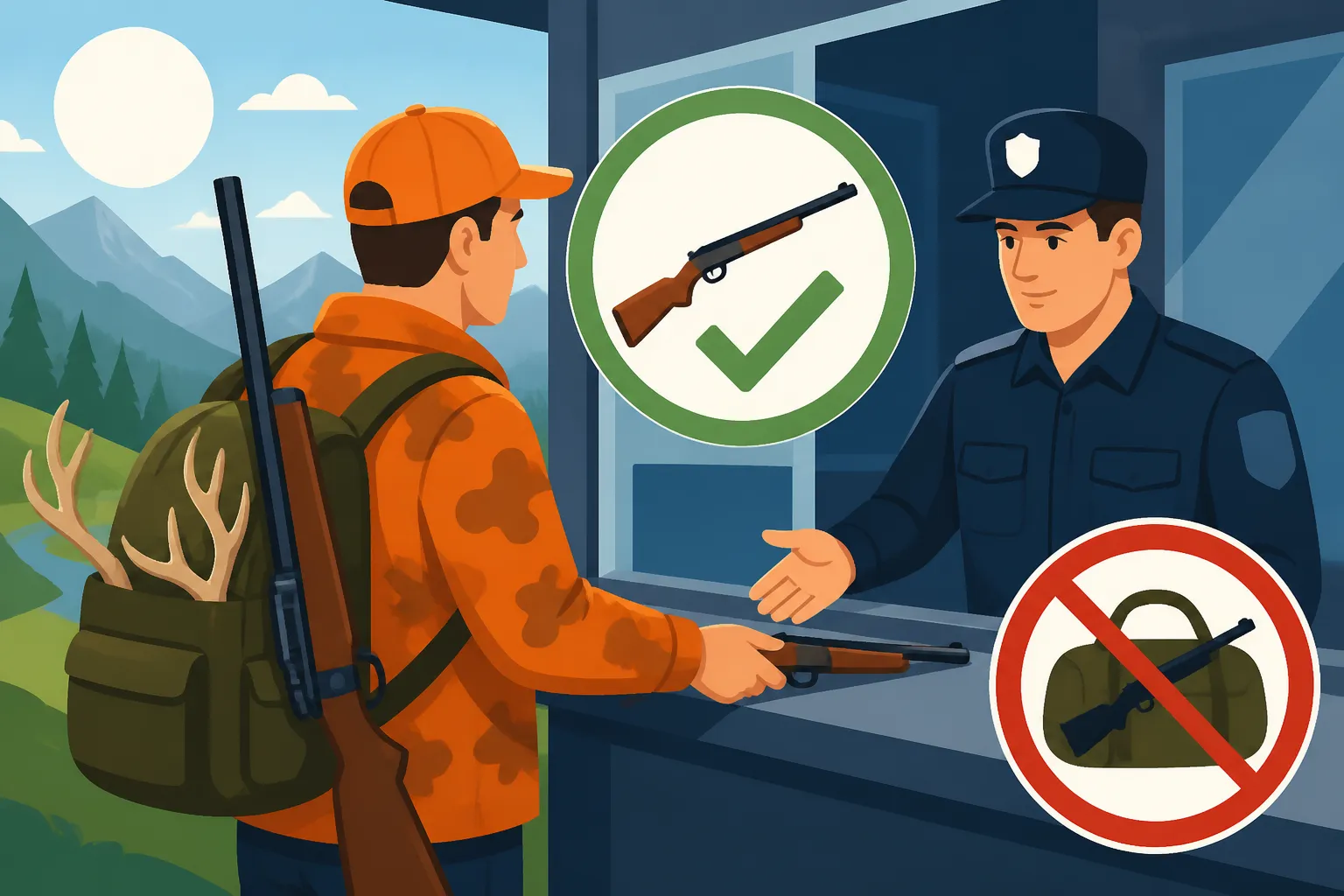
Declaring a Firearm When You Cross
Crossing an international border with firearms can feel like walking a tightrope, and the thought of making a mistake with customs when you're just trying to get to your hunting grounds in Alberta is enough to give anyone a knot in their stomach. Many seasoned hunters dread the paperwork and the unknown reception, but with the right preparation, declaring your firearm at the Canadian border can be a surprisingly smooth process. This guide is here to demystify that experience, helping you navigate the requirements for bringing your hunting rifle or shotgun into Alberta legally and without a hitch.
Why Declaring Your Firearm is Non-Negotiable
Let’s be honest, we’ve all heard the stories, or maybe you’ve even had a friend who tried to take a shortcut. But when it comes to firearms and international borders, cutting corners isn't just risky – it can be catastrophic for your hunting trip and your ability to travel internationally in the future. Canadian law is quite clear, and border services agents are trained to enforce it to the letter. Trying to slip a firearm across without proper declaration is a serious offense that will almost certainly lead to confiscation, fines, and even a permanent ban from entering Canada.
Imagine finally getting your dream Alberta Moose Licence Cost for Residents or a coveted draw tag, packing up your truck, and driving all the way to the border, only to have your rifle seized because you didn't fill out a form or pay a small fee. That's a nightmare scenario no hunter wants to live through. It’s not about being unlucky; it’s about understanding and respecting the rules of the country you’re entering. Canadian authorities prioritize safety, and proper firearm declaration is a cornerstone of that commitment.
The good news is that millions of hunters have brought their firearms into Canada legally without any issues. The system is designed to allow legitimate hunters to pursue their passion, provided they follow the established protocols. It truly boils down to preparation, honesty, and a healthy dose of patience when you arrive at the port of entry.
The Legal Ramifications of Not Declaring
The consequences of failing to declare a firearm when entering Canada are severe and can ripple through your life for years. At a minimum, you’re looking at your firearm being immediately seized and likely forfeited. This isn't a temporary hold; it's a permanent loss of your valuable hunting tool. Beyond that, fines can range into the thousands of dollars, far exceeding the small fee associated with the declaration form itself.
But it gets worse. You could face criminal charges, which can result in jail time and a criminal record. A criminal record in Canada can then make you inadmissible to the country indefinitely, meaning your future hunting trips – and even regular tourism or business travel – to Canada would be impossible. This isn't just a slap on the wrist; it's a door slammed shut on a significant part of your life. It’s simply not worth the gamble, not when the solution is straightforward and readily available.
Furthermore, any issues at the Canadian border can impact your ability to re-enter your home country. Border agencies in different nations often share information, and a violation in one country could raise red flags with your own authorities. So, what might seem like a minor oversight could lead to increased scrutiny every time you cross any international border in the future. The stress and hassle alone are enough reason to ensure every 't' is crossed and every 'i' is dotted before you even leave your driveway.
Understanding Canadian Firearm Laws
Canada has its own distinct set of firearm laws, which differ significantly from those in other countries, particularly the United States. While many aspects are complex, for hunters bringing in firearms temporarily, the key is understanding the classifications. Most common hunting rifles and shotguns fall under the "non-restricted" category. These are typically long guns with non-folding stocks, standard barrel lengths, and are generally used for sporting or hunting purposes. This is the category you’ll be dealing with for your hunting trip.
"Restricted" firearms generally include handguns, certain semi-automatic rifles, and some shotguns with shorter barrels. These are far more regulated, and non-residents are typically not permitted to bring restricted firearms into Canada for hunting or sporting purposes. There are extremely rare, specific exceptions, but for 99.9% of hunters, leaving handguns and restricted rifles at home is the safest and only viable option. "Prohibited" firearms, which include fully automatic weapons and certain other types, are strictly forbidden.
It's crucial to understand that even if your hunting rifle is legal and common where you live, you still must declare it and ensure it fits the Canadian "non-restricted" definition. The Canadian Border Services Agency (CBSA) officers are the final arbiters of what is admissible. Having done your homework, perhaps by checking resources like GoHunt for Canadian hunting regulations or by consulting your outfitter, will help ensure your gear aligns with Canadian law before you even approach the port of entry. Remember, ignorance of the law is no excuse, and officials won't hesitate to enforce the rules, no matter how sincere your apology.
The Canadian Non-Resident Firearm Declaration Form (CAFC 909): Your Best Friend
This form, officially known as the Non-Resident Firearm Declaration (Form CAFC 909), is your golden ticket to bringing your hunting firearm into Canada. It’s essentially a temporary licence that permits you to possess and transport your declared non-restricted firearms within Canada for a specific period. It’s a single document that covers all your non-restricted firearms, up to three, that you intend to bring for your trip. Don't try to bring in more than three, as that can complicate things unnecessarily.
Think of it as your passport for your rifle. Just like you wouldn't travel internationally without your personal passport, you shouldn't approach the Canadian border without this form properly filled out. The form asks for basic personal information, details about the firearm(s) you are bringing (make, model, serial number, calibre/gauge), and the purpose of your visit (e.g., hunting). It's designed to be straightforward, but attention to detail is paramount.
You can download and print this form from the Canadian Border Services Agency (CBSA) website before you travel. Having it already filled out (but not signed!) when you arrive at the border will save you a lot of time and potential stress. While you can often get the form at the border crossing itself, being prepared in advance demonstrates diligence and respect for the process, which can go a long way with border agents.
Filling Out the Form Correctly
Accuracy is the name of the game when filling out the CAFC 909. You’ll need your full name, address, and date of birth, just like on your passport. Then comes the critical part: detailing your firearm(s). For each firearm, you'll need the manufacturer (e.g., Remington, Winchester), the model (e.g., 700, Model 70), the serial number, and the calibre or gauge (e.g., .30-06, 12 gauge). Double-check, then triple-check, that these details match what’s engraved on your firearm exactly. Any discrepancies could cause delays or issues.
It's also important to indicate your hunting licence information if you have it already, or at least the general purpose of your visit (hunting). While you can't sign the form until you're in front of a CBSA officer, filling everything else out beforehand is a huge time-saver. Don't leave any blanks that you can fill in; a partially completed form will just mean more time spent at the inspection counter.
Many outfitters or hunter hosts who assist non-residents are intimately familiar with this form and can often guide you on the specific details or even provide you with a pre-filled version with their outfitter number or specific hunting location. If you’ve booked your trip through a reputable service like BookYourHunt, they should be able to connect you with an outfitter who can walk you through these specifics. Having a knowledgeable contact is a real advantage for a smooth crossing.
The Declaration Process at the Border
When you arrive at a Canadian port of entry, whether by land or air, you will first declare your firearm verbally to the CBSA officer. This is the critical first step. Do not wait for them to ask; volunteer the information immediately: "Hello, I am here to hunt, and I need to declare a non-restricted hunting firearm." This upfront honesty sets a positive tone. The officer will then typically direct you to a secondary inspection area or to a specific counter where a firearms officer can assist you.
At this secondary inspection, you'll present your filled-out CAFC 909 form, your passport, and any other relevant identification or hunting permits. The officer will review your form, verify the details, and likely ask to inspect your firearm(s). Crucially, your firearm must be unloaded and encased in a non-accessible manner. This means it should be in a locked case, and the ammunition stored separately, preferably in a locked container in a different part of your vehicle. Do not present a loaded firearm, and do not present it uncased or easily accessible. Follow all instructions given by the officer; their word is law at the border.
Once satisfied, the officer will have you sign the form, officially "confirming" your declaration. They will then process the fee, and validate the form. You'll receive a stamped copy. Keep this stamped copy with you at all times, especially when transporting your firearm within Alberta, as it serves as your temporary licence. This entire process might take anywhere from 15 minutes to an hour, depending on the volume of traffic and the officer's thoroughness. Patience and politeness are your best allies here; a positive attitude can make a big difference.
Associated Fees and Validity
There is a non-refundable fee associated with the Canadian Non-Resident Firearm Declaration. While specific costs can change, it's a relatively modest amount for the legal right to bring your firearms into the country. You can typically pay this fee by credit card or Canadian cash. It's always a good idea to check the most current fees on the official CBSA website before you leave to avoid any surprises.
Once validated, the declaration is typically valid for 60 days from the date of issue. This means you can use the same declaration for multiple entries and exits within that 60-day period, as long as you are bringing the exact same firearms and the declaration remains with you. This is particularly convenient if you plan a short scouting trip followed by a longer hunt, or if you make multiple trips to Alberta within a couple of months, perhaps for different seasons like Hunting Alberta's September Archery Opener and then Hunting Alberta's November Whitetail Rut.
It’s worth noting that this declaration is for the firearm itself, not a hunting licence. You'll still need to acquire your Alberta hunting licences, WIN card, and any specific tags separately, as outlined in articles like Alberta Hunting Licences and What They Cost. The firearm declaration simply grants you the legal authority to possess the specific declared firearms in Canada for the specified duration.
What Firearms Are Permitted (and What Aren't) for Hunting
This is where common sense, mixed with a little regulatory knowledge, really pays off. Alberta is a fantastic hunting destination, and the Canadian government fully expects hunters to bring appropriate firearms for their pursuits. However, "appropriate" is defined by Canadian law, not necessarily by what's popular or legal in your home country. Sticking to recognized hunting firearms will make your border crossing infinitely easier.
Generally speaking, bolt-action, lever-action, and pump-action rifles and shotguns are your safest bets. Semi-automatic shotguns and rifles are permitted if they meet the non-restricted criteria (e.g., non-removable magazine capacities, appropriate barrel lengths). The key takeaway is to avoid anything that could be mistaken for a military or assault-style weapon, even if it's legally considered a hunting rifle where you come from. When in doubt, leave it home and bring a more traditional hunting firearm.
Ammunition is also subject to rules. You're typically allowed to bring a reasonable amount for your hunting trip (often specified as up to 200 rounds per firearm, though checking the latest regulations is advised), but it must be factory-loaded and stored separately from the firearm, ideally in a secure, locked container. Loose ammunition or reloaded cartridges might raise questions, so keeping things professional and organized is always recommended.
Hunting Rifles and Shotguns
For the vast majority of Alberta hunters, a standard bolt-action rifle in a common hunting calibre (like .270, .30-06, .308, 7mm Rem Mag, etc.) or a pump-action or semi-automatic shotgun (for birds) will fall perfectly within the non-restricted category. These are the firearms designed and primarily used for hunting. When you're packing your rifle, ensure it's clean, well-maintained, and has its serial number clearly visible. Any modifications that could alter its classification (e.g., a stock that makes it fold to an illegal length) should be avoided.
If you are unsure whether your specific rifle or shotgun meets Canadian non-restricted criteria, it's always best to err on the side of caution. Contacting the Canadian Firearms Program or an experienced outfitter well in advance of your trip is a wise move. They can provide clarification specific to your situation. Remember, the goal is to make your hunting experience stress-free, and that starts with trouble-free entry into the country.
Consider the type of game you'll be pursuing. For big game like White-Tailed Deer, Alberta's Most Hunted Big Game or Mule Deer in Alberta's Open Country, a robust centre-fire rifle is appropriate. For Waterfowl Hunting Alberta's Grain Fields or Upland Bird Hunting in Alberta, a 12 or 20 gauge shotgun is standard. Stick to these common-sense choices, and you'll generally find the border crossing to be a simple formality.
Handguns and Restricted Firearms
Here's the firm rule for almost all non-resident hunters: Do not bring handguns or other restricted firearms for hunting in Alberta. While Canada does have provisions for handgun ownership and transport for specific competitive shooting events, these are exceptionally rare for non-residents and almost never apply to hunting. Trying to bring a handgun for "bear protection" or any other reason will almost certainly result in its seizure, regardless of your good intentions. Canadian law enforcement handles predator defense, and non-residents are not permitted to carry handguns for self-defense or hunting.
Similarly, certain semi-automatic rifles that are common in some countries, particularly those with features like pistol grips, collapsible stocks, or high-capacity magazines (over 5 rounds for most semi-automatic rifles used for hunting, 10 for rimfire), may be classified as restricted or even prohibited in Canada. Even if you've never had an issue with such a firearm elsewhere, Canadian laws are different. It's not worth the risk of confiscation or legal trouble.
The safest approach is to limit your firearms to traditional, non-restricted hunting rifles and shotguns. If you are ever in doubt about a specific firearm, contact the Canadian Firearms Program before you travel. Your outfitter or hunter host can also advise you. It's better to be safe than sorry and ensure your trip is focused on the hunt, not on legal complications at the border.
Ammunition Rules
Beyond the firearms themselves, ammunition also has rules. You can bring a "reasonable amount" of ammunition for the declared firearms for your hunting trip. While this can sometimes be vague, most hunters adhere to a guideline of up to 200 rounds per firearm. If you plan to bring more, be prepared to justify it and potentially face further scrutiny. It's typically recommended to bring only factory-loaded ammunition in its original packaging. Reloaded ammunition might be allowed, but it can sometimes cause delays as officers may question its origin or safety.
The absolute most important rule for ammunition is storage. It must be transported separately from the firearm itself. This means your ammunition should not be in the same locked case as your rifle. It should be stored in a separate, secure, locked container (like an ammo can) and ideally in a different compartment of your vehicle, away from the firearm. For example, rifle in a locked case in the back seat, ammo in a locked can in the trunk. For air travel, there are very specific and strict rules about ammunition transport, which you should confirm with your airline well in advance.
Adhering to these storage rules demonstrates your understanding of safe firearm handling and respect for Canadian laws, which will greatly assist in a smooth border crossing. Articles like Ammunition Rules at the Canadian Border provide even more detailed guidance on these often-overlooked but crucial requirements.
Tips for a Smooth Border Crossing
Preparing for a border crossing with firearms isn't just about filling out a form; it's about a mindset of readiness and respect for the process. Think of it as scouting for your hunt – the more thoroughly you prepare, the higher your chances of success. A smooth crossing involves gathering all your documents, knowing what to expect, and presenting yourself in a clear, honest manner.
Beyond the firearm declaration itself, have all your personal travel documents in order. This includes your passport, driver's licence, and any invitation letters from an outfitter or hunter host. If you've communicated with an outfitter via a service like BookYourHunt, ensure you have their contact information readily available. Being organized alleviates stress for both you and the border agent.
Finally, remember that border agents have a tough job. They are focused on national security and enforcing laws. Approach them with courtesy, answer their questions truthfully and directly, and avoid making jokes or being flippant about firearm regulations. A respectful demeanor goes a long way in ensuring your entry into Alberta is as quick and painless as possible.
Preparation is Key
Before you even load your vehicle, make a checklist of everything you need for the border. This should include:
- Passport: Valid and up-to-date.
- Non-Resident Firearm Declaration Form (CAFC 909): Pre-filled, but unsigned.
- Firearms: Unloaded, secured in locked cases.
- Ammunition: Separated from firearms, in a locked container.
- Hunting License/Permits (if applicable): If you've purchased them online already.
- Proof of Purpose: This could be an outfitter contract, an email from a hunter host, or details of your planned hunting area.
- Return Address/Contact Info: For your outfitter or hunter host.
- Method of Payment: For the declaration fee.
Have these documents organized and easily accessible, not buried under a pile of gear. Imagine trying to find a crucial document while a border agent is waiting; it's a frustrating experience for everyone involved. Planning your route and knowing which border crossing you'll use can also help, as some smaller crossings might be less busy but might also have fewer staff, potentially extending wait times. Familiarize yourself with articles like Bringing a Rifle Across the Border for more specific packing tips.
Storage and Transport in Your Vehicle
Once you’ve successfully declared your firearm and paid the fee, you’ll need to ensure you transport it legally within Alberta. The rules for transport are similar to those for bringing it across the border: all non-restricted firearms must be unloaded, and either equipped with a secure locking device (like a trigger lock) or encased in a non-transparent, secure container (like a locked hard case or soft case). Ammunition must be stored separately.
Never drive around with a loaded firearm in your vehicle, even if you’re on Crown land or heading to a hunting spot. This is a serious offense. When you stop for gas or food, ensure your firearms are locked and out of sight. Leaving them visible, even if secured, can attract unwanted attention or theft. Common sense security practices go a long way to preventing issues while you're traveling to your hunting camp or between different Alberta's Wildlife Management Units.
A well-organized vehicle isn't just for convenience; it's part of legal compliance. Having your firearm and ammunition correctly stored from the moment you leave home until you set up camp will keep you on the right side of the law and make for a much more relaxed trip.
Getting Help from Your Outfitter or Hunter Host
One of the greatest resources for navigating the Canadian firearm declaration process is your Alberta outfitter or hunter host. They are intimately familiar with Canadian firearm laws, the declaration form, and the nuances of border crossings. They often deal with non-resident hunters frequently and can offer invaluable advice. If you’re using a service like GoHunt or BookYourHunt to find your outfitter, don’t hesitate to ask them about border crossing procedures during your booking process.
An outfitter can often provide you with specific details about their location that you might need for the form, or even help you fill it out. They can also advise you on any recent changes to regulations that you might not be aware of. When you book a guided trip, part of their service is to ensure you have a smooth and legal hunting experience from start to finish. This extends to your entry into the country. Hunting Alberta With a Hunter Host also sheds light on the responsibilities and benefits of having a local contact.
Leverage their expertise. Before your trip, have a conversation with your outfitter or host specifically about the firearm declaration process. Ask them if they have any tips for the particular border crossing you’ll be using. Their local knowledge can save you time, stress, and potential headaches, letting you focus on the excitement of your upcoming Alberta hunting adventure.
| Requirement | What to Do | Why It Matters |
|---|---|---|
| Declaration Form | Download and pre-fill CAFC 909 (do not sign) | Saves time, shows preparedness |
| Firearms | Unloaded, in locked, opaque cases | Legal requirement, ensures safety, prevents confiscation |
| Ammunition | Separate from firearms, in locked container | Legal requirement, enhances safety |
| Identification | Valid Passport, Driver's License, WIN card (if applicable) | Essential for entry and identification |
| Purpose of Visit | Have proof of hunting trip (outfitter contract, invite letter) | Confirms legitimate reason for firearm import |
| Border Agent Interaction | Be honest, polite, answer questions directly | Facilitates a smooth process, avoids suspicion |
| Declaration Fee | Be prepared to pay by credit card or Canadian cash | Required to validate the declaration |
| Keep Copy | Retain your stamped and signed copy of CAFC 909 | Serves as your temporary license for transporting firearms within Canada |
Disclaimer
This article is for general informational purposes only and does not constitute professional advice. Laws, prices and regulations vary by location and change over time. Consult a qualified professional for guidance on your specific situation.