Why Mule Deer Prefer Broken Country
If you've spent any time hunting or observing wildlife in Alberta, you've likely noticed that mule deer aren't often hanging out in wide-open, flat crop fields the way white-tailed deer sometimes do. Instead, they seem to vanish into the most rugged, undulating terrain imaginable. This isn't just a coincidence; it's a fundamental aspect of their survival. This guide will delve deep into why mule deer have such a strong preference for broken country and how this shapes their behavior across Alberta's diverse landscapes.
The Innate Draw of Alberta's Broken Country for Mule Deer
Mule deer, with their distinctive bounding gait and oversized ears, are creatures perfectly adapted to wide-open, yet broken, landscapes. Unlike their whitetail cousins who often prefer the dense cover of forests and thickets, mule deer instinctively seek out terrain that offers vertical relief and panoramic views. This isn't just about personal preference; it's a deep-seated evolutionary trait that has allowed them to thrive in some of North America's more challenging environments.
Hardwired for Topographical Advantage
From the moment a mule deer fawn takes its first wobbly steps, it's learning to navigate a world defined by subtle dips and dramatic rises. Their large ears, often swiveling independently, are perfectly designed to pick up distant sounds across vast expanses, while their unique bounding leap—often referred to as a "stot" or "pronk"—allows them to cover broken ground with incredible efficiency and speed, clearing obstacles and gaining elevation in a series of powerful bounds. This bounding gait also has the advantage of making them appear to "bounce" rather than run in a straight line, making them harder to track for a predator. They are built for this country, their very anatomy a testament to the advantages it offers.
Their natural inclination is to use high points for scanning and to quickly descend into depressions or behind ridges for immediate concealment. This inherent behavior is largely driven by their need for security in open spaces. Where a whitetail might rely on the impenetrable density of a bush to hide, a mule deer utilizes the contours of the land itself. This makes understanding the terrain a crucial aspect when you're looking for Where Alberta's Mule Deer Live.
Visibility, Security, and Breaking Line of Sight
In broken country, mule deer can achieve a remarkable feat: they can see for miles while simultaneously being able to vanish in plain sight. A slight roll in the prairie, a deep cut of a coulee, or a series of eroded badlands formations all provide opportunities for immediate concealment. They don't need thick timber; they need topography.
This ability to quickly break the line of sight is paramount to their survival. A mule deer might be feeding on a ridge, keenly aware of everything below and around it. The moment it detects danger, it doesn't always flee in a panic. Instead, it might simply walk a few yards, slip over the crest of a hill, or drop into a gully, instantly disappearing from view. This isn't just about hiding; it's about making predators work harder, forcing them to guess where the deer went and use precious energy trying to relocate it. This constant interplay between visibility and concealment is a cornerstone of their existence in the rugged parts of Alberta.
Defining Mule Deer Habitat in Alberta's Varied Terrain
Alberta offers a fascinating mosaic of landscapes, and within this diversity, certain areas stand out as prime mule deer habitat due to their broken nature. Understanding these specific features is key to appreciating why these magnificent animals choose to call them home.
Coulees, Badlands, and River Bottoms: Prime Real Estate
When we talk about "broken country" in Alberta, we're often referring to specific geographical features that are a mule deer's dream. Coulees, those deep, eroded ravines that crisscross the prairie, are perhaps the most quintessential example. These natural funnels often have a rich mix of dense brush, small trees like aspen and willow, and often hold snow and moisture longer, providing vital shelter and sustenance. They are natural highways and hideouts all in one, forming complex networks where deer can travel, feed, and bed down with relative safety. When you're out Hunting a Prairie Coulee Bottom, you quickly learn how mule deer vanish into these folds.
The dramatic formations of the badlands, particularly along rivers like the Red Deer or the Milk River, are another prime example. Here, erosion has sculpted the land into a maze of pinnacles, deep cuts, and hidden valleys. This creates an almost fortress-like environment where mule deer can browse on unique vegetation, find shelter from the elements, and easily evade detection. Hunters experienced in Hunting Mule Deer in the Badlands Coulees know how challenging and rewarding these areas can be. River breaks, which are the often-steep, treed banks transitioning from flat prairie to a river valley, also provide a rich and diverse habitat. These areas are a blend of open country and dense cover, offering everything a mule deer needs in a compact zone. If you ever have the chance to explore a Hunting a Milk River Ridge Coulee, you'll see firsthand the intricate network of cover and browse they provide.
Essential Resources: Food, Water, and Bedding
The varied topography of broken country directly translates to a greater diversity of plant life, offering mule deer a smorgasbord of browse options. You'll find everything from saskatoon and buffalo berry bushes clinging to slopes, to pockets of aspen and willow in the bottoms of draws. This varied diet provides them with crucial nutrients throughout the year, especially important during the lean winter months.
Furthermore, these drainage systems are often where water collects and flows, providing access to perennial water sources, a vital commodity in arid prairie regions. These hidden springs and seasonal puddles tucked away in coulee bottoms are often the lifeblood of the local deer population.
When it comes to bedding, mule deer are masters of strategic placement. In winter, you'll often find them on south-facing slopes, soaking up every ray of sunshine to conserve energy. In contrast, during the heat of summer, they'll seek out shaded benches on north-facing slopes or deep within thick brush patches in a coulee bottom, escaping the midday sun. Their choice of bedding site is always a calculated decision based on security, thermal regulation, and proximity to food and water. This understanding of their seasonal movements is critical to successful Mule Deer Hunting Alberta's Prairie and Badlands.
To further illustrate the contrast, let's look at how mule deer's habitat choices differ from those of white-tailed deer:
| Feature | Mule Deer Preference in Broken Country | White-Tailed Deer Preference in Parkland/Bush |
|---|---|---|
| Cover Type | Topographical (coulees, ridges, breaks) | Vegetative (dense bush, timber, shelterbelts) |
| Escape Strategy | Utilize elevation changes, "disappear" over ridges | Dash into thick cover, use speed through trees |
| Bedding Sites | Sun-exposed slopes (winter), shaded benches, draws | Thick tangles, under canopy, dense brush piles |
| Visibility | High vantage points to spot threats | Reliance on scent and sound in dense cover |
| Travel Routes | Along coulee bottoms, ridge lines, saddles | Well-worn trails through timber, field edges |
| Predator Avoidance | Break line of sight, rapid bounding gait | Hold tight, sudden bursts, rely on heavy cover |
Survival Strategies: How Broken Country Protects Mule Deer
The unique characteristics of broken country aren't just about comfort for mule deer; they are absolutely integral to their survival, offering unparalleled advantages against predators and the harsh elements of the Alberta landscape.
Eluding Predators and Hunter Pressure
Mule deer are renowned for their almost magical ability to vanish. One moment, a big buck might be standing proudly on a ridge, and the next, he's simply gone. This "disappearing act" is their primary defense mechanism, a skill honed over millennia in these rugged landscapes. Instead of relying solely on speed in a straight line, they use the terrain to their advantage, slipping over a rise, dropping into a draw, or weaving through a maze of badlands formations. This forces predators like coyotes, wolves, and even human hunters to constantly search and reassess, often losing the scent trail or line of sight entirely.
For hunters, this means that even after you spot a deer, the real challenge begins. A seemingly easy stalk can turn into a frustrating game of hide-and-seek as the deer uses every contour, every scrub brush, and every shadow to its advantage. This is why tactics like Stalking Mule Deer in Badlands Breaks are so dependent on patience and understanding the terrain as well as the animal. The broken landscape provides not just one escape route, but often dozens, allowing the deer to choose the path of least resistance or greatest concealment.
Mastering the Elements in Rugged Landscapes
Alberta's weather can be notoriously unpredictable and extreme. From scorching summer days to brutal winter blizzards, game animals must adapt to survive. Broken country provides mule deer with crucial tools for thermal regulation and protection. In winter, deep coulees and river bottoms act as natural windbreaks, offering respite from relentless prairie winds and heavy snowfalls. South-facing slopes, basking in the weak winter sun, become vital warming stations, helping deer conserve energy during the coldest months. This is particularly important for How Mule Deer Use Coulees in Winter.
Conversely, in the heat of summer, north-facing slopes and the shaded bottoms of steep draws provide cool sanctuaries, allowing deer to escape the sun's intense rays and conserve moisture. The diverse elevation and aspect changes within broken country mean that within a relatively small area, a mule deer can find dramatically different microclimates, allowing them to regulate their body temperature and survive the full spectrum of Alberta's harsh weather conditions.
Navigating and Hunting Broken Country for Alberta Mule Deer
Hunting mule deer in Alberta's broken country is a true test of a hunter's patience, glassing skills, and ability to read the landscape. It's not always about covering miles of ground, but rather understanding how to efficiently cover the right ground and letting your optics do the walking.
Effective Scouting and Glassing Techniques
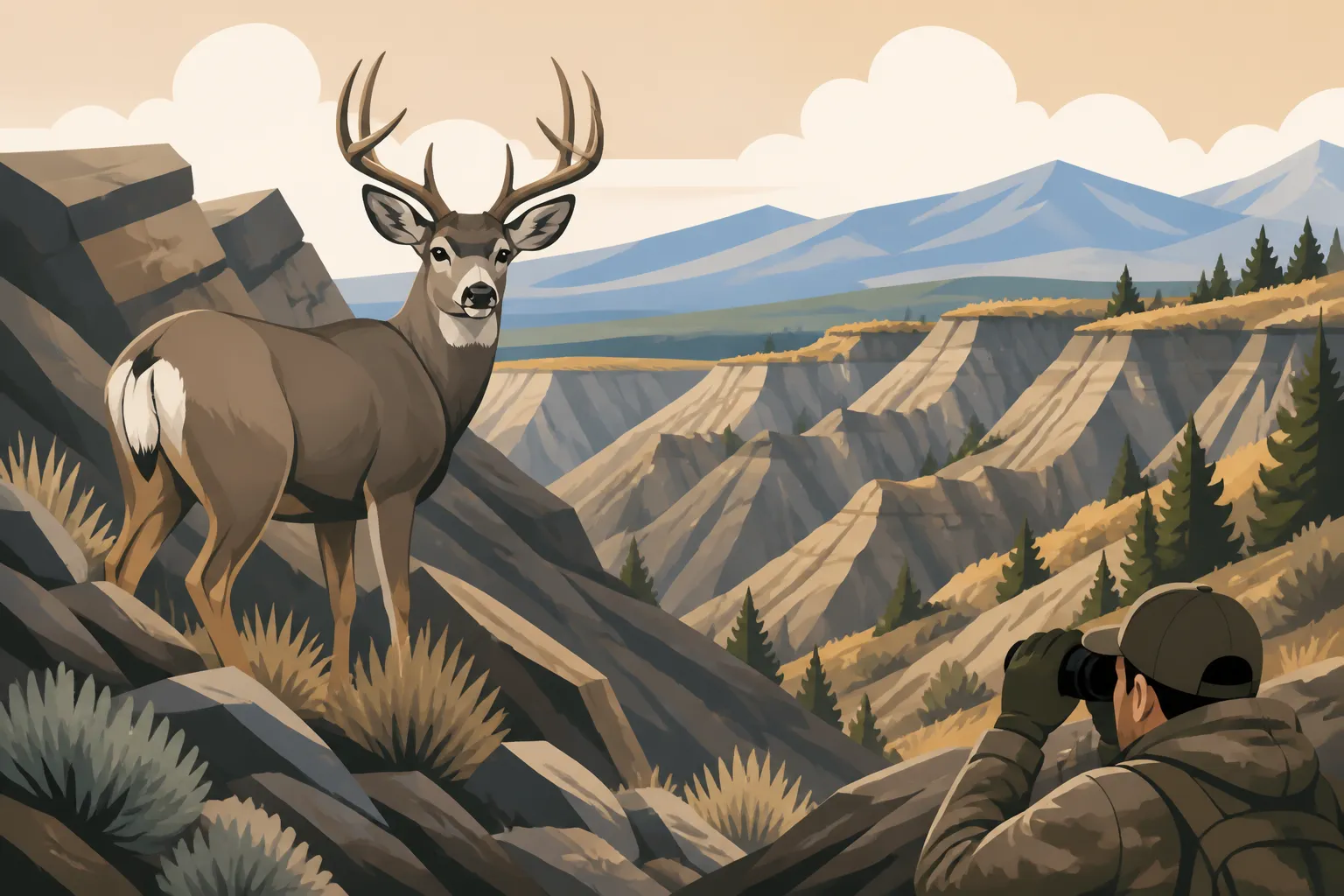
When you're chasing mule deer in these rugged environments, your eyes and your optics are your most valuable tools. High-quality binoculars and spotting scopes are non-negotiable. The strategy is to find a high vantage point—a prairie knob, a badlands pinnacle, or a prominent ridge overlooking a series of coulees—and methodically glass every inch of the landscape below and around you. This involves slowly picking apart the terrain, looking for subtle movements, flicking ears, or the tell-tale horizontal line of a deer's back against the vertical patterns of the environment. Many hunters find that digital mapping tools are invaluable for this pre-hunt scouting and in-field navigation. Platforms like GoHunt allow you to analyze topographical maps, identify potential vantage points, understand elevation changes, and mark promising areas from the comfort of your home. This way, when you get out there, you have a solid plan for where to set up your glassing stations. Mastering Glassing an Alberta Coulee for Mule Deer is a skill that takes time, but it’s incredibly rewarding.
Before you even step foot in the field, use tools like GoHunt to explore the terrain virtually. You can zoom in on specific coulees, study the aspect of different slopes, and identify potential bedding areas or travel corridors. This kind of advanced preparation, often referred to as Scouting With Satellite Imagery in Alberta, gives you a significant edge, helping you prioritize where to focus your efforts.
Locating and Approaching Mule Deer
Once you've spotted a mule deer, especially a good buck, the real game begins. Their movements are often dictated by the broken terrain itself. They'll use ridge lines as travel routes, drop into saddles to cross between drainages, and follow the bottoms of coulees for concealed movement. Understanding these patterns is key to getting within range. GoHunt can be particularly useful here, as it can overlay various layers of information, helping you predict how a deer might move through the landscape given the wind direction and available cover. Knowing where to anticipate their next appearance is half the battle.
The next step is the stalk, which requires meticulous planning and execution. This is where the broken country becomes your ally, just as it is the deer's. You must use every dip, rise, and patch of brush to your advantage, keeping out of sight and minimizing noise. Always be mindful of the wind, as a mule deer's nose is incredibly sensitive. A successful Spot-and-Stalk Mule Deer in Alberta hunt is a chess match against nature, requiring patience, stealth, and a deep understanding of how to use the land to your benefit. Whether you're trying Hunting Mule Deer on a Prairie Ridge or following a track into a deep draw, always consider the animal's likely escape routes and where it might try to disappear next. The reward for this effort can be seeing a magnificent animal like a What a Mature Alberta Mule Deer Weighs up close.
Disclaimer
This article is for general informational purposes only and does not constitute professional advice. Laws, prices and regulations vary by location and change over time. Consult a qualified professional for guidance on your specific situation.