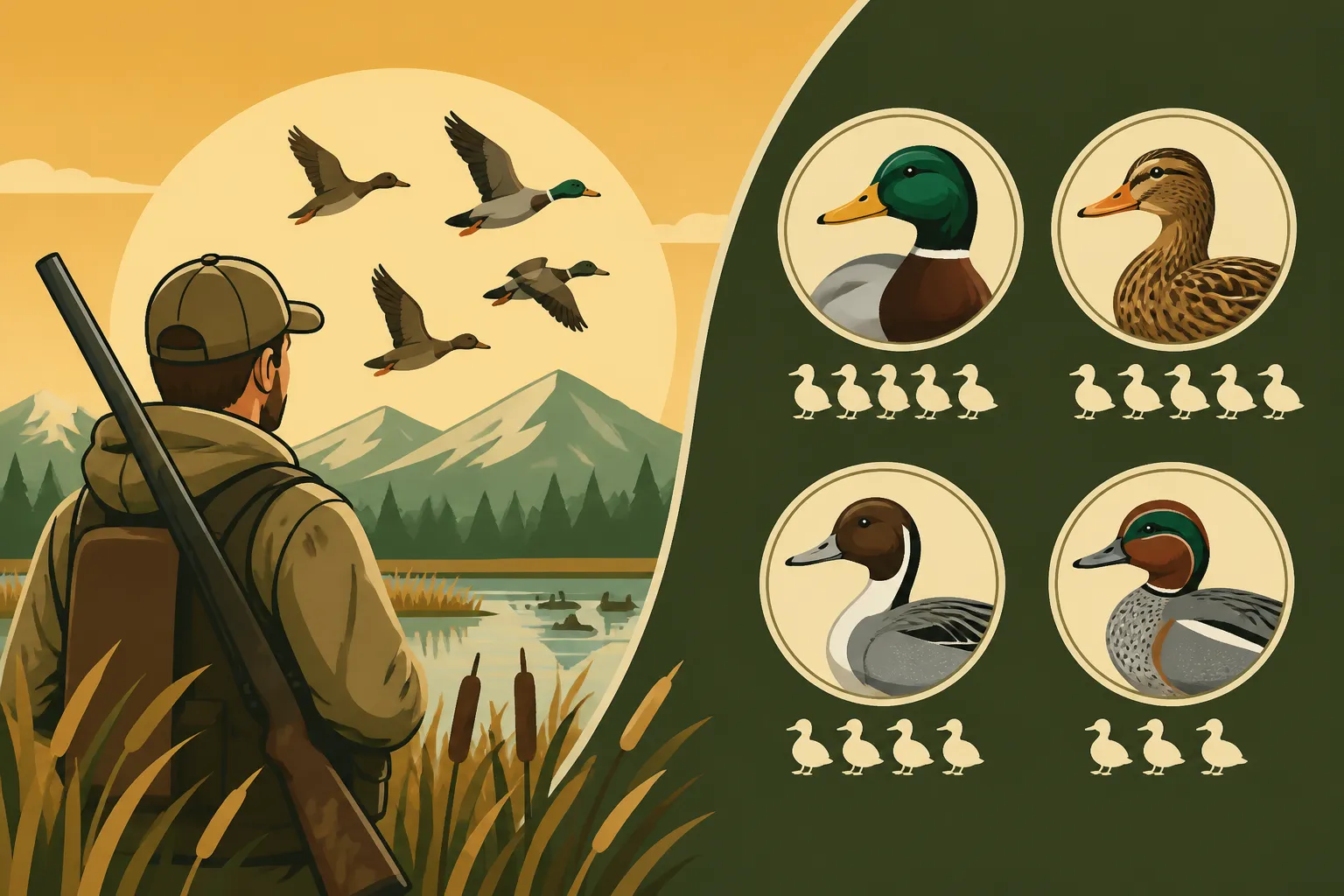
Duck Daily Bag Limit by Species
Navigating the specifics of duck daily bag limits in Alberta can feel like trying to hit a fast-flying teal with a slingshot—confusing and often frustrating if you're not absolutely sure of the rules. Between the federal migratory bird regulations and Alberta's own nuanced approach, it’s easy to second-guess yourself when you're out in the field. This comprehensive guide is here to untangle all that, providing clear, practical information on the daily bag limits for various duck species across Alberta, so you can hunt with confidence and stay well within the law.
Understanding Alberta's Waterfowl Regulations Framework
Alberta’s waterfowl hunting regulations are a blend of federal and provincial rules, a two-tiered system that sometimes trips up even seasoned hunters. The federal government, through Environment and Climate Change Canada, sets the overarching rules for migratory birds, including ducks, geese, and cranes. This covers everything from the necessity of a Federal Migratory Game Bird Permit Cost to the requirement for non-toxic shot. Then, Alberta Fish and Wildlife adds its own layer of regulations, often specifying season dates by wildlife management unit (WMU) and sometimes adjusting bag limits within the federal framework.
It’s crucial to remember that you absolutely need a federal Migratory Game Bird Hunting Permit, which includes the Canadian Wildlife Habitat Conservation Stamp, in addition to your provincial hunting license and a valid Alberta Wildlife Certificate. This permit is your ticket to legally hunt migratory birds anywhere in Canada, and the stamp directly supports conservation efforts. Without it, even if you have all your provincial paperwork in order, you’re hunting illegally. Many hunters use digital tools like the GoHunt app to keep track of their licenses and permits, ensuring everything is valid before heading out into the field. This dual regulatory system ensures that both continental and local waterfowl populations are managed sustainably, accounting for migration patterns and regional nesting success.
For those just starting out or crossing into Alberta from another province, the first step should always be to consult the official Alberta hunting regulations guide for the current year. This document, available online and at most license vendors, will outline the most up-to-date information regarding Alberta Game Bird Seasons and Limits, including specific season dates which can vary slightly from year to year based on population surveys and management objectives. The general principles of daily bag limits, however, tend to remain fairly consistent, especially for the most common duck species.
Specific Daily Bag Limits for Common Duck Species
When it comes to ducks, it’s not just a single limit for "ducks." The regulations break down limits by species, or groups of species, recognizing their differing population statuses and conservation needs. This is where most hunters find themselves pulling out their regulation book or checking an app like GoHunt to make sure they're not over-bagging on a particular duck type. Knowing these limits by heart, or at least having quick access to them, is essential for a responsible hunt.
Let's dive into the specifics for some of Alberta’s most common and sought-after duck species. Keep in mind that "total ducks" usually refers to the aggregate number of ducks you can harvest, and within that total, there are often sub-limits for specific species.
Mallards: These are arguably the most popular ducks across Alberta, found everywhere from Pothole Hunting Ducks on Small Water in the prairies to the vast Hunting Alberta's Waterfowl and Migration Routes of the parkland. For Mallards, Alberta generally has a generous daily bag limit. You can typically harvest up to 8 Mallards per day, but with a specific restriction: only 2 of these 8 can be hens. This is a critical detail, as hen Mallards are often key to successful breeding seasons, and their protection helps ensure future generations. Always strive to identify your ducks before shooting, especially when hunting over decoys or pass shooting, to avoid inadvertently taking too many hens.
Pintails: Northern Pintails are elegant birds with distinctive long tails, making them a prize for many hunters. Unfortunately, their populations have seen fluctuations over the years, leading to more conservative bag limits. Typically, the daily bag limit for Pintails in Alberta is much lower than for Mallards, often restricted to just 1 or 2 per day. This reflects conservation efforts to help their numbers rebound, particularly in their key breeding grounds which include much of Alberta's agricultural areas where they seek out wet fields and ponds.
Canvasbacks: Known for their striking appearance and exceptional table fare, Canvasbacks are another species with lower daily bag limits due to historical population concerns. Hunters can usually only harvest 1 or 2 Canvasbacks per day. These birds are strong flyers and tend to inhabit larger bodies of water, making them a challenging and rewarding target. Their distinctive head shape and coloration make them relatively easy to identify in flight once you're familiar with them.
Redheads: Similar to Canvasbacks, Redheads are diving ducks with distinct red heads (on drakes) and a propensity for larger wetlands. Their daily bag limit is also typically restricted to 1 or 2 per day. These limits are in place to ensure sustainable harvesting and support population stability. Hunters pursuing Redheads should be adept at identifying diving ducks quickly, as they often fly in mixed flocks with other species.
Scaup (Bluebills): Both Lesser and Greater Scaup, often referred to as "bluebills" due to their bill colour, are diving ducks common in Alberta. Their daily bag limit usually allows for a higher number, often around 4 to 6 per day. Scaup can be found in a variety of habitats but are particularly fond of larger lakes and rivers during migration. Identifying them can sometimes be tricky, especially distinguishing between Lesser and Greater Scaup, but for bag limit purposes, they are usually grouped together.
Other Ducks (including Teal, Gadwall, Wigeon, Shoveler, etc.): For many other common duck species like Green-winged Teal, Blue-winged Teal, Gadwall, American Wigeon, and Northern Shoveler, the daily bag limits are often more generous, typically falling under a "total ducks" category with a collective limit. After accounting for the specific limits on Mallard hens, Pintails, Canvasbacks, and Redheads, hunters can usually fill the remainder of their daily bag with these species up to a higher overall total, often 6 to 8 birds. Teal, being small and incredibly fast, are a favourite early-season bird, particularly when Alberta Archery Season Opening Day brings warmer weather and abundant feed in shallow waters.
Here's a simplified table illustrating common duck daily bag limits in Alberta. Always consult the official regulations for the most current and precise numbers, as they can be subject to change.
| Duck Species | Typical Daily Bag Limit | Specific Notes |
|---|---|---|
| Mallard | 8 | Only 2 can be hens |
| Northern Pintail | 1 – 2 | Consult regulations for exact yearly limit |
| Canvasback | 1 – 2 | Consult regulations for exact yearly limit |
| Redhead | 1 – 2 | Consult regulations for exact yearly limit |
| Scaup (Bluebill) | 4 – 6 | Grouped as Lesser and Greater Scaup |
| Other Ducks (e.g., | 6 – 8 | Combined total, after specific limits are met |
| Teal, Gadwall, | (part of overall total) | |
| Wigeon, Shoveler) | ||
| Total Ducks | 8 | Maximum total number of ducks, including all species |
Note: This table is for illustrative purposes. Always refer to the current Alberta Hunting Regulations.
This breakdown illustrates the importance of not just knowing how many ducks you can shoot, but which kinds. Misidentification or carelessness can lead to exceeding a species-specific limit, which is a violation. Tools like GoHunt can often provide quick access to these tables right on your phone, making it easier to reference while in the field.
Dealing with Possession Limits and Special Cases
Beyond the daily bag limit, there's another crucial number hunters need to understand: the possession limit. While the daily bag limit dictates how many birds you can harvest in a single day, the possession limit refers to the maximum number of birds you can legally have in your possession at any given time, whether they're in your cooler, freezer, or at your camp. For most duck species in Alberta, the possession limit is typically three times the daily bag limit. This allows hunters to participate in multi-day hunts or save their harvest over several outings without immediately needing to process and consume all their birds.
For example, if the daily bag limit for Mallards is 8 (2 hens), your possession limit would generally be 24 Mallards (with a maximum of 6 hens). This means if you hunt for three consecutive days and limit out on Mallards each day, you’d be right at your possession limit. If you plan a longer hunt, say a full week of Hunting Ducks on an Alberta Stubble Field, you’ll need to manage your harvest carefully, perhaps only shooting certain species on specific days, or ensuring you've consumed or given away birds to stay within legal possession. It’s a good practice to keep track of your harvest, whether it's a mental tally or a written record, to avoid accidentally exceeding this limit.
Special cases can arise, particularly with species that have very restrictive limits or during specific periods. For instance, the limits for species like Sandhill Cranes Passing Through Alberta are distinct and separate from duck limits. It’s also vital to remember that all migratory game birds, including ducks, must be transported in a way that allows for species identification and sex determination (if relevant to limits) until they are processed at your ordinary residence. This means keeping at least one fully feathered wing attached to the bird while transporting it from the field. This rule is in place to ensure that enforcement officers can verify compliance with bag and possession limits.
Another significant consideration is Non-Toxic Shot Requirements for Migratory Birds. Federal regulations mandate the use of non-toxic shot (e.g., steel, bismuth, tungsten-iron) for all migratory bird hunting. Lead shot is strictly prohibited for waterfowl. This regulation is critical for environmental health, preventing lead poisoning in birds that might ingest spent shot. Ensure your shotgun shells are clearly marked as non-toxic before heading into any duck blind or field.
For hunters using tools like the GoHunt app for digital mapping and record-keeping, it can also be invaluable for marking harvest locations or noting specific regulations tied to a particular WMU or hunting zone. While duck limits are largely consistent province-wide, local conditions or specific conservation initiatives could sometimes lead to nuances, making ongoing vigilance of the regulations essential. It helps ensure that every hunter can contribute to sustainable wildlife management and enjoy the incredible opportunities for Alberta's Waterfowl and Migration Routes that our province offers.
Practical Tips for Adhering to Limits and Enjoying Your Hunt
Adhering to bag and possession limits isn't just about following the law; it's about being a responsible, ethical hunter. It ensures that wildlife populations remain healthy for future generations and maintains the integrity of our hunting heritage. Here are some practical tips to help you stay compliant and maximize your enjoyment while duck hunting in Alberta.
First and foremost, know your ducks. This might sound obvious, but in the heat of the moment, with birds decoying fast, it can be challenging to differentiate between a Canvasback and a Redhead, or a Mallard hen from a Pintail hen. Spend time studying identification guides, use flashcards, or practice with bird identification apps. Many experienced hunters make an effort to only shoot at birds they can positively identify to ensure they don't accidentally exceed a species-specific limit. This practice also helps reduce crippling losses, as you're more likely to make a clean shot on a bird you've clearly identified and targeted. Understanding the flight patterns, sizes, and colours of the various species will make you a much more effective and ethical waterfowl hunter.
Check the regulations annually. Hunting regulations are not static. They can change from year to year based on population surveys, environmental conditions, and management goals. Always consult the most current Alberta Hunting Regulations before the season starts. Don't rely on last year's knowledge or what a friend told you. Websites like GoHunt or the official Alberta Fish and Wildlife site are your best sources for up-to-date information, including Alberta Duck Season Dates and any specific alerts for certain WMUs or species. A quick check of the regulations can save you a significant headache and potential legal trouble.
Keep a tally. For multi-day hunts, or if you're hunting with a group, keeping a running tally of harvested birds is invaluable. A small notebook, a digital note on your phone, or even a simple clicker counter can help you track how many of each species you've taken. This is especially important for species with lower, specific limits like Pintails or Canvasbacks. If hunting with partners, ensure everyone understands the group's collective harvest to avoid exceeding limits across the party. For instance, if you're Scouting Fields for Alberta Waterfowl and planning multiple trips to productive areas, knowing your cumulative possession can dictate your strategy.
Respect the resources. Remember that Which Ducks Nest in Alberta's Pothole Country contributes significantly to continental duck populations, making Alberta a truly special place for waterfowl hunting. Our role as hunters is to be stewards of this resource. Only take what you need and what is legally allowed. Avoid wanton waste of game meat, which is also against regulations. Proper field dressing and care of your birds will ensure the meat is of the highest quality. Consider sharing your harvest with friends or family, always ensuring that any gifted game is accompanied by a document explaining the species, number, and license information, as per regulations.
By combining diligent preparation, continuous learning, and responsible hunting practices, you'll not only stay within the legal framework of Alberta's duck daily bag limits but also contribute positively to the conservation of these magnificent migratory birds. Happy hunting, and may your flights be full and your freezer fuller (within limits, of course)!
Disclaimer
The information provided in this guide is for general informational purposes only and does not constitute legal advice. Hunting regulations in Alberta are subject to change, and it is the hunter's responsibility to consult the official Alberta Hunting Regulations and federal Migratory Bird Hunting Regulations for the current year before engaging in any hunting activities. Always ensure you have the appropriate licenses and permits, and adhere to all local, provincial, and federal laws.