Telling a Whitetail From a Mule Deer
Stepping out into the crisp Alberta morning, rifle in hand or bow at the ready, there's a unique thrill. But then you spot movement in the distance—a flash of brown, a flicker of white. Is it a whitetail, Alberta's most hunted big game, or a majestic mule deer? For many hunters, especially those new to our diverse landscapes, telling these two incredible deer species apart can be a real head-scratcher. Their ranges often overlap, their colors can be similar, and in a fleeting moment, a misidentification can mean a missed opportunity or, worse, an illegal harvest. This guide is dedicated to helping you confidently distinguish between whitetail and mule deer, ensuring you make the right call in the field every time.
The Obvious Tells: Physical Differences You Can Spot
When you're trying to quickly identify a deer in the field, there are a few key physical characteristics that, once you know them, become unmistakable clues. These aren't just subtle nuances; often, they're dramatic differences that stand out if you know what to look for.
Tail, The Ultimate Flag (or Rope) Test
Perhaps the most famous and reliable differentiator between these two species lies in their tails. It's truly a "tell-tale" sign, pun intended!
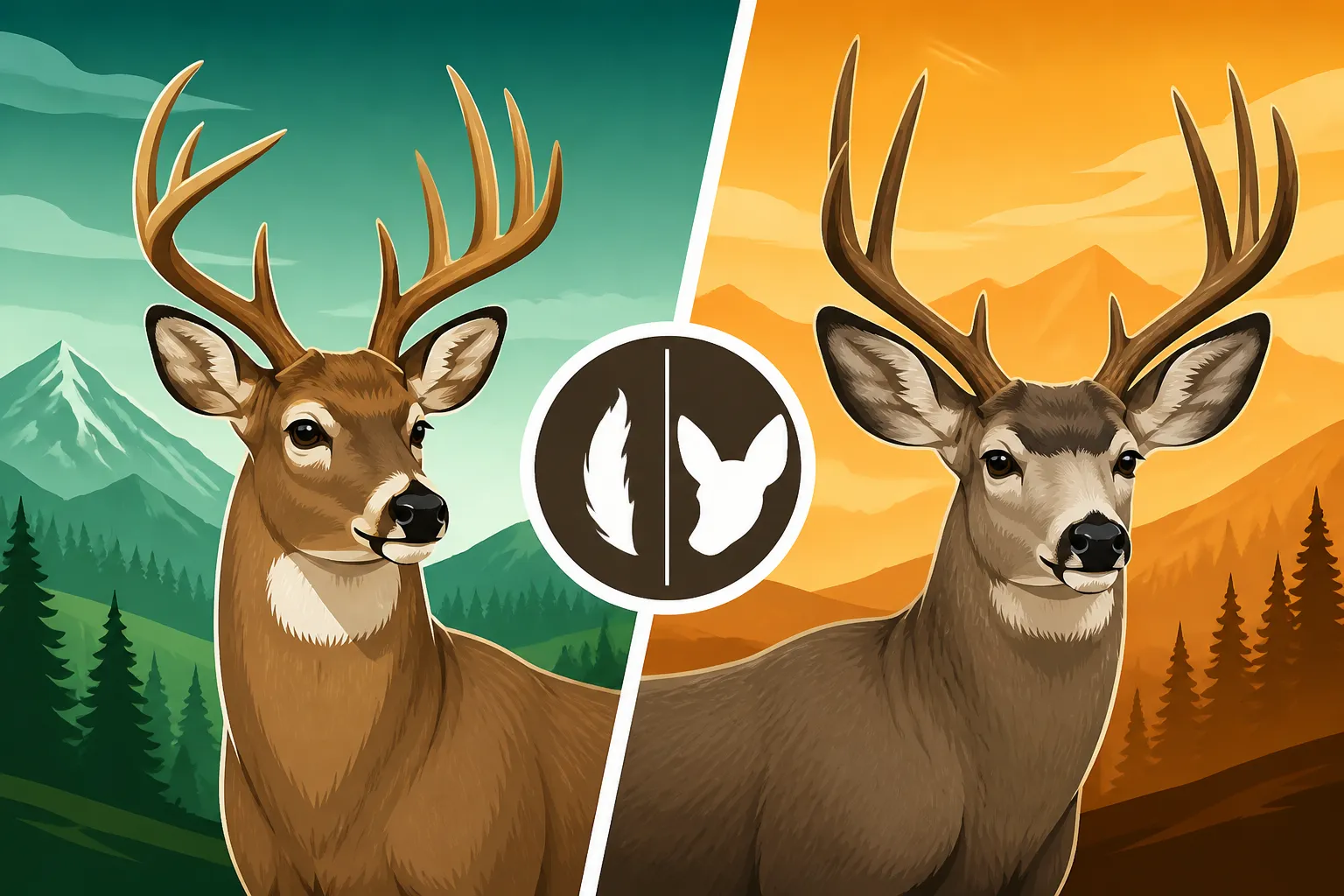
A whitetail deer, when alarmed or running, will lift its tail high, revealing a broad, bright white underside. This is their iconic "flag." That pure white underside acts as a visual signal to other deer in the area, a warning that danger is present. When a whitetail bounds away, that flashing white flag is often the last thing you see. It's a truly beautiful sight to behold, but also a crucial identifier. The tail itself is quite broad at the base, tapering to a point, and the top side is typically brown, matching their body coat. Even when a whitetail is calm, its tail often has that distinctive white fringe visible. You can read more about what makes these animals so distinctive in our guide on White-Tailed Deer, Alberta's Most Hunted Big Game.
In stark contrast, the mule deer's tail is quite different. Imagine a skinny rope with a black paintbrush tip. That's essentially what you're looking for. A mule deer's tail is narrow, usually a light tan or yellowish-white, and it’s typically short, terminating in a distinct patch of black hair at the very end. They rarely, if ever, raise their tails as high as a whitetail. When a mule deer is fleeing, its tail might swish or be held somewhat erect, but it will never "flag" with a broad white underside like its whitetail cousin. This difference alone is often enough to make a positive identification in all but the densest cover.
Ear Size and Shape
The clue is right there in the name: "mule" deer. Take a good look at their ears, and you'll immediately understand why.
Mule deer possess remarkably large ears, often disproportionately so compared to their head size. These ears are long, broad, and constantly swiveling, giving them an almost comical appearance, much like those of a donkey or mule. These impressive auditory appendages are highly efficient at picking up even the faintest sounds across vast open landscapes, a testament to their evolutionary adaptation to more exposed habitats. Even from a distance, if you can clearly make out notably large ears, you're almost certainly looking at a mule deer.
Whitetail deer, on the other hand, have ears that are more proportionate to their head size. They are smaller, narrower, and less prominent than those of a mule deer. While still very effective at detecting sound, they don't have that "mule-like" quality. If the ears seem "normal" or not particularly striking, you're likely observing a whitetail. This difference, combined with the tail, provides a strong initial identification, especially when you're glassing at long range.
Antler Configuration
While antlers can certainly confuse things with non-typical points and unique growth patterns, there's a general rule of thumb that holds true for typical racks on both species.
For whitetail bucks, the antlers typically grow off a main beam that extends forward and then curves backward. All the tines (points) usually grow upwards from this main beam, without significant branching or forking of the main beam itself. Think of a candelabra shape, where the main beam is the base, and the tines are the candles. Even on a big Alberta whitetail with a massive rack, this fundamental growth pattern usually remains consistent. Of course, non-typical racks do occur, with points growing in unusual directions, but the typical form is quite distinct. You might find our article on What a Big Alberta Whitetail Weighs interesting for more details on these magnificent animals.
Mule deer bucks, in contrast, are famous for their "forked" antlers. Their main beams tend to fork or bifurcate, meaning they split into two distinct branches, and then those branches can fork again. So, instead of points coming off a single main beam, you see a series of splits and re-splits. This creates a more complex, often wider, and more symmetrical appearance than a typical whitetail rack. Even a smaller mule deer buck will usually show this characteristic forking. When judging a mule deer buck at distance, these forking patterns are a clear indicator. For more on these animals, consider checking out our piece on What a Mature Alberta Mule Deer Weighs.
Body and Gait: More Than Just Antlers and Ears
Beyond the obvious, there are subtle differences in their body structure and how they carry themselves that become apparent with experience.
Whitetail deer tend to have a more slender, graceful build. They often appear more streamlined and agile, especially in dense cover where they navigate with remarkable stealth. Their legs can seem longer in proportion to their body, giving them an elegant, almost delicate appearance. When they move through the woods, it's often with a quiet, slinking grace, using every bit of cover to their advantage. Their neck and head usually appear longer and more refined.
Mule deer, conversely, are often stockier, with a more robust, "blockier" body. They tend to have deeper chests and appear more heavily muscled, built for traversing rugged, broken terrain. Their legs can seem shorter relative to their body depth, contributing to that robust look. They often stand with a more upright posture, and their head, with those large ears, might appear broader and more powerful. Observing them carefully as they walk can provide further clues.
Here's a quick comparison table to keep these key differences straight:
| Feature | Whitetail Deer | Mule Deer |
|---|---|---|
| Tail | Broad, brown top, bright white underside. Flags high when alarmed. | Narrow, light tan/yellowish-white, black tip. Rarely flags. |
| Ears | Proportionate to head, smaller, narrower. | Large, long, wide, "mule-like". Constantly swiveling. |
| Antlers | Main beam with tines growing upward. (Typical) | Main beam forks, then re-forks. (Typical) |
| Body Build | Slender, graceful, agile, longer neck. | Stockier, robust, blockier, deeper chest. |
| Gait (Fleeing) | Smooth, fluid run, often low to the ground. | Distinctive "stotting" or bounding leap. |
| Habitat | Thick cover, timber, riparian areas. | Open country, broken terrain, coulees, mountains. |
Beyond the Visual: Behavioral Cues and Habitat Preferences
Physical traits are a great starting point, but observing how a deer moves and where it prefers to spend its time can be just as crucial for identification, especially in those moments when you only catch a glimpse.
The Distinctive "Stott" vs. Swift Sprint
This is arguably the most dramatic behavioral difference and often the easiest to spot when a deer is in flight.
The mule deer's signature escape move is known as "stotting" or "bounding." When startled, a mule deer will typically gather all four legs beneath its body and leap simultaneously, bouncing across the landscape like a pogo stick. Each leap covers significant ground, and it's an incredibly efficient way for them to cover broken, uneven terrain quickly while keeping their head high to scan for threats. It's a majestic, almost exaggerated, form of locomotion that once witnessed, you won't forget. If you see a deer bouncing away with all four feet hitting the ground at once, you've got a mule deer. For those interested in Spot-and-Stalk Mule Deer in Alberta, understanding this movement is absolutely critical.
Whitetail deer, in contrast, flee with a more traditional, fluid run. They don't typically bound with all four feet simultaneously. Instead, they run in a powerful, graceful, and often low-to-the-ground sprint, using their speed and agility to weave through dense brush, duck under obstacles, and disappear into cover with surprising swiftness. Their focus is often on getting into thick vegetation as quickly as possible. If the deer is running with a more conventional, powerful stride, it's likely a whitetail.
Preferred Haunts: Where You'll Likely Find Them
While Alberta has many areas where both species coexist, they do have general preferences for different types of habitat. Knowing these tendencies can narrow down your identification.
Whitetail deer are creatures of the edge and the cover. They thrive in areas with dense vegetation, thick timber, river bottoms, and agricultural fringes that offer plenty of concealment. They love the security of dense bush, using it for bedding, feeding, and escaping predators. You'll often find them utilizing aspen bluffs, willow runs, and the edges of grain fields. They are incredibly adept at Reading Whitetail Sign in Alberta Aspen Bluffs and disappearing into seemingly thin cover. This preference for concealment is a significant factor in their survival strategy.
Mule deer, on the other hand, are more typically found in open, broken country. Think prairie coulees, badlands, foothills slopes, and mountainous terrain. They rely more on their eyesight and incredible hearing (those big ears!) to detect threats from a distance. While they will certainly use cover when available, especially for bedding, they are much more comfortable in wide-open spaces, using topography like ridges, draws, and hillsides to their advantage. If you're hunting in expansive, rolling prairie or the rugged foothills, your chances of encountering a mule deer are generally higher. For specific strategies, our guide on Mule Deer Hunting Alberta's Prairie and Badlands offers great insights.
General Demeanor and Reaction to Pressure
Even their "personality" can offer clues, though this is much more anecdotal and can vary greatly by individual deer and hunting pressure.
Whitetails are often described as more nervous, jumpy, and secretive. They tend to be highly alert and, when startled, are quick to bolt and disappear into the thickest cover available. Their entire existence seems predicated on remaining unseen. They're excellent at sensing danger and using their environment to vanish silently.
Mule deer can sometimes appear more curious or even a bit bolder. When disturbed, they might pause to assess the situation for a moment longer than a whitetail, giving you a better chance for identification (or a shot!). They often rely on distance and their bounding gait to escape, rather than immediately melting into dense cover. This isn't to say they aren't wary, but their immediate reaction to pressure can differ.
Navigating Alberta's Mixed Zones: Where Deer Overlap
One of the biggest challenges for hunters in Alberta is that our incredible province offers such a diverse range of habitats, which means whitetails and mule deer frequently share the same general areas. This overlap can make identification particularly tricky, even for seasoned hunters.
Parkland and Foothills — The Melting Pot
Alberta's parkland and foothills regions are prime examples of where these two species coexist, often in surprising proximity.
The parkland, with its mosaic of aspen bluffs, willow bottoms, and agricultural fields, provides ideal habitat for both deer. Whitetails thrive in the dense bluffs and river corridors, while mule deer can often be found utilizing the open fields and more rolling terrain between the bush pockets. It’s not uncommon to see both species feeding in the same field at different times, or even passing through the same narrow pinch points. Imagine hunting an aspen bluff in the parkland – you might be looking for a whitetail emerging from the timber, only to spot a mule deer buck feeding out in the stubble field just a hundred yards away. This makes a careful, multi-faceted identification approach crucial. Our article on Hunting Alberta's Aspen Parkland Bluffs explores these complex hunting areas.
Similarly, the foothills, with their blend of open slopes, timbered ridges, and riparian zones, create excellent habitat for both. Mule deer often prefer the higher, more open benches and clearcuts, while whitetails will stick to the river valleys, denser timber, and lower-lying brush. However, a big mule deer buck might drop down into a creek bottom for water, or a whitetail might venture onto a more open, grassy slope. Understanding the typical preferences is a great start, but always be prepared for exceptions in these transitional zones. If you're specifically targeting mule deer in the region, our guide to Hunting Alberta's Foothills Country has more detailed insights.
How Agriculture Blurs the Lines
Alberta's vast agricultural landscape also plays a significant role in blurring the lines between whitetail and mule deer ranges.
Crop fields, especially those with standing or swathed grains, are a huge draw for both species, particularly during the fall hunting seasons. Whitetails will emerge from nearby bush pockets to feed in wheat, barley, or canola fields, utilizing the cover these crops provide. Mule deer, accustomed to more open feeding, will also readily move into these fields, especially during evening hours or after dark. This means that a field you're Hunting a Swathed Grain Field at Dusk might have both species present, making it essential to identify correctly before making a move.
The sheer abundance of food available in agricultural areas can sometimes override a deer's natural habitat preference, bringing them into areas where you might typically only expect to see the other species. It's a reminder that while general rules apply, local conditions and food sources can significantly influence deer movement and distribution.
Understanding Population Dynamics and Local Anomalies
Deer populations are dynamic, and understanding this can help manage expectations and identify tricky situations.
While province-wide populations might show trends, local numbers can fluctuate due to factors like winter severity, hunting pressure, and habitat changes. For example, a particular WMU might traditionally be known for one species, but a series of mild winters could lead to an expansion of the other. Or, changes in farming practices might create new pockets of habitat that attract both. This is why local scouting and staying updated on wildlife reports are so important. Using tools like GoHunt can help you overlay species range maps with aerial imagery, giving you a better understanding of potential overlap zones. It's always a good idea to scout and understand the specific game populations in the area you plan to hunt.
Practical Strategies for Positive Identification in the Field
Even with all the knowledge in the world, making a split-second decision in the field can be tough. Here are some practical strategies to ensure you confidently tell the difference every time.
Take Your Time and Use Quality Optics
The most crucial piece of advice for any hunter is to slow down. Rushing an identification is the quickest way to make a mistake.
Always reach for your binoculars or spotting scope first. Even if a deer seems relatively close, quality optics will magnify the details, allowing you to clearly see the tail, ear size, and antler configuration. Don't just scan; really focus on each identifying characteristic mentioned above. Observe the deer's movement pattern. Does it run, or does it stott? How does it carry its tail when it moves? Patience is your most powerful tool in the field. A good pair of binos is not just for finding game; it's for identifying it correctly.
For hunters working expansive landscapes like those found in Hunting Alberta's Prairie WMUs, a spotting scope becomes invaluable. It allows you to study animals at extreme distances, confirming features like tail color and antler forks long before you even consider a stalk. This careful, deliberate observation significantly reduces the chance of misidentification.
Look for the Combination of Cues
Rarely will you get just one perfect look at a deer in the field. Often, you'll pick up one clue, then another, and another. The trick is to synthesize all of these observations.
Don't rely on a single characteristic, especially if it's ambiguous. For example, a whitetail might hold its tail lower than usual, or a mule deer might be moving through dense scrub that obscures its tail entirely. Instead, look for a combination. Does it have big ears and a black-tipped tail? Does it have a forked antler pattern and stott when it moves? If you see a deer with small ears, a full white flag, and it runs smoothly into the timber, you can be almost certain it’s a whitetail. If it has huge ears, a thin rope tail with a black tip, and bounds away with all four feet, it’s a mule deer. The more confirming cues you can gather, the higher your confidence in the identification.
Leveraging Tools and Resources
In today's hunting world, we have access to incredible technology that can aid in pre-season scouting and even in-field decision-making.
Mapping apps like GoHunt are fantastic resources for understanding the landscape and typical species distribution. You can often find layers that show historical harvest data or species ranges, giving you a general idea of what to expect in a particular area. While not a substitute for on-the-ground observation, it can help you anticipate which species are more likely in certain zones. Knowing the predominant species in a Alberta's Wildlife Management Units can prepare you mentally for what to look for.
Additionally, carrying a small field guide or having photos on your phone of the distinguishing features can be a quick reference if you're ever in doubt. Before the season, spend time studying images and videos of both species, paying close attention to their unique attributes. The more familiar you are with both whitetails and mule deer, the more quickly and accurately you'll be able to tell them apart when it counts. It’s all about preparation, practice, and patience to ensure a safe and successful hunt.
Disclaimer
This article is for general informational purposes only and does not constitute professional advice. Laws, prices and regulations vary by location and change over time. Consult a qualified professional for guidance on your specific situation.