Hunting South of the Milk River
The vast, often parched landscapes south of the Milk River present a formidable challenge for any hunter. With its unique blend of coulees, open prairie, and river bottom thickets, knowing where to begin and how to gain access can feel like navigating a maze. This guide will cut through the confusion, offering a realistic look at the hunting opportunities, access challenges, and practical strategies needed to successfully pursue game in this iconic Alberta region.
The Unique Landscape South of the Milk River
This corner of Alberta is unlike much of the province. When you picture Alberta, you might think of the vast Boreal Forest or the dramatic Foothills, but south of the Milk River, you're stepping into a different world entirely. This is southern prairie, a land of wide-open skies, deep coulees carved by ancient waterways, and an ecosystem perfectly adapted to extremes. Understanding this unique topography and climate isn't just academic; it's absolutely fundamental to successful hunting here. It dictates where game lives, how they move, and the strategies you'll need to employ.
Geographical Features and Habitat Types
The dominant feature here is the prairie grassland, but it's far from flat and uniform. The Milk River itself acts as a ribbon of green through an otherwise arid landscape, creating vital riparian habitat. This river valley is often choked with cottonwood, willow, and thick brush, providing crucial cover, food, and water for deer and other wildlife. Away from the river, the landscape quickly rises into a labyrinth of coulees and draws, which are essentially small, dry valleys or ravines. These breaks in the terrain offer sheltered pockets from the wind, thermal cover, and often contain denser vegetation than the surrounding plains.
Further south, you might encounter areas with more pronounced badlands formations, where erosion has sculpted the earth into dramatic buttes, hoodoos, and steep-sided canyons. These areas, while sometimes difficult to traverse, provide incredibly dense cover and broken terrain that deer, especially mule deer, absolutely thrive in. The sheer diversity of these micro-habitats within the broader prairie environment means that while it looks open, there's always somewhere for an animal to hide, and it's your job as a hunter to learn to read these subtle shifts. This is where attention to detail really pays off, because a small change in elevation or vegetation can mean the difference between seeing game and seeing nothing. This region is a masterclass in Hunting a Prairie Coulee Bottom and understanding how subtle terrain features dictate animal movement.
Climate and Its Influence on Game
Hunting south of the Milk River means contending with a semi-arid climate that defines everything about the local wildlife. Summers are hot and dry, often leading to sparse vegetation on the open prairie and concentrating game around reliable water sources like the Milk River, dugouts, or irrigation canals. This aridity means that hunting pressure on these water points can be high, and knowing alternative water sources, even small ones, can give you an edge. The sun can be intense, so heat management and hydration are critical, especially during early season hunts.
Winters, conversely, can be incredibly harsh, with strong winds sweeping across the open plains, plummeting temperatures, and significant snowfall. While the region generally receives less snow than the mountains or boreal forest, what does fall can drift severely in the open country, making travel difficult. Deep snow can push deer and other animals into the sheltered coulees and river bottoms, providing temporary relief but also concentrating them in smaller areas. Understanding these seasonal shifts in animal behavior due to weather is paramount. For example, Hunting Mule Deer After a Snowfall can be a game-changer, as fresh tracks can reveal movement patterns that were invisible just days before. Similarly, Wind in Open Prairie Country is a constant factor; animals use it to their advantage, and so should you.
Key Game Species and Hunting Opportunities
The open, often stark landscape south of the Milk River is a specialist's paradise, home to a unique blend of game species perfectly adapted to this environment. While you won't find the moose and elk populations typical of Alberta's northern forests or mountain regions, what you will find here are some truly spectacular prairie animals, each requiring its own set of tactics and understanding. This region offers some of Alberta's most iconic plains hunting experiences, challenging you to become a keen observer of vast landscapes.
Pronghorn
When you think of hunting south of the Milk River, pronghorn often come to mind first. These incredible animals are built for speed and survival in open country, and pursuing them is an exhilarating challenge. Their eyesight is legendary, making long-range glassing an absolute necessity. You simply won't sneak up on a pronghorn by walking aimlessly; you need to spot them from afar, often miles away, and then meticulously plan your stalk. The draws and rolling hills are your best friend here, offering precious cover as you try to close the distance.
Hunting pronghorn is an exercise in patience and precision. You'll spend hours behind your spotting scope, dissecting every fold in the landscape, looking for that telltale flash of white or dark horn. Once a buck is located, the stalk can be physically demanding, covering significant ground, often crawling or using every bit of available terrain for concealment. Glassing Alberta Prairie for Pronghorn is a skill you'll hone quickly here, as is Stalking Pronghorn Across Open Ground. Success often hinges on a well-executed final approach, usually culminating in a longer shot than many hunters are accustomed to. Always check Alberta's Pronghorn Draw Odds by WMU before planning your hunt, as these are a special draw species.
Mule Deer
This region also holds a healthy population of mule deer, particularly in the broken country of the coulees and badlands. Unlike their whitetail cousins, mule deer prefer these more open, rugged environments, using the steep banks, draws, and sparse timber for cover. They are masters of using topography to disappear, often just walking over a ridge or into a small depression and vanishing. Spot-and-stalk is the quintessential mule deer hunting method here, requiring exceptional glassing skills and a willingness to hike steep, uneven terrain.
During the early archery seasons or rifle seasons, you'll often find mule deer bucks tucked into the brushy draws during the day, emerging to feed in the evenings and mornings. The deep coulees provide not just cover but also a sense of security, and tracking their movements within these complex networks can be incredibly rewarding. Look for evidence of rubs, scrapes, and well-used trails leading into and out of these sheltered areas. Hunting Mule Deer in the Badlands Coulees is a prime example of the kind of detailed work required. The ability to identify suitable habitat from a distance, perhaps using mapping tools like onX Hunt, can significantly reduce wasted effort and put you on game faster.
White-tailed Deer and Upland Birds
While mule deer are more prevalent in the truly open and broken country, white-tailed deer are certainly present, especially closer to the Milk River itself and in areas with more agricultural influence or denser riparian vegetation. These whitetails will stick to the river bottom thickets, brushy field edges, and even small aspen bluffs in sheltered draws. Hunting them here often means still-hunting through dense cover or setting up stands or blinds along established travel corridors where cover meets open feeding areas. Hunting a River Valley Bottom in Alberta specifically describes tactics that apply directly to whitetails along the Milk River.
Beyond big game, the region offers excellent opportunities for upland bird hunting. Hungarian partridge, often referred to as "Huns," thrive in the prairie environment, especially around farm fields and shelterbelts. Sharp-tailed grouse are also common in the native grasslands and brushy edges. Hunting Hungarian Partridge on Alberta Farms is a classic experience here, often involving walking miles of field edges with a good bird dog. These birds can offer a fun, fast-paced challenge that complements a big game hunt or stands alone as a fantastic outing. Don't forget your Game Bird Licence Cost and Stamps if you plan to pursue them.
Navigating Access and Regulations
Access is perhaps the single biggest hurdle for hunters wanting to explore the Milk River region. Unlike vast tracts of continuous Crown Land in Alberta's northern Green Area, the land south of the Milk River is a complex checkerboard of private property, grazing leases, and smaller, often fragmented parcels of public land. Understanding this patchwork and knowing how to respectfully gain access is absolutely critical. Failing to do so can quickly turn a hopeful hunt into a frustrating experience, or worse, lead to trespassing charges.
Understanding Land Ownership and Permission
The majority of the land south of the Milk River is privately owned, primarily by ranchers and farmers. This means that to hunt most of this ground, you must obtain explicit permission from the landowner. This isn't just a courtesy; it's the law in Alberta. Knocking on doors, being polite, and having a clear plan can go a long way. Many landowners are receptive to hunters who respect their property, close gates, and drive carefully. However, some land may be leased for grazing, and in such cases, you might also need permission from the leaseholder in addition to the landowner. This can be confusing, but patience and a friendly approach are key.
Crown land, or public land, does exist, but it's often in smaller, scattered parcels or within specific river corridors. Identifying these pieces of public ground is essential. However, even on Crown land, access can sometimes be tricky if it's surrounded by private property, requiring you to navigate agreements with adjacent landowners to get to it. Familiarize yourself with the Alberta Trespass Act and Hunting to ensure you understand your rights and responsibilities. It’s always best to err on the side of caution: if you're not absolutely sure, don't go. A simple phone call can prevent a big headache. For more details, refer to Asking a Grazing Leaseholder for Access.
Utilizing Mapping Tools for Access
In a region with such fragmented land ownership, modern mapping tools are not just helpful; they are indispensable. Services like onX Hunt and GoHunt provide detailed overlays showing property boundaries, land ownership (public vs. private), and even sometimes the names of landowners. This technology has revolutionized how hunters approach access in areas like the Milk River country. Before you even leave home, you can scout potential hunting areas, identify blocks of Crown land, and pinpoint private parcels where you might seek permission.
These tools allow you to visualize the terrain, identify coulees, water sources, and potential bedding areas, even from your couch. When you're in the field, they act as a real-time GPS, showing your exact location relative to property lines, preventing accidental trespass. Imagine glassing a distant buck only to realize he's just across a private fence line; having that information instantly means you can adjust your plans rather than pushing into restricted areas. Using onX Hunt to identify Finding Alberta Public Land Boundaries or to locate contact information for landowners can save countless hours and help you hunt ethically and legally. These platforms aren't just maps; they're your primary scouting and navigation tools for complicated landscapes.
Essential Strategies for Success
Hunting south of the Milk River demands a different skill set than hunting in dense timber or rugged mountains. The wide-open spaces, the keen senses of the animals, and the often remote nature of the terrain require a thoughtful and well-prepared approach. Success here isn't about luck; it's about meticulous planning, sharp observation, and the ability to execute under challenging conditions.
Scouting and Glassing Techniques
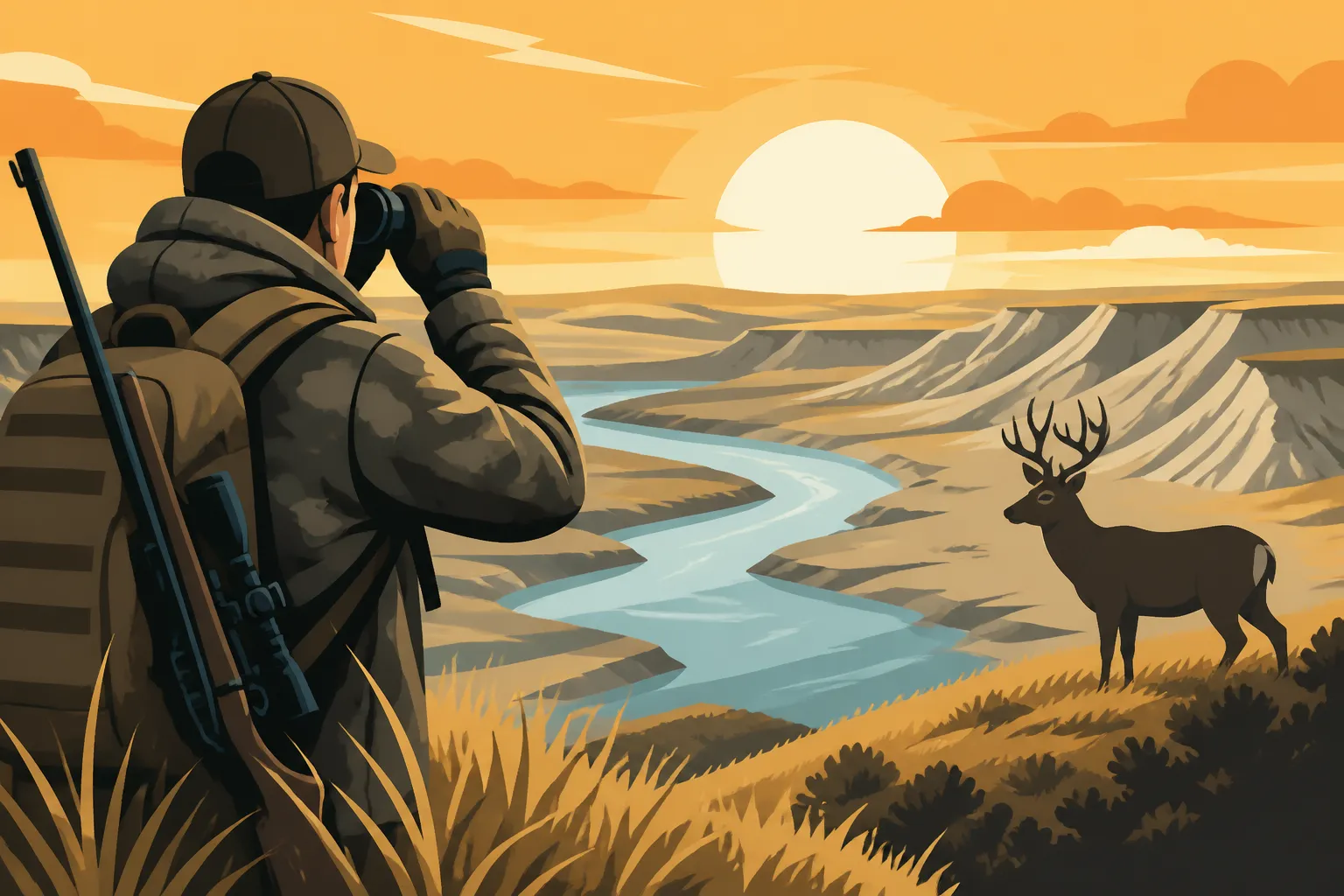
The sheer scale of the landscape makes effective glassing your most important tool. Forget walking miles hoping to jump a deer; you'll exhaust yourself and push game out of the country. Instead, find high vantage points that offer expansive views of coulees, river breaks, and open plains. Good quality binoculars (10x or 12x) and a powerful spotting scope (20-60x or 25-75x) are non-negotiable. Spend hours, not minutes, behind the glass, slowly dissecting every shadow, every cluster of brush, every distant ridge.
Focus your efforts during the low-light periods of dawn and dusk when animals are most active, but don't discount midday; deer, especially mule deer, will often bed in spots that offer thermal cover and security, and a careful scan can reveal a flick of an ear or a patch of hide. When glassing, look for anomalies – a horizontal line in a vertical landscape, a patch of colour that doesn't quite match the vegetation, or the subtle movement of an animal feeding. Patience is paramount. It’s surprising what you can pick out with enough time and attention. Remember to use mapping apps like GoHunt to mark potential vantage points and areas where you’ve seen activity for future reference.
Stalking in Open Country
Once you've spotted an animal worth pursuing, the real challenge of the Milk River country begins: the stalk. Unlike hunting in the bush, cover is often minimal, and the terrain can be deceptively open. This demands extreme stealth, precise route planning, and an intimate understanding of the wind. A bad wind can ruin a stalk before it even begins, carrying your scent across vast distances. Always approach from downwind, or at least crosswind, taking advantage of every dip, rise, and bit of sparse vegetation.
Your stalk needs to be slow, deliberate, and opportunistic. Sometimes you'll have to crawl for hundreds of yards, using the smallest changes in elevation for concealment. Other times, you might have a good run of cover, but you must be prepared for the moment that cover ends. Knowing your shooting distances and being comfortable taking a shot from an unconventional position – kneeling, prone, or using a shooting stick – is crucial. Stalking Mule Deer in Badlands Breaks is a skill honed over many frustrating attempts, but immensely rewarding when successful. Think like the animal; anticipate where it might move and plan your approach to intercept it or get within shooting range unnoticed.
Preparing for Remote and Arid Conditions
The country south of the Milk River can be remote, and cell service is often spotty or non-existent. Being self-sufficient and prepared for a range of conditions is non-negotiable. Water is a constant concern; always carry more than you think you'll need, especially during warmer seasons. Dehydration can quickly turn a great day into a dangerous situation. A reliable GPS or satellite communication device (like a Garmin inReach or similar) is a smart investment for safety, allowing you to signal for help even without cell service.
Your vehicle needs to be reliable, capable of handling rough two-tracks and potentially muddy conditions after rain. A good spare tire, a jack, and basic recovery gear are essentials. The weather can change quickly, so layers of clothing are important – cool mornings can turn into hot afternoons, and sudden thunderstorms or cold fronts are not uncommon. Being physically fit will also greatly enhance your experience, as you'll often be walking significant distances and climbing steep coulee banks. Being prepared isn't just about gear; it's about having the right mindset for self-reliance in a wild, beautiful, and often unforgiving landscape. Winter Truck Kit for an Alberta Hunt and What to Do If You Get Stuck in the Bush are valuable reads for anyone venturing into remote Alberta terrain.
Here's a quick overview of some hunting characteristics in the Milk River region:
| Game Species | Preferred Habitat | Key Challenges | Primary Hunting Method | Best Months |
|---|---|---|---|---|
| Pronghorn | Open prairie, rolling hills | Exceptional eyesight, lack of cover | Spot & Stalk | September |
| Mule Deer | Coulees, badlands, broken country | Utilizing topography, long stalks | Spot & Stalk, Still-hunt | October, November |
| White-tailed Deer | River bottom thickets, brushy field edges | Dense cover, identifying travel paths | Stand hunting, Still-hunt | October, November |
| Hungarian Partridge | Farm fields, shelterbelts, native grassland | Fast flyers, scattered coveys | Walking with dogs, Flushing | September, October |
| Sharp-tailed Grouse | Native grasslands, brushy edges | Flushing range, strong flight | Walking, Flushing | September, October |
Disclaimer
This article is for general informational purposes only and does not constitute professional advice. Laws, prices and regulations vary by location and change over time. Consult a qualified professional for guidance on your specific situation.